Role of Smart Contracts in Subscription Management for OTT Platforms
 Michael Willson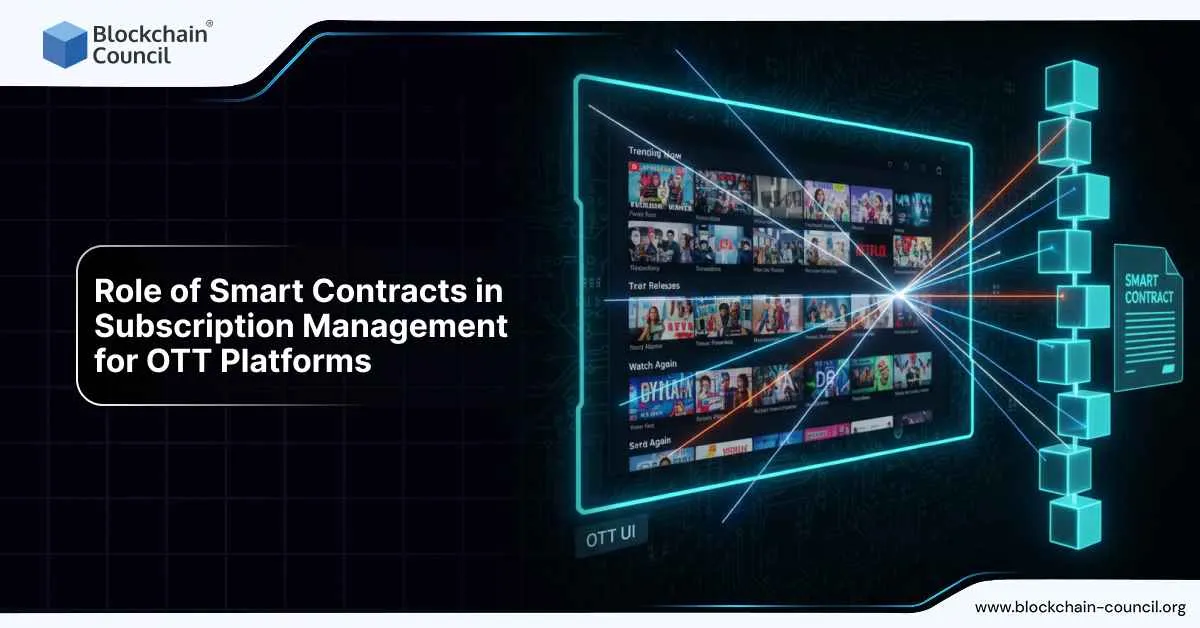
Subscription based OTT platforms have become one of the fastest growing digital business models in the world. Whether it is streaming services, digital entertainment libraries, or niche content platforms, recurring subscriptions now represent a large share of digital revenue. Yet behind the scenes, most OTT subscription systems still depend on outdated billing engines, centralized access control, and manual processes that struggle to keep up with global user behavior.
This is where smart contracts bring meaningful transformation. As programmable agreements that execute automatically when conditions are met, smart contracts introduce transparency, automation, accuracy, and trust to subscription management. In 2026, their role is becoming increasingly important as OTT platforms face higher customer expectations, cross border transactions, content licensing challenges, and fraud risks.

Many professionals working on OTT infrastructure strengthen their understanding of decentralized logic through the Blockchain Course, which helps them see how smart contracts align with digital governance and content rights enforcement.
The Growing Complexity of OTT Subscriptions
OTT subscriptions look simple on the surface. A user signs up, pays a fee, and gains access to content. In reality, the back end is far more complex. Platforms must manage renewal cycles, payment failures, upgrades, downgrades, content rights, trials, geolocation rules, and multi device usage.
Traditional subscription systems rely on centralized databases, manual reconciliation, and third party billing processors. These systems introduce several problems. Errors in renewal logic can lock users out of paid content. Fraudulent chargebacks can erode revenue. Unreliable licensing enforcement can violate agreements with content creators. Manual handling increases operational costs.
Platforms using a White-label OTT Platform often face similar challenges, since they operate globally and must manage high subscription volumes daily. Smart contracts offer a solution that aligns naturally with these operational demands.
How Smart Contracts Transform Subscription Management
Smart contracts operate on blockchain networks and are designed to execute automatically once the programmed conditions are fulfilled. For OTT platforms, this ability removes uncertainty from subscription lifecycles.
Smart contracts can automate renewal payments at precise intervals without relying on intermediaries. They can revoke access immediately when a subscription expires, eliminating inconsistencies between billing and entitlement. They provide a tamper proof record of all subscription actions, giving platforms and users full transparency.
Many marketers and growth professionals exploring subscription strategy strengthen their foundational skills through the AI Marketing Course, since understanding user segmentation, retention triggers, and recurring revenue models gives them insight into how smart contracts enhance subscription accuracy and user trust.
Eliminating Manual Work and Reducing Operational Errors
Traditional subscription software requires engineers and operators to manage large sets of rules in billing systems. As platforms scale across regions and devices, inconsistencies appear. Smart contracts simplify this by shifting logic into code that executes consistently.
Renewals become automated. Refunds and trial periods can be encoded with clear conditions. Multi tier plans can be controlled with verifiable logic. Revenue sharing with content creators can be distributed immediately based on contract rules without manual tracking.
For OTT businesses, this reduces support tickets, operational overhead, and the need for reconciliation teams. It also makes subscription handling predictable, which improves internal forecasting.
Building Trust With Transparent Subscription Records
OTT platforms depend heavily on user trust. Subscribers expect their payments to be charged correctly, renewals to occur on time, and access to align with what they purchased. Smart contracts store all interactions on an immutable ledger, providing confidence that the system behaves fairly.
Users and content partners can verify contract outcomes independently. This transparency increases user retention, reduces disputes, and improves brand reliability. Smart contracts also enable clearer communication when subscriptions change, since every action is recorded and traceable.
Fighting Fraud and Abuse in OTT Subscriptions
Subscription fraud is a growing challenge. Some users exploit loopholes to gain unauthorized access, share premium accounts extensively, or manipulate renewals. Smart contracts reduce this by requiring verified transactions and enforcing rules at the protocol level.
Fraudulent alterations are prevented because smart contracts execute exactly as written. Unauthorized access attempts fail if conditions are not met. Revenue leakage from unmonitored device sharing or repeated trial misuse becomes significantly harder, protecting both the platform and its creators.
Supporting Global Payments and Cross Border Subscriptions
OTT platforms often operate in multiple countries with different currencies, payment gateways, and subscription regulations. Traditional systems require building individual integrations for each region.
Smart contracts simplify this with currency agnostic logic and decentralized payment solutions. They can support cross border micropayments, subscription bundles, and unified billing structures. Users in different geographic locations can subscribe without complex backend adjustments.
This makes it easier for platforms to scale internationally while maintaining a consistent user experience.
Automating Licensing and Content Rights Enforcement
OTT platforms depend heavily on licensing agreements. Content creators, production houses, and distribution partners need assurance that their work is used only under agreed terms. Smart contracts can encode these rules directly into the system.
If licensing is time limited, access can be automatically revoked at expiration. If royalties must be distributed per subscriber, smart contracts can calculate and send payments instantly. If certain geographies have restrictions, the contract enforces them without human intervention.
For content driven businesses, this eliminates disputes, speeds up revenue distribution, and builds stronger relationships with creators.
Reducing Subscription Billing Costs
Billing infrastructure is expensive. Payment processors charge fees, reconciliation teams require staffing, and errors often create costly issues. Smart contracts remove many intermediaries from the system.
By automating payments, renewals, cancellations, and entitlements, platforms can reduce third party dependency. Operational efficiency increases, while long term maintenance costs decrease.
Engineering teams responsible for OTT subscription systems often enhance their technical confidence with foundational training such as the Python Course when deploying automated decision logic.
Better Insights Through Immutable Data
Smart contracts do not just automate processes. They create a clean, reliable dataset for analytics. Every subscription event is recorded consistently, making it easier for platforms to study behavior patterns, measure churn, test pricing models, and optimize marketing strategies.
Because data cannot be altered retroactively, historical accuracy improves significantly. This allows growth teams to make decisions based on validated subscription timelines, rather than dealing with inconsistent metadata from fragmented billing systems. Consistent data quality is essential for predictive analytics and customer lifecycle modeling.
Supporting Multi Platform OTT Ecosystems
Modern OTT consumption spans phones, smart TVs, web browsers, gaming consoles, and tablets. This makes subscription enforcement difficult when traditional systems are involved. Smart contracts provide a central logic layer that can be accessed across devices.
Regardless of the access point, the smart contract conditions apply. This ensures that entitlements remain consistent, content restrictions are enforced reliably, and unauthorized usage becomes harder.
Challenges to Consider When Implementing Smart Contracts
Smart contracts offer many benefits, but they also come with risks. Poorly written code can create vulnerabilities. Changes or updates require deploying new versions, since smart contracts are immutable once launched. Gas fees and scalability vary across blockchain networks. Not all regions have regulatory clarity regarding blockchain transactions.
Businesses must ensure proper auditing, version control, and security testing. They must also choose the right blockchain platform that aligns with cost structure, transaction volume, and user experience expectations.
The Future of OTT Subscription Management With Smart Contracts
By 2026, OTT platforms are expected to expand into personalized content, interactive entertainment, global creator ecosystems, and AI driven recommendations. Smart contracts will play an essential role in supporting these innovations.
Subscription bundling, dynamic pricing, sponsorship models, and hybrid revenue structures will require flexible automation. Smart contracts will help OTT platforms operate more transparently, scale more confidently, and build stronger trust with users and partners.
Conclusion
Smart contracts introduce a more secure, automated, and transparent approach to subscription management for OTT platforms. As digital entertainment grows and business models evolve, traditional subscription engines will struggle to keep pace. Smart contracts solve many of these challenges by removing manual work, reducing fraud, simplifying global billing, and ensuring fairness for both users and creators.
OTT platforms that adopt smart contract based systems will be positioned to deliver better experiences, reduce operational overhead, and scale efficiently in a competitive digital landscape.
Frequently Asked Questions
1. How do smart contracts improve subscription management for OTT platforms?
Smart contracts automate subscription processes such as renewals, cancellations, and access control. They remove manual intervention and ensure that every subscription action follows predefined rules. This increases efficiency, reduces errors, and ensures that users receive consistent and accurate access to paid content.
2. Can smart contracts help OTT platforms reduce fraud?
Yes. Smart contracts verify payments and apply subscription rules with precision. Unauthorized access, repeated trial misuse, and fraudulent renewal behavior become much harder to execute. Because all actions are recorded on a blockchain, fraud attempts are easier to detect and prevent.
3. How do smart contracts support global OTT audiences?
Smart contracts can manage subscription logic across borders without relying on region specific billing processors. They support currency independent transactions and can enforce licensing rules automatically for different countries. This helps OTT platforms deliver consistent experiences to international users.
4. Are smart contracts expensive to implement?
Implementation involves development, auditing, and deployment costs, but long term savings are significant. OTT platforms reduce reliance on billing intermediaries, minimize operational errors, and automate complex workflows. For large subscription bases, these savings often outweigh initial setup expenses.
5. What challenges should OTT platforms consider before adopting smart contracts?
Platforms must ensure that contracts are written securely because coding mistakes can create vulnerabilities. Updating smart contracts requires deploying new versions, which needs careful management. Scalability and gas fees depend on the blockchain network. Regulatory clarity may vary by region, so businesses must consider compliance requirements.