
RAGs (Retrieval-Augmented Generation)
 Michael Willson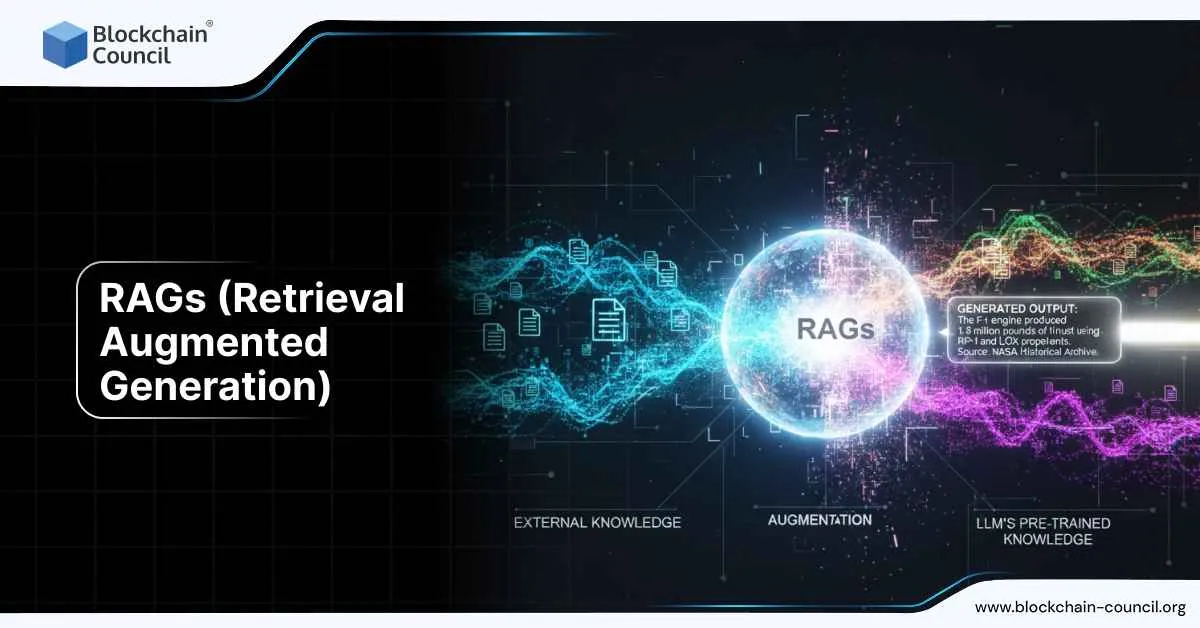
Retrieval-Augmented Generation, or RAG, is a method that combines information retrieval with generative AI to make answers more accurate, relevant, and verifiable. Instead of relying only on what a model learned during training, RAG retrieves real documents at query time and uses them to ground the generated response. Experts testing RAG pipelines confirm that this approach reduces hallucinations and provides users with answers that can be linked back to sources. For learners who want to explore this field, an AI certification is a reliable way to gain practical knowledge of how RAG systems are built and deployed.
What Is RAG in AI?
RAG is sometimes called an “open-book” model because it retrieves relevant documents when answering questions, rather than working as a closed-book system that depends only on its pretraining data. Experts describe it as a bridge between search engines and generative models. Case studies in enterprises show that RAG assistants can answer queries with precise, source-backed explanations — something that traditional large language models often fail to provide consistently.
How Does RAG Work?
At a high level, RAG works in five steps: indexing, retrieval, augmentation, generation, and post-processing. Documents are embedded and stored in a database, queries are matched with relevant content, that content is fed into the generative model, and the model produces an answer that incorporates retrieved information.
How Retrieval-Augmented Generation Works in Practice
| Step | Explanation |
| Indexing | Documents such as PDFs, logs, or manuals are split into smaller chunks, embedded into vectors, and stored in a searchable index. |
| Retrieval | When a query is made, algorithms find the top-k relevant chunks using vector similarity or hybrid search. |
| Augmentation | Retrieved passages are added to the user’s query to create a context-rich prompt for the generative model. |
| Generation | The AI model produces an answer grounded in the retrieved context, improving factual accuracy. |
| Post-processing | The system may cite sources, highlight confidence levels, or refine inconsistent outputs. |
Experts testing RAG systems in finance reported that retrieval pipelines can pull the latest SEC filings, enabling models to generate real-time earnings summaries — a task impossible with closed-book models trained months earlier.
Why Is RAG Important?
RAG is important because it solves three major problems with large language models: outdated knowledge, hallucinations, and lack of verifiability. Instead of retraining models every time new data is released, RAG systems simply update the retrieval database. This lowers costs and improves flexibility. For professionals interested in designing such systems, a Prompt Engineering Course teaches how to structure inputs so retrieval and generation work together seamlessly.
Benefits of Retrieval-Augmented Generation
Experts and industry reports highlight several benefits of RAG:
- Access to up-to-date knowledge: Keeps answers current by retrieving the latest documents.
- Reduced hallucinations: Grounds responses in verifiable data.
- Cost savings: Avoids retraining large models for every dataset update.
- Domain specialization: Enables tailoring assistants for medicine, law, or finance.
- Trust and transparency: Allows users to trace answers back to sources.
Organizations adopting RAG often combine it with structured training programs such as AI certs to ensure teams understand both retrieval and generative components.
Use Cases of RAG
- Enterprise knowledge assistants: RAG can answer employee questions using policy documents and manuals.
- Customer support automation: Experts tested RAG chatbots in telecoms, which successfully pulled past ticket histories to resolve queries.
- Healthcare and medicine: Case studies show RAG systems retrieving clinical guidelines and using them to draft accurate patient summaries.
- Regulated industries: Legal firms use RAG pipelines to cite sections of regulations when generating responses.
- Search and research tools: Unlike simple search engines, RAG can provide direct answers with citations.
For professionals building AI agents that rely on external data, an Agentic AI certification covers how retrieval-augmented methods can be integrated into agent workflows.
Challenges of RAG
RAG is not without limitations. Experts highlight issues such as retrieval quality, conflicting documents, latency, and maintaining vector databases. In experiments, RAG systems performed poorly when indexes contained outdated or irrelevant material, proving that the pipeline is only as strong as its knowledge base.
These challenges show why understanding broader technology trends — from search algorithms to vector databases — is essential for anyone building or deploying RAG solutions.
Recent Advances in RAG
Recent research has expanded the potential of RAG:
- Graph-based RAG: Systems like GFM-RAG combine graphs with retrieval to capture relationships between entities.
- Prompt-RAG: A newer method that uses prompts to guide retrieval when embeddings underperform.
- RAG-WM: A watermarking technique developed to protect RAG pipelines from intellectual property theft.
- Domain-specific RAG agents: Tools like MoRSE in cybersecurity use multiple retrievers in parallel to handle complex technical queries.
For learners aiming to keep up with such advances, a Data Science Certification provides the foundation for managing the data pipelines that power retrieval systems.
Why RAG Matters for Businesses
RAG enables companies to build AI systems that are more reliable, accurate, and trustworthy. Experts believe it will be a cornerstone in sectors where outdated or inaccurate information can cause real damage, such as finance, law, and healthcare. Business leaders preparing to integrate AI assistants can strengthen their knowledge with a Marketing and Business Certification to align RAG deployment with customer strategies. At the same time, emerging blockchain technology courses explore how decentralized storage can make RAG pipelines even more secure and tamper-resistant.
Conclusion
Retrieval-Augmented Generation combines the best of search and generative AI. By grounding model outputs in retrieved documents, it reduces hallucinations, stays up to date, and builds user trust. Experts testing RAG systems in industries from finance to healthcare confirm that they make AI more practical and verifiable. For professionals, the way forward lies in mastering both the retrieval and the generation sides of this equation — and certifications across AI, prompt engineering, data science, marketing, and blockchain provide the skills to do exactly that.