Project Aura Smart Glasses
 Michael Willson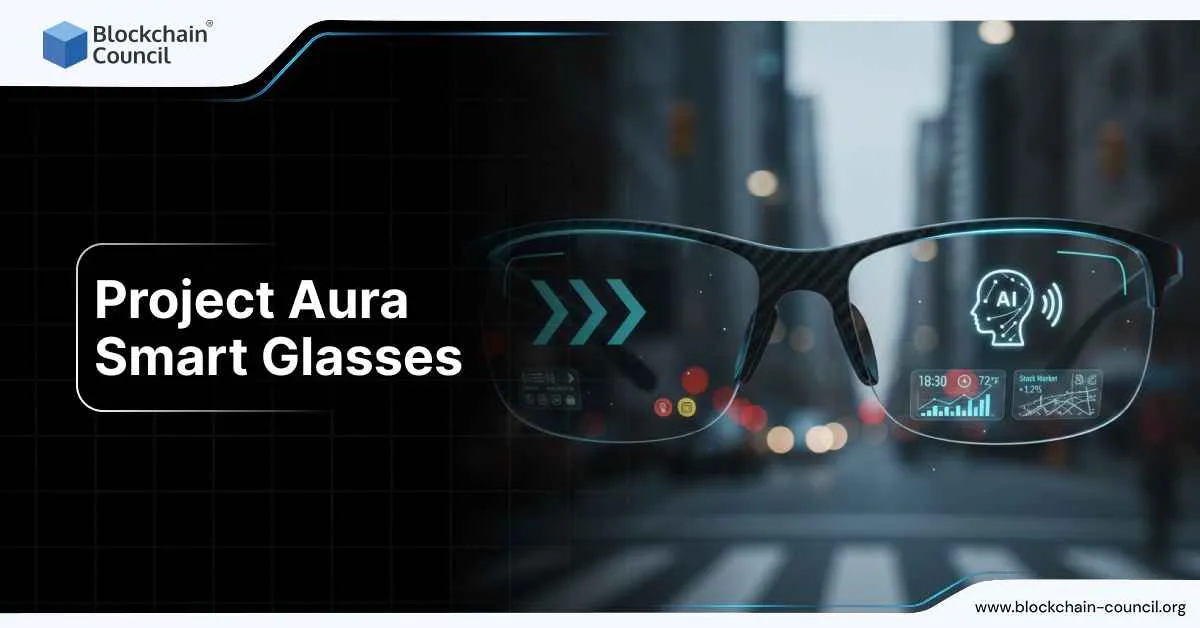
When Google spoke about the future of Android XR on 8 December 2025, the message was clear even without flashy demos. The company no longer wants a single hero device that tries to do everything. Instead, it wants a platform that can quietly live across different form factors, built with partners who already understand hardware. Project Aura is the clearest expression of that strategy so far.
Aura is a pair of smart glasses developed with Xreal as the hardware partner and positioned for a 2026 release. Rather than chasing full immersion like bulky headsets, Aura is designed around assistive use cases that fit naturally into daily life. Anyone who has worked with spatial interfaces knows how hard that balance is, which is why learning paths like the AR VR Certification often focus as much on human comfort and perception as they do on graphics or compute.

What Project Aura Is Trying to Be
Project Aura sits inside Google’s broader Android XR ecosystem, alongside Samsung’s XR headset work. It is not a reboot of Google Glass and it is not positioned as a developer toy. Aura is meant to be worn outside, in real situations, without drawing attention or exhausting the user.
Early coverage published in the days following Google’s Android XR update described Aura as sitting between lightweight smart glasses and full mixed reality headsets. That middle ground is intentional. Google appears to believe that the next step for AR is not deeper immersion but better utility.
The Hardware Choices That Reveal Google’s Intent
Even without a full spec sheet, the hardware decisions behind Aura tell a clear story.
A wide enough field of view to matter
Xreal’s Project Aura page lists a field of view above 70 degrees. In AR terms, that is significant. Many earlier smart glasses struggled to display useful information without forcing users to constantly shift their gaze. A wider field of view allows navigation arrows, translation captions, and contextual prompts to appear naturally rather than feeling bolted on.
A tethered design on purpose
Aura is not fully self contained. It relies on a wired puck that combines battery and input functions. This choice reduces weight on the face, keeps heat away from the lenses, and makes longer sessions practical. It is a tradeoff, but a deliberate one. Google seems willing to sacrifice absolute freedom in exchange for comfort and reliability.
A split compute approach
Xreal’s materials point to a dual chip setup, combining Xreal silicon with Qualcomm Snapdragon components. That implies local processing for latency sensitive tasks like vision and display control, rather than pushing everything to the cloud. This aligns with Google’s recent emphasis on responsive, on device AI.
These decisions suggest Aura was designed by people who expect it to be worn for hours, not minutes.
What Aura Is Expected to Do in Daily Life
Google has been consistent about how it talks about AI glasses. The focus is not entertainment first. It is assistance.
Aura runs on Android XR, which means it is built to work with existing Android services instead of forcing developers to start from zero. The assistant layer is Gemini, which Google has positioned as a contextual helper rather than a command driven voice bot.
The use cases that keep coming up in briefings and early impressions are practical ones:
- Turn by turn navigation cues that stay in your peripheral vision
- Real time translation overlays
- Camera based help that understands what you are looking at
- Simple media controls and notifications without pulling out a phone
None of these are flashy on their own. Together, they describe a product meant to disappear into routine.
Why Google Chose Partners Over a Solo Device
One of the most important signals around Project Aura is not technical. It is strategic.
Google has repeatedly emphasized that Android XR is a partner led platform. Working with Xreal allows Google to move faster on optics and industrial design while keeping its focus on software, AI, and ecosystem stability. It also avoids repeating past mistakes where a single Google built device had to carry the entire vision.
This approach mirrors how Android phones succeeded, not how Pixel scaled. For people working at the intersection of platforms, user adoption, and product positioning, this is familiar territory. It is also why professionals often look to frameworks taught in programs like the Tech Certification to understand how hardware, software, and ecosystems grow together.
What Is Still Unknown and Why That Matters
Several important details remain unconfirmed:
- Final pricing
- Real world battery life
- Display resolution and optical stack specifics
- Exact launch timing within 2026
- Whether Aura launches globally or in limited regions first
Those gaps suggest Google is still tuning the balance between capability, comfort, and cost. Given the history of smart glasses, that caution makes sense.
How Aura Fits Into the Bigger Picture
Project Aura is best understood as a platform validation device. It is meant to show that Android XR can support glasses that people might actually want to wear, not just experiment with. If Aura succeeds, it opens the door to multiple designs from different partners, each tuned for different audiences.
For brands, developers, and experience designers, this shift matters. Smart glasses that focus on assistance rather than spectacle change how digital information enters everyday life. That has implications for communication, navigation, and engagement, which is why broader strategic learning like the Marketing and Business Certification becomes relevant as AR moves from novelty to infrastructure.
Final Thoughts
Project Aura does not try to redefine reality. It tries to fit into it. By choosing a tethered design, prioritizing comfort, and focusing on assistive use cases, Google is signaling that the future of AR may be quieter and more practical than many expected. If Aura launches as planned in 2026, it will not be remembered as a spectacle device but as a step toward making augmented reality feel normal.