This Open Source AI Model Makes Better Agents Than GPT-5

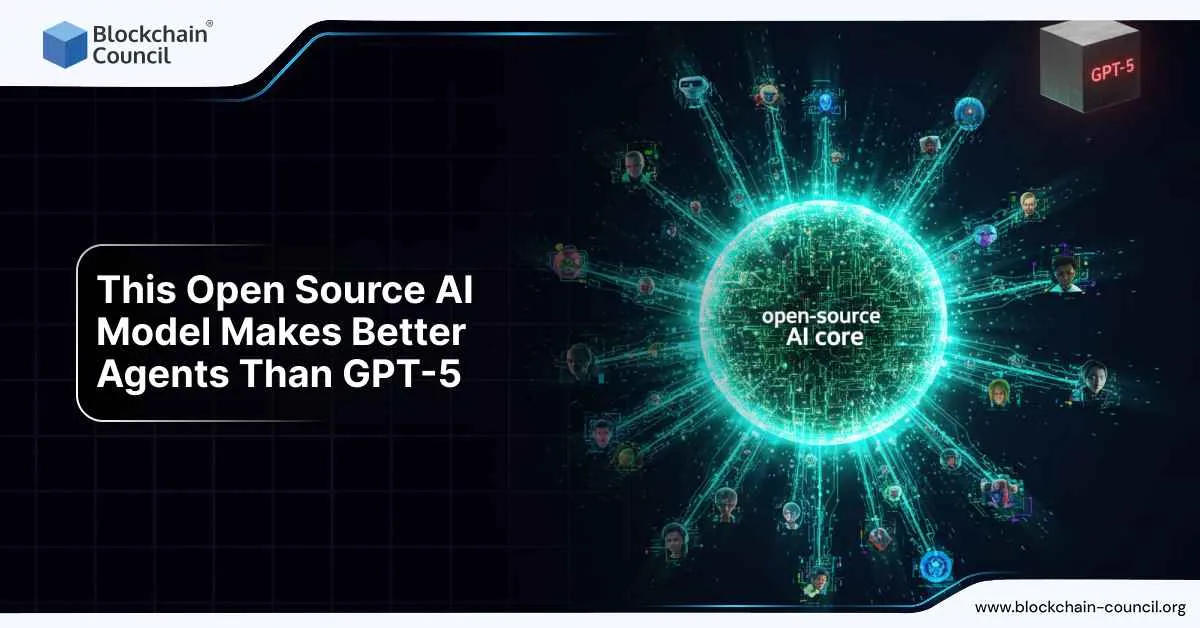
A new chapter in artificial intelligence has begun with the release of Kimi K2 Thinking, an open-source model from China’s Moonshot AI. The model has outperformed GPT-5 in several reasoning and agent-based benchmarks, signaling a potential shift in global leadership in AI innovation. What sets Kimi K2 apart is its accessibility—developers and researchers worldwide can download, test, and deploy it freely. Experts see this as a defining step toward the democratization of AI technology.
Global Implications of Kimi K2 Thinking
Recent benchmark tests show that Kimi K2 Thinking achieved a 51% score on Humanity’s Last Exam, surpassing both GPT-5 and Claude Sonnet 4.5 in key areas like BrowseComp and SEAL-0, which measure real-world data retrieval and agentic performance. While it lags slightly behind on specialized coding tests such as SweetBench Verified, its efficiency makes up for it.

Kimi K2 operates at a cost of just $0.60 per million input tokens and $2.50 per million output tokens, generating around 15 tokens per second on a dual Mac M3 Ultra setup. This performance level allows even small teams and independent developers to run advanced models locally without massive infrastructure costs.
Professionals looking to stay relevant in this rapidly evolving landscape are turning to programs such as AI certification, which explore how architectures like Kimi K2 are changing the technical and business dynamics of AI.
The DeepSeek Legacy
To understand Kimi K2’s impact, one must look back at DeepSeek R1, another Chinese model that redefined expectations earlier in 2025. DeepSeek demonstrated reasoning comparable to Western models but trained at a fraction of their cost. When its chatbot app became the most downloaded free app on Apple’s App Store, it proved that the demand for reasoning-focused AI tools was global.
Kimi K2 Thinking builds directly on this foundation. DeepSeek showed that Chinese labs could match global leaders; Kimi K2 shows they can surpass them.
Superior Agentic Intelligence
Kimi K2 Thinking’s most remarkable feature is its agentic capability—its ability to perform autonomous reasoning tasks involving multiple steps and tool calls. Whereas GPT-5 tends to lose coherence after 20 to 50 tool calls, Kimi K2 can execute up to 300 in sequence without external supervision. This lets it perform extensive research, verify data, and refine results on its own.
Analysts say this makes it the most capable open-source model ever built for coding, data analysis, and automation workflows. Dean Sakuransky, an AI researcher, remarked that just a year ago, “models could barely handle five tool calls. Now, they can sustain complex reasoning for more than an hour.”
Startups and Investors Moving Fast
The business community is already responding to Kimi K2’s promise. Venture capitalist Chamath Palahapitiya revealed that one of his portfolio companies migrated its production workflows to Kimi K2, citing major savings compared to OpenAI and Anthropic. Airbnb’s CEO Brian Chesky also noted that his company’s internal AI assistant runs on Alibaba’s Qwen 3 due to its speed and affordability.
Data from Hugging Face indicates that Qwen models are now downloaded more frequently than Meta’s LLaMA family, signaling a strong shift toward open and cost-effective systems. For entrepreneurs adapting to these trends, programs like the Marketing and business certification are helping them understand how open AI ecosystems are reshaping cost structures and strategic planning.
The Economics of Open Source AI
Kimi K2 Thinking represents a philosophy centered on accessibility. Investors like Cash Patel argue that “the real race in AI isn’t toward AGI—it’s toward making intelligence affordable.”
This mirrors China’s approach in other tech sectors, where efficiency and scalability outweigh brand prestige. Open models are closing the performance gap with closed systems, often within three to four months. As a result, open AI projects are now competing directly with their commercial counterparts.
Professionals interested in understanding these fast-changing dynamics can explore the Tech certification, which provides insight into open-source development, data infrastructure, and the economics of AI accessibility.
Coding and Development at a Fraction of the Cost
AI-driven coding tools have become central to software development in 2025. While GPT-5 and Claude 4.5 still lead slightly in complex code generation, Kimi K2 offers near-equal performance for much lower prices. Analysts suggest this could challenge companies that rely heavily on API-based revenue models for coding assistance.
With Chinese firms offering competitive performance at a tenth of the cost, the market is shifting. Developers are finding that open systems like Kimi K2 Thinking are not only affordable but reliable enough for production-level deployment.
Local AI Deployment Becomes Realistic
Running large AI models locally was once impractical due to high memory demands and limited efficiency. The rise of quantization, which compresses model weights without losing accuracy, has changed that.
Now, Kimi K2 can operate on consumer-grade setups, making it ideal for industries like healthcare and finance that require private, self-contained systems. This technological leap is enabling a new class of startups focused on self-hosted enterprise AI, prioritizing data security and operational autonomy.
China and the U.S.: A New Balance
The global AI race is no longer dominated by the United States. NVIDIA CEO Jensen Huang recently remarked that China is “nanoseconds behind,” while analysts like Dylan Patel countered claims that China lacks the infrastructure to sustain growth. Instead, they highlight that Chinese data centers are expanding rapidly but discreetly.
Bloomberg columnist Katharine Thorbeck pointed out that open Chinese models are quietly gaining traction in Silicon Valley. She emphasized that many American developers now prefer these models because of their balance between cost and performance.
Open vs Closed AI Models
| Feature | Open Models (Kimi K2, Qwen) | Closed Models (GPT-5, Claude 4.5) |
| Tool Calls | 200–300 | 20–50 |
| Performance Lag | 3–4 months | Slight lead |
| Cost per Million Tokens | $0.60–$2.50 | $10–$20 |
| Deployment | Local or Cloud | Cloud only |
| Accessibility | Fully open-source | Subscription-based |
This comparison illustrates how the line between open and closed AI models is blurring. Open models now offer flexibility and affordability without major compromises in quality.
Predictions and Industry Outlook
Experts predict that 2025 will be remembered as “the year of open agentic models.” By 2026, open-weight models could dominate the field entirely. New entrants such as DeepSeek R2 and Kimi K3 Thinking are already rumored, suggesting that innovation will continue at an accelerated pace.
According to analysts, future benchmarks will focus less on text fluency and more on how effectively a model performs complex, real-world reasoning. The open ecosystem is now driving that evolution faster than corporate labs anticipated.
Market and Industry Impact
The momentum of open-source AI has introduced new competition in a sector once dominated by a few Western companies. While U.S. tech stocks have faced volatility, China’s focus on accessible AI is sparking renewed investment and collaboration across global markets.
Developers in Europe, India, and Latin America are adopting models like Kimi and Qwen to build local solutions tailored to their regions. This distributed innovation model could redefine the structure of the AI economy.
The Future of Intelligence Is Open
Kimi K2 Thinking is more than a technical achievement—it represents a philosophical shift in how intelligence is created and shared. By combining high reasoning power, long tool-use chains, and open availability, Moonshot has proven that the next phase of AI doesn’t need billion-dollar infrastructure.
The global AI frontier is moving toward openness, affordability, and collective innovation. As more companies and researchers embrace this direction, the race will no longer center on who builds the most powerful model, but on who builds the most accessible one.
Open source is no longer a background movement—it’s becoming the foundation of the AI era.