
NVIDIA Released DreamGen, Robots That Learn in Pixels
 Michael Willson
NVIDIA has introduced DreamGen — an AI system that teaches robots how to do tasks by watching synthetic videos instead of relying on real-world training. If you’re wondering how robots can now learn by “dreaming” in pixels, here’s the simple answer: DreamGen uses AI to generate video-based lessons that robots can use to learn new actions without needing human demos or real-world trials.
This article explains how DreamGen works, why it’s a game-changer, and how it compares to other training methods. We’ll also look at who it’s useful for, real-world use cases, and how you can get started.

What Is DreamGen?
DreamGen is NVIDIA’s newest AI tool for robotics. It teaches robots by showing them AI-generated videos paired with movement data — so they can learn how to complete tasks just by watching. These aren’t random videos; they’re generated specifically to teach a robot what to do, where to move, and how to perform a task.
Instead of needing to show the robot the task physically, DreamGen lets AI do the heavy lifting in a simulated environment.
How DreamGen Works
DreamGen follows a four-step process:
1. Customizes Video Models
It first fine-tunes an AI video model to match the robot’s design and how it moves.
2. Creates Training Videos
Next, it generates pixel-perfect training videos of the robot doing various tasks. These videos are made using just a few reference frames and text instructions.
3. Extracts Actions from Videos
It then uses inverse dynamics AI to understand what the robot is doing in the video and translate that into step-by-step actions.
4. Trains the Robot
Finally, those actions become the robot’s training data. This lets the robot learn without trial and error in the real world.
DreamGen vs Traditional Robot Training
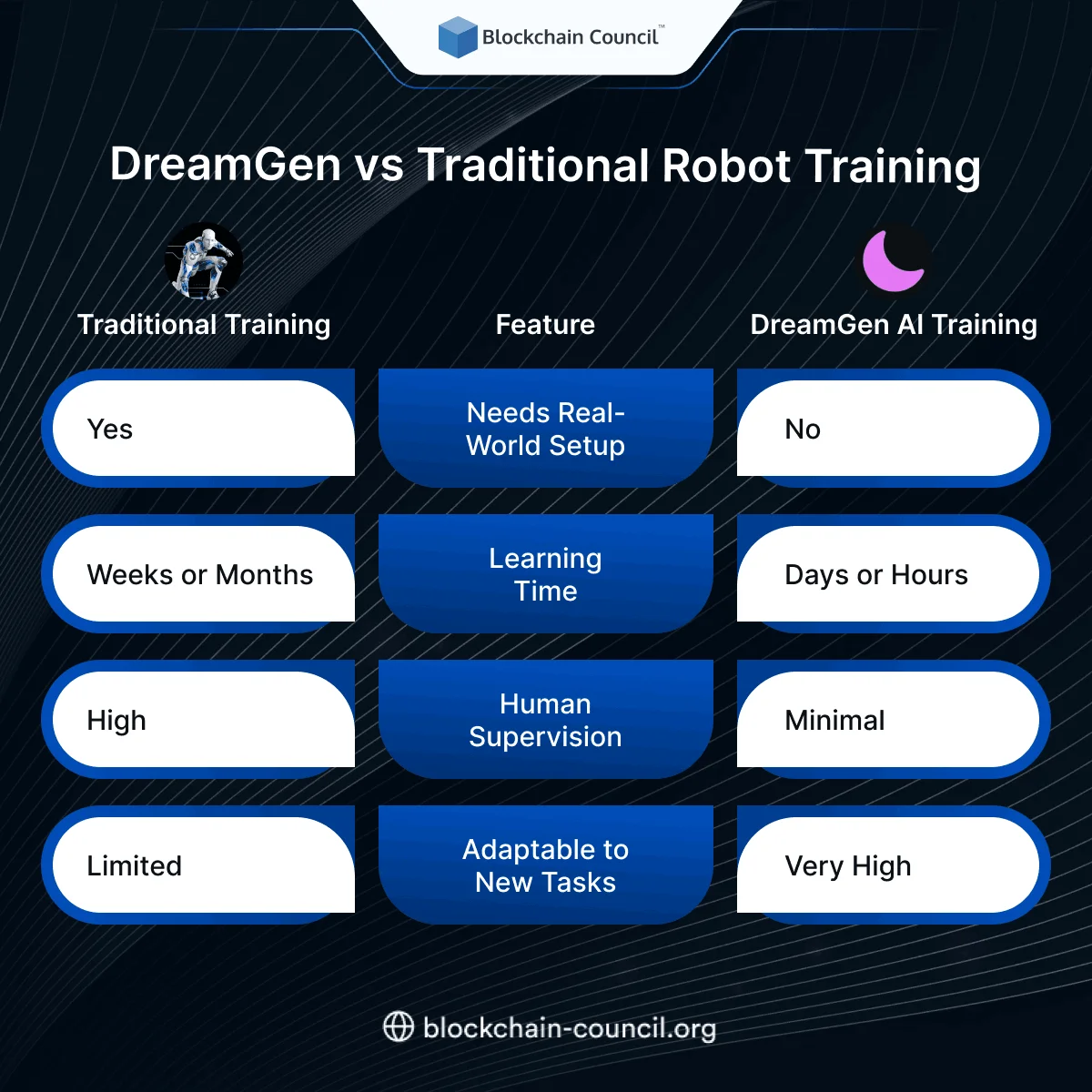
DreamGen replaces physical setup with synthetic experience — making it faster and more scalable.
Who Should Use DreamGen?
DreamGen isn’t just for high-tech labs. It’s designed to help in:
Manufacturing
- Robots can learn to assemble new products on the fly
- No need to manually reprogram robots for every new task
Healthcare
- Assistive robots can adapt to different patient needs
- Nurses and doctors don’t need to train them manually
Home Automation
- Personal robots can learn chores by watching videos
- Great for devices like robot vacuums, helpers, and smart arms
Robotics Developers
- Faster prototyping and testing for new robot designs
- Scaled-up simulation training without expensive labs
This is why professionals and engineers looking to understand how DreamGen-like models work are exploring AI systems through the AI Certification. Others go deeper into technical AI workflows with the Data Science Certification, while startups and automation businesses benefit from a Marketing and Business Certification to position these tools in the market.
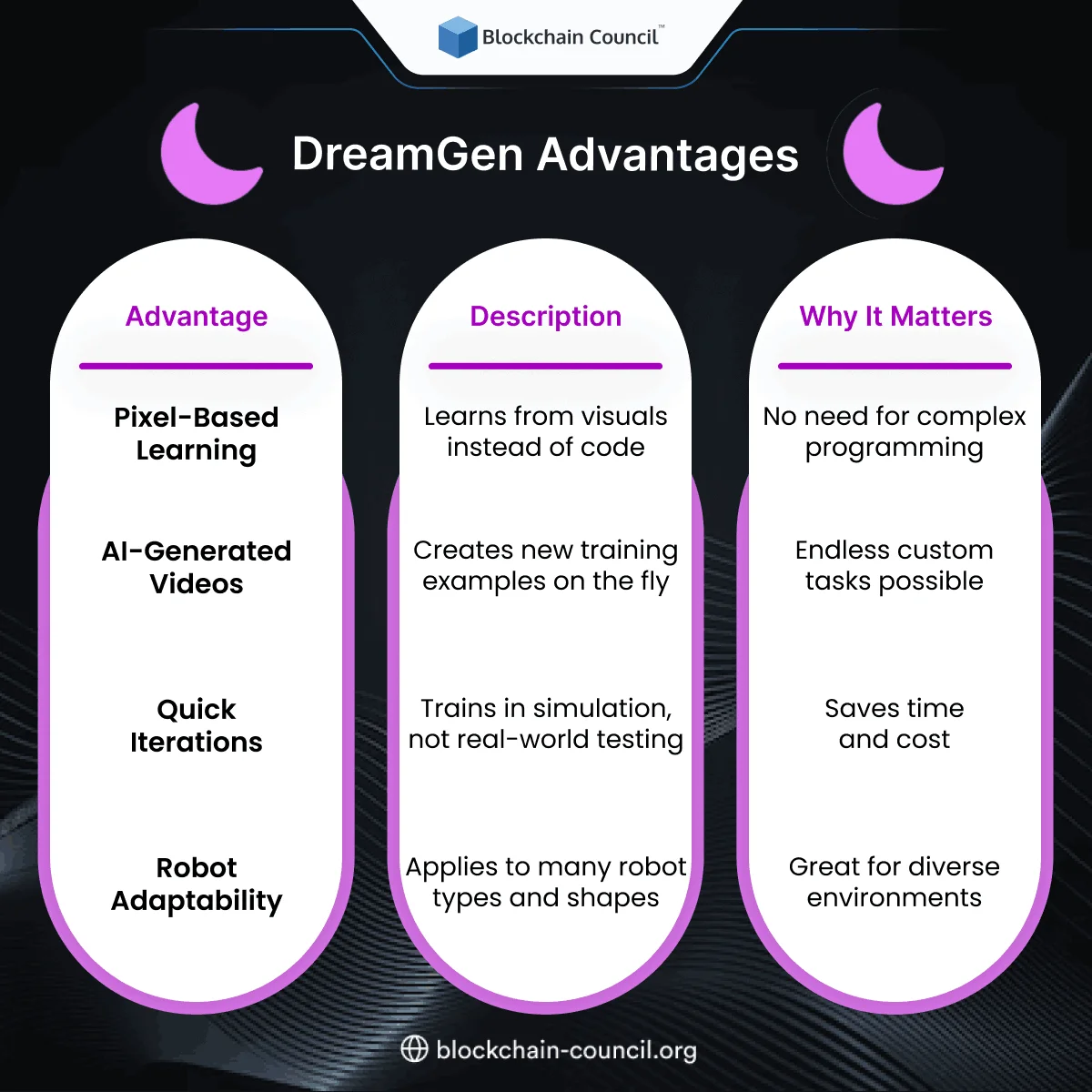
DreamGen Advantages
Final Thoughts
NVIDIA’s DreamGen is a major step forward in how robots learn. It skips the slow, physical training process and replaces it with smart, AI-generated videos. This makes it easier, faster, and cheaper to train robots for anything — from folding laundry to assembling car parts.
As robots continue to enter homes, hospitals, and workplaces, tools like DreamGen are what will make them smarter and more useful. And if you’re building in robotics or AI, this is one technology to keep your eyes on.
Related Articles
View All
AI & ML
AI Skills for Children: Fun and Safe Ways to Learn AI Concepts, Ethics, and Creativity
Teach AI skills for children with games, storytelling, and guided projects that build core concepts, ethics, creativity, and safe habits at home and school.

AI & ML
NVIDIA Releases “Alpamayo”
Introduction NVIDIA’s “Alpamayo” is not a single product. It is a portfolio release that combines models, simulation, and datasets aimed at reasoning-based autonomous driving. For professionals tracking AI systems in safety-critical environments, this release is significant because it shifts focus…

AI & ML
Freelancing with Vibe Coding Skills
Learn how vibe coding empowers freelancers to deliver faster, smarter, and more efficient AI-driven projects.
Trending Articles

The Role of Blockchain in Ethical AI Development
How blockchain technology is being used to promote transparency and accountability in artificial intelligence systems.

AWS Career Roadmap
A step-by-step guide to building a successful career in Amazon Web Services cloud computing.

Top 5 DeFi Platforms
Explore the leading decentralized finance platforms and what makes each one unique in the evolving DeFi landscape.