
NVIDIA GTC 2026 Breakdown: DLSS 5, NemoClaw & the Future of AI Platforms

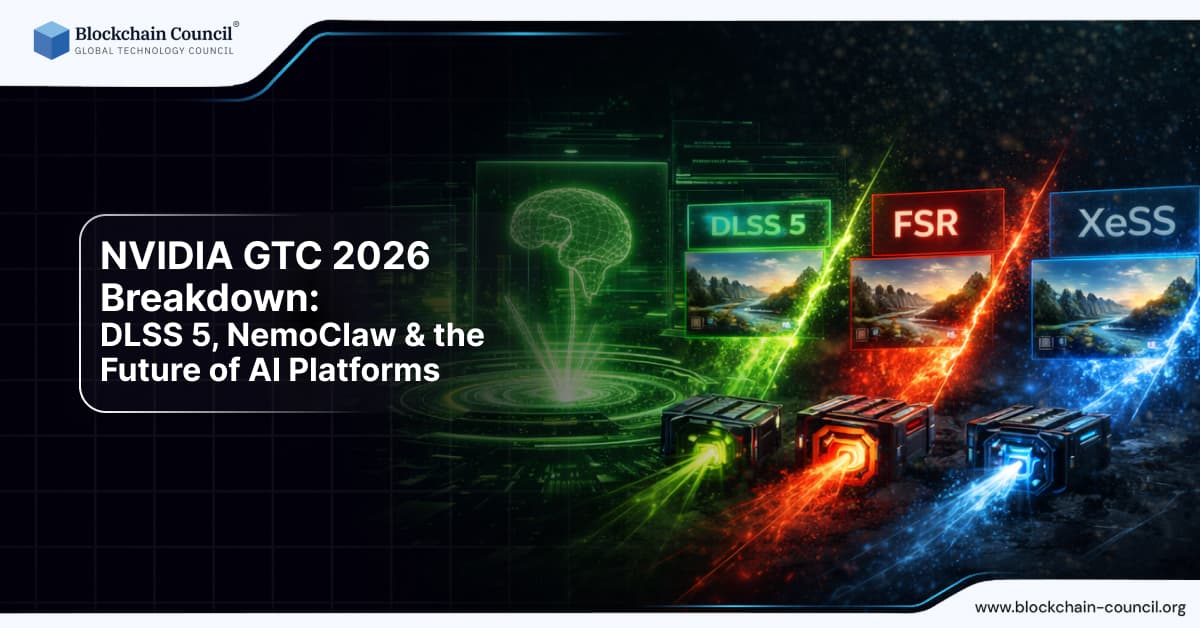
NVIDIA GTC 2026 was not just another tech conference—it was a clear signal that the industry is moving toward AI-first platforms across gaming, enterprise, and infrastructure. From DLSS 5’s neural rendering to the launch of NemoClaw AI agents, NVIDIA positioned itself as more than a hardware company—it is becoming a full-stack AI ecosystem leader.
In this breakdown, we analyze the key announcements, technologies, and long-term impact of GTC 2026 in a structured and practical way.

If you are learning through an Agentic AI Course, Python Course, or an AI powered marketing course, this event is a real-world case study of how AI moves from research to large-scale deployment.
What Is NVIDIA GTC and Why It Matters
NVIDIA GTC (GPU Technology Conference) is one of the most important global events for AI, computing, and graphics innovation.
GTC 2026 Focus Areas
AI infrastructure and cloud platforms
Agentic AI systems
Neural rendering and graphics
Robotics and physical AI
The 2026 event emphasized a “full-stack AI strategy”, covering chips, models, software, and applications.
Key Insight
GTC 2026 marks a shift from AI tools → AI platforms → AI ecosystems.
DLSS 5: The Shift to Neural Rendering
DLSS 5 was one of the biggest highlights of GTC 2026, introducing a new paradigm in graphics—AI-driven neural rendering.
What DLSS 5 Actually Does
Uses AI to reconstruct lighting, textures, and materials
Enhances realism in real time
Reduces computational load using Tensor Cores
It represents a move beyond upscaling into AI-generated rendering pipelines.
Key Features
Neural rendering instead of traditional rendering
AI-enhanced lighting, shadows, and character detail
Integration with ray tracing pipelines
Real-World Demonstrations
DLSS 5 was showcased in games like:
Starfield
Assassin’s Creed Shadows
Hogwarts Legacy
These demos highlighted significant visual improvements, especially in lighting and environmental detail.
Challenges and Industry Reaction
Despite its innovation, DLSS 5 faced criticism:
Concerns about altering artistic intent
“AI-generated look” in character rendering
High hardware requirements (early demos used dual RTX GPUs)
Key Insight
DLSS 5 is not just a feature—it is a fundamental shift toward AI-generated graphics, redefining how games are built.
NemoClaw: NVIDIA’s Entry into Agentic AI Platforms
Beyond gaming, NVIDIA made a major strategic move with NemoClaw, an open-source AI agent platform.
What Is NemoClaw?
NemoClaw is an enterprise-grade AI agent platform designed for:
Task automation
Workflow orchestration
Secure AI deployment
It builds on NVIDIA’s NeMo framework and integrates with its AI infrastructure stack.
Core Capabilities
Autonomous AI agents for business workflows
Built-in security and privacy controls
Open-source architecture for scalability
NemoClaw is designed to solve a major gap in AI adoption—enterprise trust and control.
Why NemoClaw Matters
Competes with emerging agent platforms like OpenClaw
Positions NVIDIA in the AI software layer, not just hardware
Enables organizations to deploy self-operating AI systems
Key Insight
NemoClaw signals NVIDIA’s transition from GPU company → AI platform company.
The Rise of Agentic AI at GTC 2026
A major theme across GTC 2026 was Agentic AI—systems that can act, decide, and execute tasks autonomously.
What Is Agentic AI?
Agentic AI refers to systems that:
Understand goals
Make decisions
Perform multi-step tasks
NVIDIA’s Approach
Integration of Nemotron models
AI agents running on enterprise workflows
Combination of models + infrastructure + APIs
NemoClaw plays a central role in this ecosystem.
Key Insight
The future of AI is not just chatbots—it is autonomous systems performing real work.
Full-Stack AI Strategy: NVIDIA’s Bigger Vision
GTC 2026 made it clear that NVIDIA is building a complete AI stack.
The AI Stack Layers
Layer | NVIDIA Offering |
Hardware | GPUs (Blackwell, Rubin) |
Infrastructure | AI cloud + data centers |
Models | Nemotron AI models |
Platforms | NemoClaw, NeMo |
Applications | Gaming, enterprise, robotics |
What This Means
NVIDIA controls both compute + intelligence layers
Enables faster AI deployment
Creates ecosystem lock-in
Key Insight
The real competition is no longer GPUs—it is who owns the AI platform stack.
Impact on Gaming, Enterprise, and Industry
Gaming
AI-driven rendering replaces traditional pipelines
Higher realism with lower hardware cost
Faster game development cycles
Enterprise
Industry-Wide Shift
From software tools → AI-driven systems
From manual workflows → autonomous execution
From hardware focus → platform dominance
Learning Perspective
GTC 2026 provides a real-world example of how AI technologies scale across industries.
To build expertise in this space:
Learn how autonomous systems work through an Agentic AI Course
Build technical foundations with a Python Course
Understand real-world AI applications via an AI powered marketing course
These concepts are no longer theoretical—they are actively shaping products used by millions.
Final Thoughts
NVIDIA GTC 2026 was a defining moment for the AI industry.
DLSS 5 introduced AI-driven rendering
NemoClaw launched enterprise AI agents
NVIDIA positioned itself as a full-stack AI leader
The biggest takeaway is clear:
AI is no longer a feature—it is becoming the foundation of entire platforms and ecosystems.
To stay ahead in this transformation:
Explore AI systems through an Agentic AI Course
Strengthen programming knowledge with a Python Course
Apply AI in business using an AI powered marketing course
Quick Recap
DLSS 5 brings neural rendering to gaming
NemoClaw introduces enterprise AI agents
GTC 2026 focused on full-stack AI platforms
NVIDIA is expanding beyond hardware into software ecosystems
FAQs: NVIDIA GTC 2026
1. What was the biggest announcement at GTC 2026?
DLSS 5 and NemoClaw were the most significant highlights.
2. What is DLSS 5?
An AI-based neural rendering technology for real-time graphics.
3. What is NemoClaw?
An open-source AI agent platform for enterprise automation.
4. Why is NemoClaw important?
It brings security and scalability to AI agent deployment.
5. What is agentic AI?
AI systems that can perform tasks autonomously.
6. Is DLSS 5 available now?
It is expected to roll out starting in late 2026.
7. What industries are impacted?
Gaming, enterprise software, robotics, and cloud computing.
8. What is NVIDIA’s strategy?
Building a full-stack AI ecosystem.
9. Will AI replace traditional workflows?
It will automate and enhance many processes.
10. How can I learn these technologies?
Through AI, programming, and applied learning courses.
Related Articles
View All
AI & ML
NVIDIA NemoClaw 101
Nvidia NemoClaw 101 introduces a secure AI agent platform that adds sandboxing, policy control, and privacy protection to modern AI automation systems.
AI & ML
What Is NVIDIA DLSS 5?
NVIDIA DLSS 5 is a next-gen neural rendering technology that uses AI to improve performance and image quality in modern games.

AI & ML
NVIDIA AI Enterprise Explained: Deploying Production-Grade AI on Hybrid and Multi-Cloud
NVIDIA AI Enterprise enables production-grade AI across hybrid and multi-cloud, combining NeMo, NIM microservices, and NemoClaw for secure, scalable agentic AI.
Trending Articles

The Role of Blockchain in Ethical AI Development
How blockchain technology is being used to promote transparency and accountability in artificial intelligence systems.

AWS Career Roadmap
A step-by-step guide to building a successful career in Amazon Web Services cloud computing.

Top 5 DeFi Platforms
Explore the leading decentralized finance platforms and what makes each one unique in the evolving DeFi landscape.