
Security vs Performance in AI Systems: NemoClaw Guardrails vs OpenClaw Freedom

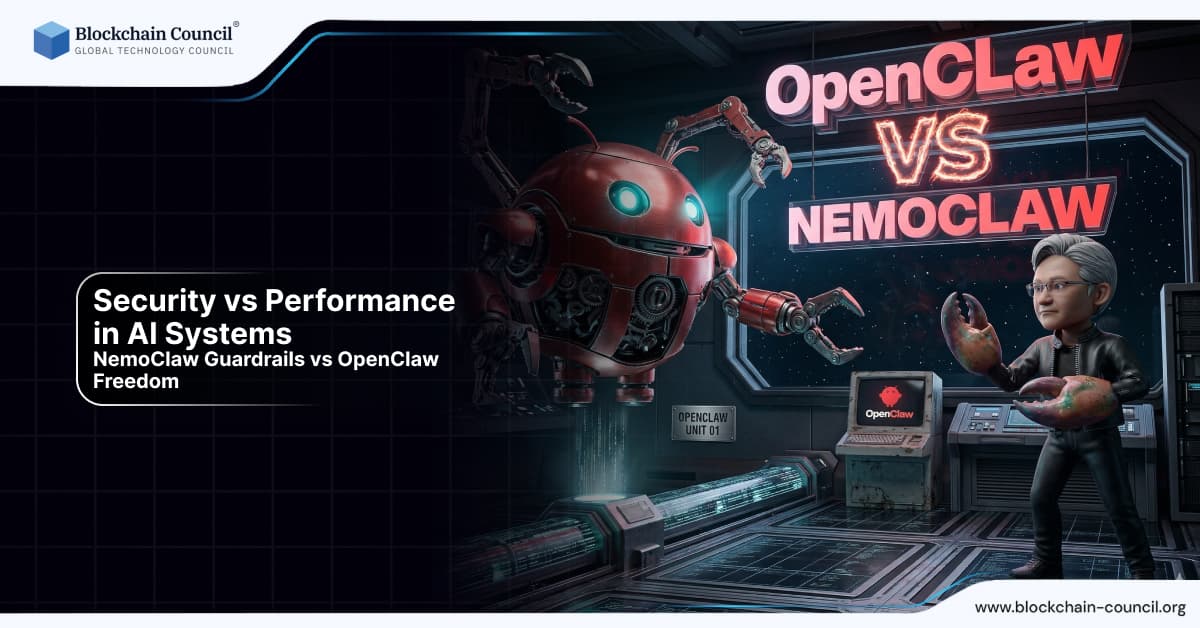
As AI systems evolve from simple assistants to autonomous agents, a critical debate is shaping the future of AI architecture: security vs performance.
Platforms like NemoClaw and OpenClaw represent two fundamentally different approaches. One prioritizes guardrails, compliance, and controlled execution, while the other emphasizes speed, flexibility, and unrestricted performance.

But in real-world AI systems, which matters more?
This guide breaks down the core trade-offs, architecture decisions, performance impact, and deployment strategies behind NemoClaw guardrails and OpenClaw freedom.
If you are learning through an Agentic AI Course, Python Course, or an AI powered marketing course, this comparison will help you understand how AI systems are designed for both innovation and safety at scale.
Understanding the Core Debate: Security vs Performance
AI systems today are no longer passive—they take actions, execute workflows, and interact with sensitive data. This makes security a first-class concern.
At the same time, performance determines how fast and efficiently these systems operate.
What Security Means in AI Systems
Controlled access to data and APIs
Safe execution of tasks
Compliance with regulations
Monitoring and auditability
What Performance Means in AI Systems
Fast response times
Efficient resource usage
Minimal latency in workflows
High throughput in multi-step tasks
Key Insight
Security and performance are not opposites—but prioritizing one often impacts the other.
NemoClaw Guardrails: Security-First AI Architecture
NemoClaw is built with a security-first philosophy, making it ideal for enterprise and regulated environments.
What Are Guardrails?
Guardrails are predefined controls that ensure AI systems behave safely and predictably.
Core Guardrail Features
Access control layers for data and APIs
Real-time monitoring and logging
Policy-based decision constraints
Sandboxed execution environments
How Guardrails Impact Performance
Additional validation steps introduce latency
Monitoring systems consume compute resources
Restricted execution may limit optimization
Strengths of NemoClaw Guardrails
High trust and reliability
Compliance with enterprise standards
Reduced risk of unintended actions
Limitations
Slower execution compared to open systems
Reduced flexibility in dynamic workflows
Higher infrastructure complexity
Key Insight
NemoClaw ensures safe AI behavior, even if it comes at the cost of raw performance.
OpenClaw Freedom: Performance-First AI Systems
OpenClaw takes a performance-first approach, allowing developers to build fast and highly customizable AI agents.
What Does “Freedom” Mean?
Minimal restrictions on agent behavior
Direct access to APIs and workflows
Full control over execution logic
Core Features
Lightweight architecture
Direct model integration
Customizable pipelines
How Freedom Impacts Performance
Faster execution due to fewer checks
Lower latency in decision-making
Higher throughput in workflows
Strengths of OpenClaw
Maximum speed and efficiency
Rapid experimentation and iteration
Ideal for performance-critical applications
Limitations
Higher risk of unsafe behavior
Lack of built-in governance
Requires manual security implementation
Key Insight
OpenClaw maximizes performance and flexibility, but shifts responsibility for safety to developers.
Architecture-Level Comparison
NemoClaw Architecture
Layered security model
Controlled execution pipelines
Built-in monitoring systems
OpenClaw Architecture
Modular and open design
Developer-defined workflows
Minimal system constraints
Key Insight
NemoClaw is designed for controlled environments, while OpenClaw is built for open experimentation.
Security vs Performance: Direct Comparison
Factor | NemoClaw | OpenClaw |
Security | Very High | Low (manual) |
Performance | Moderate | Very High |
Latency | Higher | Lower |
Flexibility | Limited | Extensive |
Best Use Case | Enterprise, regulated industries | Startups, experimentation |
Key Insight
The choice depends on whether your priority is risk reduction or execution speed.
Real-World Trade-Off Scenarios
Scenario 1: Financial Systems
Requires strict compliance and auditability
NemoClaw is the preferred choice
Scenario 2: Startup AI Product
Needs rapid iteration and speed
OpenClaw is more suitable
Scenario 3: Hybrid Enterprise Setup
Key Insight
Most organizations adopt a hybrid approach to balance both needs.
Performance Impact of Security Layers
Where Performance Is Affected
Input validation processes
Policy enforcement checks
Logging and monitoring systems
Optimization Strategies
Selective guardrail application
Efficient logging mechanisms
Parallel processing of validation steps
Key Insight
Security does not have to drastically reduce performance—smart design can minimize the trade-off.
Risks of Ignoring Security
Unauthorized data access
Uncontrolled AI actions
Compliance violations
System failures
Key Insight
High performance without security can lead to critical system risks.
Future of AI Systems: Balancing Both Worlds
The industry is moving toward systems that combine:
High performance execution
Built-in security layers
Adaptive guardrails
Emerging Trend
Dynamic guardrails that adjust based on context
AI systems that self-monitor and optimize
Key Insight
The future is not security vs performance—it is security with performance.
Learning Perspective
Understanding this trade-off is essential for building modern AI systems.
To build expertise:
Learn agent-based architectures through an Agentic AI Course
Strengthen programming skills with a Python Course
Apply AI in real-world scenarios via an AI powered marketing course
These concepts are critical for designing scalable and responsible AI systems.
Final Thoughts
NemoClaw and OpenClaw highlight a fundamental truth in AI system design:
NemoClaw ensures safe, controlled, and compliant AI systems
OpenClaw enables fast, flexible, and high-performance AI execution
The real challenge is not choosing one over the other—it is balancing both effectively.
To stay ahead in this evolving landscape:
Explore AI systems through an Agentic AI Course
Build technical expertise with a Python Course
Understand business applications via an AI powered marketing course
Quick Recap
Security and performance are both critical in AI systems
NemoClaw prioritizes guardrails and control
OpenClaw prioritizes speed and flexibility
Hybrid models are the future
FAQs: Security vs Performance in AI Systems
1. What are AI guardrails?
Controls that ensure safe and compliant AI behavior.
2. Does security reduce performance?
It can, but optimized systems minimize the impact.
3. Which is better: NemoClaw or OpenClaw?
It depends on your use case and priorities.
4. Is OpenClaw secure?
Only if developers implement security manually.
5. Why are guardrails important?
They prevent unsafe or unintended AI actions.
6. Can both systems be used together?
Yes, many organizations use hybrid approaches.
7. What industries need high security?
Finance, healthcare, and government sectors.
8. Is performance always more important?
No, security is critical for real-world deployments.
9. What is the future of AI systems?
Balanced systems with both performance and security.
10. How can I learn this topic?
Through AI, programming, and applied learning courses.
Related Articles
View All
AI & ML
OpenClaw vs NemoClaw: Flexibility vs Security in AI Agents
OpenClaw and NemoClaw represent two approaches to AI agents—one focused on flexibility, the other on security. Here’s how they differ and where each excels.
AI & ML
Running AI Agents on RTX PCs: OpenClaw + NemoClaw + Gaming GPUs
RUN AI agents locally using RTX GPUs with OpenClaw and NemoClaw for high performance and privacy.
AI & ML
OpenClaw Security Risks Explained
Running OpenClaw gives AI access to your system, so it’s important to apply security practices like sandboxing and access control.
Trending Articles

The Role of Blockchain in Ethical AI Development
How blockchain technology is being used to promote transparency and accountability in artificial intelligence systems.

AWS Career Roadmap
A step-by-step guide to building a successful career in Amazon Web Services cloud computing.

Top 5 DeFi Platforms
Explore the leading decentralized finance platforms and what makes each one unique in the evolving DeFi landscape.