
Is AI Good or Bad?

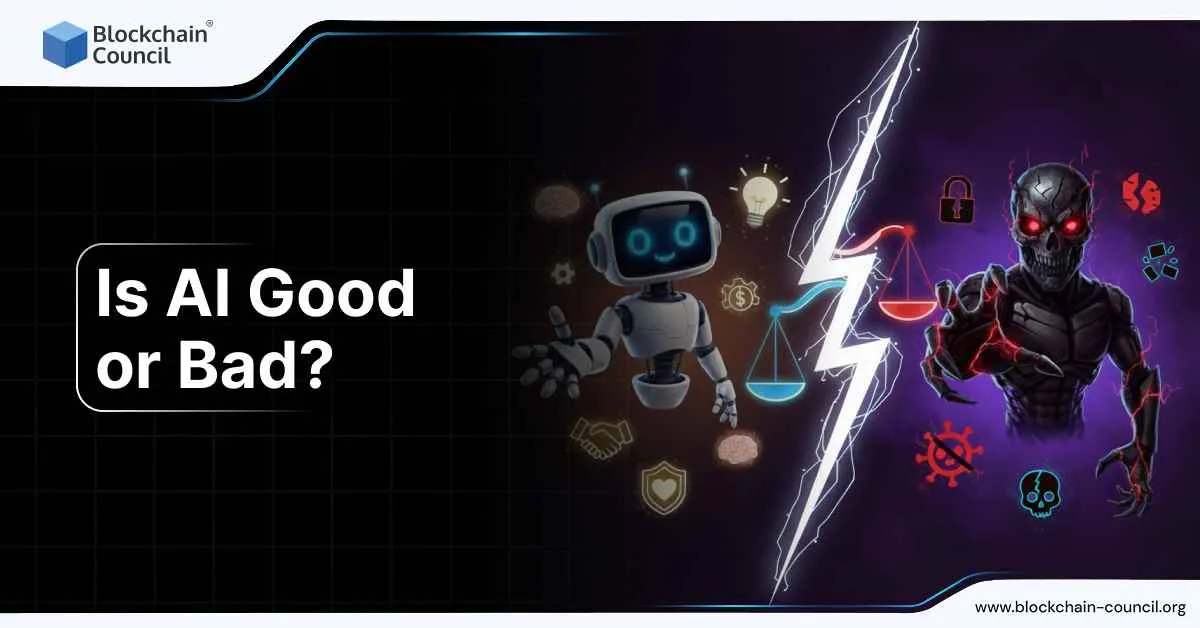
AI is not cleanly good or bad. It is a capability. What matters is how, where, and why it is used. In everyday work, AI can save time, improve quality, and reduce boring effort. In careless or high-risk deployments, it can mislead, discriminate, invade privacy, or remove human judgment where it matters most.
So the honest answer to is AI good or bad is simple: AI is good when it helps people do legitimate work better and safer, and bad when it is deployed without care, limits, or accountability.
To understand this clearly, it helps to look at what actually happens when AI is used in the real world.
When AI is good
AI shows its value most clearly in low-risk, assistive work where humans stay in control.
Research backs this up.
In a large MIT study involving 444 college-educated professionals doing realistic writing tasks, people using ChatGPT completed work about 37% faster and received higher quality scores, improving by roughly 0.45 standard deviations. That is not hype. That is measurable productivity.
At a broader level, McKinsey estimates generative AI could add between $2.6T and $4.4T in annual economic value across use cases like customer operations, marketing and sales, software engineering, and research. The key phrase here is “if implemented well.”
AI is also good when it improves access and service quality. Examples include faster customer support, better translation, accessibility tools for speech and vision, and automation of repetitive administrative tasks, as long as humans review outcomes.
This is why many professionals first learn how to use AI responsibly through an AI Certification. Understanding what AI can and cannot reliably do makes the benefits real instead of risky.
AI and jobs
A common fear is that AI replaces people outright. The data paints a more nuanced picture.
The World Economic Forum’s Future of Jobs 2025 outlook projects that from 2025 to 2030, job creation and job displacement together will affect about 22% of current roles. Around 170 million new roles are expected to be created, while about 92 million may be displaced, resulting in a net increase of roughly 78 million jobs.
What changes is not work disappearing, but work shifting. Tasks move from manual execution to review, coordination, and decision making. This is why AI often rewards people who can define goals clearly and judge outputs well.
When AI is bad
The risks are real and documented.
Stanford’s AI Index reports 233 tracked AI-related incidents in 2024, a 56.4% increase from the previous year. These include failures, misuse, and unintended harm as systems scale.
Generative AI also accelerates disinformation. OECD reporting highlights that G7 countries see manipulation of opinions, deepfakes, and misinformation as the top risks, alongside intellectual property and privacy issues.
Bias is another serious concern. NIST evaluations of face recognition systems show demographic performance gaps where false positives can be 10 to 100 times higher for certain groups, depending on the algorithm and scenario. In contexts like law enforcement or border control, that is not a technical flaw. It is a civil rights issue.
Because of these risks, high-stakes uses require stricter limits. The EU AI Act explicitly bans certain “unacceptable risk” practices and places strong obligations on high-risk systems, reflecting the reality that some AI deployments are too dangerous without safeguards.
Why people argue over “good vs bad”
Most debates fail because very different uses of AI get lumped together.
Low-stakes assistance is usually positive. Drafting, summarizing, coding help, brainstorming, and translation work well when humans review the output.
Medium-stakes decisions are mixed. HR screening, credit pre-checks, fraud triage, and content moderation can gain efficiency but also introduce bias, opacity, and false positives.
High-stakes decisions are dangerous without strict controls. Healthcare decisions, law enforcement identification, public benefits eligibility, and critical infrastructure management require accountability, transparency, and legal oversight.
AI behaves very differently across these layers, which is why blanket statements never hold.
Is AI Good or Bad?
Instead of asking abstract questions, people can apply a simple checklist.
- Who is harmed if the system is wrong? Minor inconvenience or loss of money, liberty, or health
- Can outputs be audited and explained? Is there traceability and documentation
- What is the failure mode? Hallucination, bias, privacy leakage, or security abuse
- Is there a clear human override and accountability
- Has the system been tested on the population it affects
- Is the use legally allowed in that region
This thinking closely matches the NIST AI Risk Management Framework, which organizes responsible AI around GOVERN, MAP, MEASURE, and MANAGE. It treats accuracy, fairness, privacy, and interpretability as trade-offs that must be managed, not ignored.
As systems grow more complex, understanding architecture, deployment, and limits becomes important, which is why many teams complement AI skills with a Tech Certification to ground decisions in real systems knowledge.
The energy and infrastructure
Even beneficial AI has costs.
The International Energy Agency projects that global electricity consumption by data centres could reach about 945 TWh by 2030, roughly 3% of global electricity use. AI is not only a software story. It is also a power, infrastructure, and sustainability story.
This matters when evaluating large-scale deployment. Efficiency and necessity start to matter as much as capability.
How organizations make AI a net positive
AI tends to be good when organizations follow a few patterns.
>They keep humans in the loop for meaningful decisions.
> They define clear accountability when systems fail.
> They limit autonomy based on risk.
> They invest in context quality, not just models.
> They train people before scaling deployment.
Leaders who treat AI as a workflow change rather than a shiny tool usually see better outcomes. This is why adoption often pairs technical capability with business readiness, supported by paths like a Marketing and Business Certification when AI moves from pilot to organization-wide use.
Conclusion
AI is not morally good or bad by default. It amplifies intent and design choices. Used thoughtfully, it saves time, improves quality, and expands access. Used carelessly or in high-stakes settings without controls, it can cause real harm.
For individuals and organizations, the real question is not whether AI is good or bad. The question is whether it is being used responsibly, transparently, and with humans still accountable for outcomes.