Infinite Agents

What are Infinite Agents?
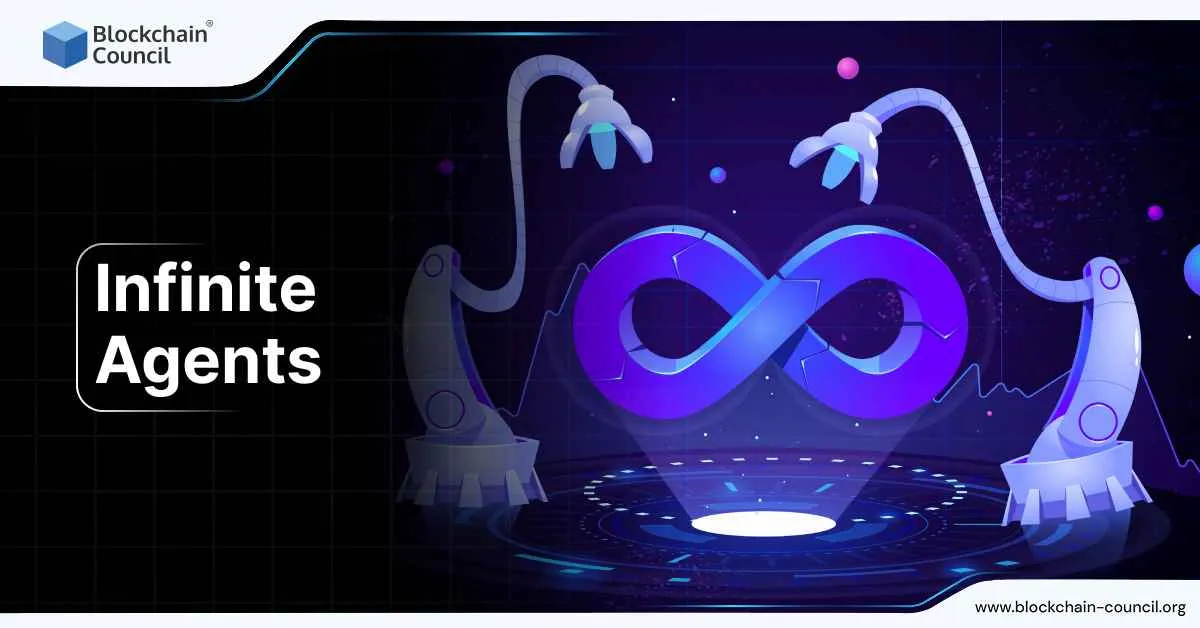
Infinite agents means running many AI agents in parallel so work keeps moving even when humans are offline. Instead of one assistant that answers questions, you have a coordinated set of agents that can draft, plan, execute, check, and report back across multiple streams of work. The human role shifts from doing every step to supervising outcomes, setting priorities, and approving decisions.
If you want to build the skill set needed to direct multi-agent workflows well, starting with an AI Course helps because it trains you to think in systems, inputs, constraints, and verification rather than single prompts.

Simple meaning
Infinite agents is not “a smarter chatbot.” It is a work model where:
- Many agents run at the same time
- Each agent has a specific job to do
- Work continues in the background across hours and time zones
- You step in mainly for decisions, corrections, and approvals
The practical effect is leverage. One person can coordinate multiple streams of progress without needing to write every message, open every tab, or manually transfer context between tools.
Infinite agents vs regular AI
Most people use AI in a linear way: ask, wait, reply, repeat. Infinite agents is parallel. You can assign:
- Agent A: research and extract key facts
- Agent B: draft a structured output
- Agent C: create variants for different audiences
- Agent D: run checks against a rubric or policy
- Agent E: prepare next steps and action items
When you work this way, speed does not come from typing faster. Speed comes from delegation and coordination.
Impact
In an infinite-agent setup, the human becomes a manager of outcomes. That sounds abstract, so here is what it looks like in real work:
- You define the goal and success criteria
- You split the work into clear tasks
- You give agents constraints and guardrails
- You review results at checkpoints, not at every step
- You approve what matters and send back what needs revision
This is closer to running a production line than writing everything yourself. The human value is judgment, prioritization, and quality control.
Why companies care
At company level, the biggest problem is not “getting AI.” Most teams already tried pilots. The bottleneck is turning scattered usage into predictable workflows that deliver measurable outcomes.
Infinite agents matters because it changes two things that normally slow organizations down:
- Coordination cost: teams spend huge time aligning, updating, and transferring context
- Throughput limits: work pauses when humans pause, like nights, weekends, and meetings
When agents handle repetitive work and keep context moving, teams can maintain momentum with less overhead.
The two blockers that stop it from working
Infinite agents is powerful, but it fails quickly if two core issues are not solved.
Context
Knowledge work is scattered. Information lives across docs, chats, emails, dashboards, tickets, calendars, and unwritten tribal knowledge. Humans usually act as the glue, copying and pasting context from one place to another.
Agents struggle when:
- they cannot access the right context
- they receive partial context
- context is inconsistent across teams
This is why strong internal knowledge systems and good tool connections matter more than fancy prompts. Many organizations now explore building better internal infrastructure using Blockchain Technology concepts too, especially when auditability, provenance, and data integrity become part of the workflow story.
Verification
Code has tests and errors. Many business tasks do not. If you ask an agent to draft a policy, summarize a meeting, or plan a rollout, how do you prove it is correct?
Infinite agents becomes reliable only when you build checks such as:
- rubrics and scoring rules
- approval gates for risky actions
- logging and traceability of decisions
- comparisons against known references
- “show your work” outputs like step lists and assumptions
Without verification, humans get pulled back into checking everything, which removes the leverage.
What “agent workflows” look like
Infinite agents usually runs in a loop. A practical version looks like this:
Step 1: Define the target
You specify:
- what the output should be
- what “good” looks like
- what is not allowed
- what sources or inputs must be used
This is where you reduce ambiguity. The clearer the target, the more reliable the agents become.
Step 2: Break work into roles
Instead of one agent doing everything, you create roles. Examples:
- Research agent
- Draft agent
- Reviewer agent
- Risk and compliance agent
- Editor agent
This prevents one agent from mixing tasks and producing a confident-sounding but messy output.
Step 3: Run parallel execution
Agents operate at the same time. This is where “infinite” starts to feel real, because the work output grows in parallel.
Step 4: Merge and judge
You compare outputs, pick the best pieces, and identify gaps. This can be done by you or by a judge agent with a strict rubric.
Step 5: Approve and deploy
Only the final step needs human approval for important actions. Low-risk tasks can be automated fully if they are reversible and logged.
Use cases
The most common use cases are repetitive and structured tasks, such as:
- meeting notes and follow-up summaries
- internal Q and A over company knowledge
- IT and operations requests
- customer feedback tagging and routing
- onboarding help
- weekly reporting and status updates
These are the kinds of workflows where the cost of human attention is high, but the pattern is consistent enough to automate safely.
As systems mature, the scope grows into more complex work, like:
- preparing product briefs
- drafting customer communications with approval
- analysis of performance metrics and anomalies
- generating and testing multiple strategy options
Why the “infinite” idea keeps growing
When work becomes cheaper and faster, people attempt more of it. This is a real pattern in technology. The result is not only doing the same work at lower cost. It is expanding what you even consider possible.
With infinite agents, teams may:
- run more experiments
- ship more iterations
- test more variations
- explore more markets and segments
- document more internal knowledge
This is why the biggest impact may show up not as small efficiency gains, but as a higher rate of decision-making and output.
Trust and safety
Infinite agents can create speed, but speed increases risk if you do not set boundaries.
Good guardrails include:
- permissions by role, not by convenience
- approval requirements for money, identity, and irreversible actions
- detailed logs that record agent actions and outputs
- rate limits and scope limits per workflow
- red-team style testing for failure modes
If you want a way to communicate these ideas to business teams without turning it into a technical lecture, frameworks from a Marketing and business certification can help because they focus on clarity, positioning, and decision-ready summaries.
Role of Blockchain
As companies scale agent workflows, they need stronger guarantees about integrity and traceability. That is where Blockchain concepts become relevant. Not every agent system needs a Blockchain, but the design goals overlap:
- tamper-evident logs
- clear provenance of actions and data
- audit trails for compliance
- accountability across teams and tools
If you want to go deeper into how decentralized systems handle trust and auditability, a structured Blockchain Course is a useful pathway, especially for people building workflow infrastructure rather than only using apps.
Bottom line
Infinite agents is the shift from using AI as a single helper to running many agents in parallel inside real workflows, with humans focused on direction, verification, and approvals. The promise is massive leverage and continuous progress. The blockers are context and verification. The winners will be the teams that build reliable systems around agents, not just exciting demos.