
Impact of the Latest Trump Tariffs on the AI Industry
 Blockchain Council
The recent Trump tariffs have brought about significant challenges for the artificial intelligence (AI) sector. These tariffs, especially on imports from China and Taiwan, have raised costs and disrupted the supply chains that AI companies depend on. With tariffs of up to 145% on Chinese goods and 32% on Taiwanese imports, companies working on AI infrastructure are facing a dilemma. The tariffs have the potential to slow down AI development, increase costs for hardware components, and even impact the future of AI innovation in the U.S.
This article explores how these tariffs are affecting the AI industry, the impact on supply chains, and how companies can respond to mitigate these effects. We’ll also examine the broader geopolitical implications and the strategies that AI companies are adopting to navigate this challenge.

The Impact on AI Hardware and Infrastructure
AI development depends heavily on advanced hardware such as semiconductors, chips, and data center components, much of which is sourced from Taiwan and China. These components are essential for building the infrastructure that powers AI systems, including machine learning and deep learning models.
Increased Costs of Key Components
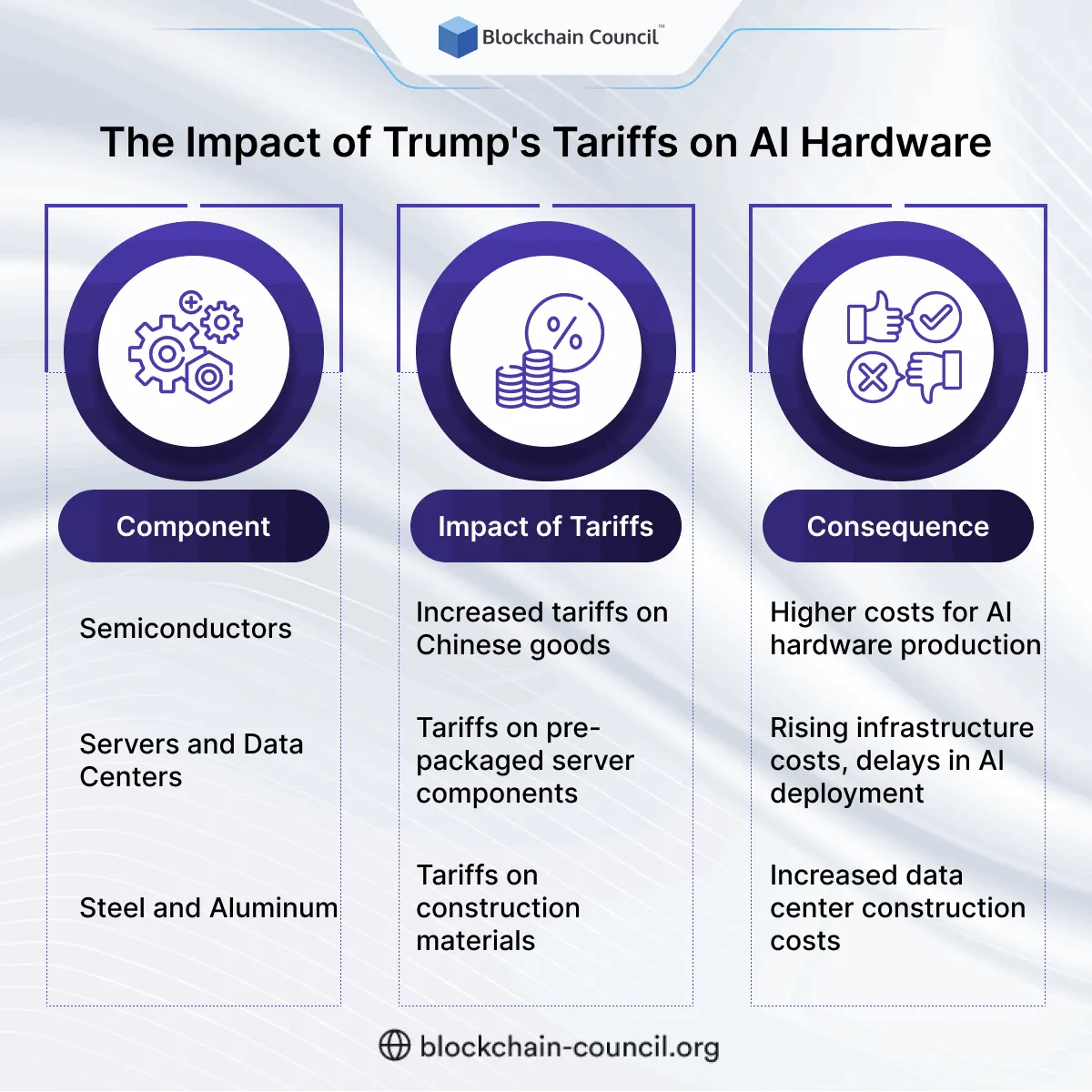
One major issue arising from the tariffs is the increased cost of essential components. Although individual chips may be exempt from tariffs if imported as standalone products, many of these chips arrive pre-packaged in servers, which are subject to high tariffs. This discrepancy has made it more expensive for U.S. AI companies to build and maintain the infrastructure needed for AI research and development.
Moreover, the construction of data centers—critical for hosting AI systems—has become more expensive due to higher prices for steel and aluminum, which are subject to tariffs. This rise in construction costs could hinder the growth and expansion of the AI industry in the U.S., especially for smaller companies and startups that rely on cost-effective infrastructure.
The Impact of Tariffs on AI Hardware
Effects on AI Companies and Investments
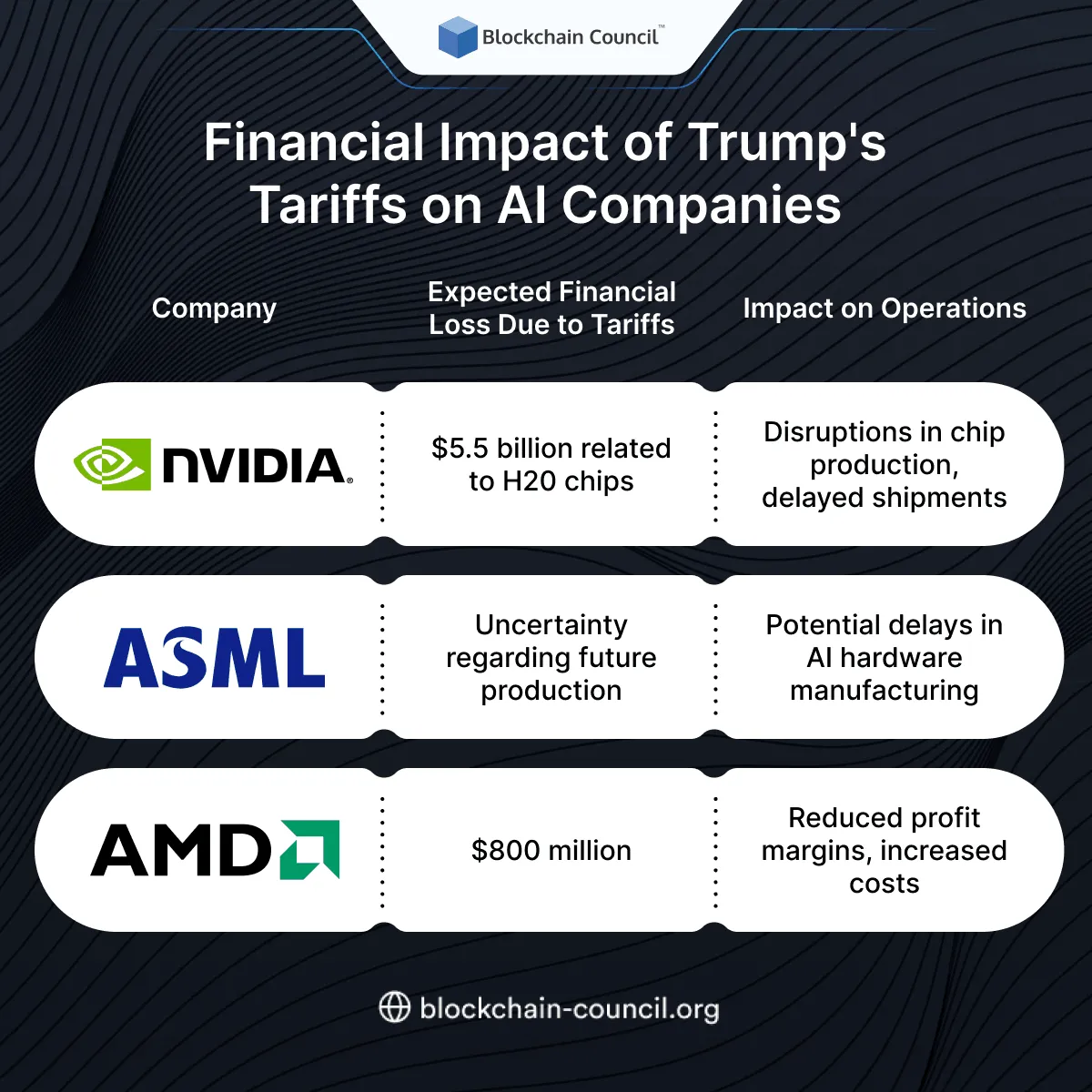
AI companies are facing significant financial impacts due to the tariffs. Major players like Nvidia, AMD, and ASML have reported substantial losses as a result of the tariffs. These companies rely on imported chips and components for their AI hardware.
For instance, Nvidia expects a $5.5 billion charge related to tariffs on its H20 chips, which are heavily demanded in China. AMD also faces a $800 million loss due to similar import costs. Meanwhile, ASML has warned of uncertainty about its future production schedules, citing potential disruptions caused by the tariffs.
Investors in the AI space are becoming cautious as well. Many are concerned that the tariffs will delay the growth of AI companies and reduce the innovation that drives the sector. Some investors are even worried that AI development in the U.S. will be outpaced by countries like China, which are not as affected by these tariffs.
Financial Impact on AI Companies
Geopolitical Implications of Tariffs on the AI Industry
The tariffs introduced by Trump are not just affecting the U.S. AI industry, but also have significant geopolitical implications. Taiwan, which is a major player in semiconductor manufacturing, is particularly impacted by these tariffs. In response, some Taiwanese companies, such as Inventec, have announced plans to invest in U.S.-based manufacturing facilities to reduce their exposure to tariffs.
The tariffs also threaten to shift the global balance of power in the AI race. While U.S. companies face rising costs and supply chain disruptions, China is benefitting from reduced competition. China is not impacted by these tariffs and is ramping up its own AI development. As a result, the U.S. could lose its competitive edge in AI research and development, which could have long-term effects on the industry.
Strategies to Mitigate Tariff Impacts
To deal with the challenges posed by the tariffs, AI companies are exploring several strategies:
1. Nearshoring Production
Some companies are looking to set up manufacturing facilities within the U.S. This reduces reliance on imported components and helps avoid tariffs. For example, Inventec has announced plans to invest up to $85 million in Texas to reduce its exposure to U.S. tariffs.
2. Diversifying Supply Chains
AI companies are also looking to diversify their supply chains by sourcing components from different countries, rather than relying solely on China and Taiwan. This will help mitigate the risks associated with tariff volatility.
3. Investing in Domestic R&D
Some companies are increasing their investment in domestic research and development to reduce their dependency on foreign components. By innovating within the U.S., companies can lessen their reliance on international suppliers, thereby decreasing the tariff impact.
4. Advocating for Policy Changes
Many companies are lobbying policymakers to seek exemptions or reductions in tariffs on critical AI components. By working with lawmakers, AI companies hope to secure relief and reduce the overall burden on the industry.
Conclusion
The Trump administration’s tariffs have introduced significant challenges for the AI industry. From rising hardware costs to disrupted supply chains, these tariffs have far-reaching implications. While AI companies are taking steps to mitigate the impact, such as nearshoring production and diversifying supply chains, the future of the U.S. AI sector remains uncertain.
The geopolitical landscape is shifting, with countries like China benefitting from a more stable trade environment. The U.S. must find ways to counteract the negative effects of these tariffs to maintain its leadership position in AI research and development.
For those looking to gain a deeper understanding of AI and its applications in business, pursuing certifications such as AI Certification, Data Science Certification, and Marketing and Business Certification can provide valuable insights into the intersection of AI and business.
Related Articles
View All
AI & ML
Prime Minister Narendra Modi’s Vision at India AI Impact Summit 2026
Key Takeaways from Prime Minister Modi AI should be used for global welfare, not just technological power Prime Minister Narendra Modi emphasized that artificial intelligence must benefit humanity as a whole and contribute to social progress, economic growth, and improved quality of life.…

AI & ML
PM Narendra Modi inaugurates Expo at the AI Impact Summit 2026
Key Takeaways Prime Minister Narendra Modi recently inaugurated the AI Impact Summit 2026, highlighting India’s emergence as a global leader in sovereign artificial intelligence development. The event showcases home-grown innovations like Servum, which provides offline, multi-lingual AI…
AI & ML
AI Skills for Teachers and Professors: Integrating AI into Lesson Plans, Assessments, and Academic Integrity Policies
Learn essential AI skills for teachers and professors, with practical ways to use AI in lesson plans, redesign assessments, and update academic integrity policies.
Trending Articles

The Role of Blockchain in Ethical AI Development
How blockchain technology is being used to promote transparency and accountability in artificial intelligence systems.

AWS Career Roadmap
A step-by-step guide to building a successful career in Amazon Web Services cloud computing.

Top 5 DeFi Platforms
Explore the leading decentralized finance platforms and what makes each one unique in the evolving DeFi landscape.