
How DLSS 5 Works

Introduction
The graphics industry is entering a new phase where artificial intelligence is no longer just enhancing visuals—it is actively generating them. At the center of this transformation is NVIDIA DLSS 5, a next-generation system built on neural rendering principles.
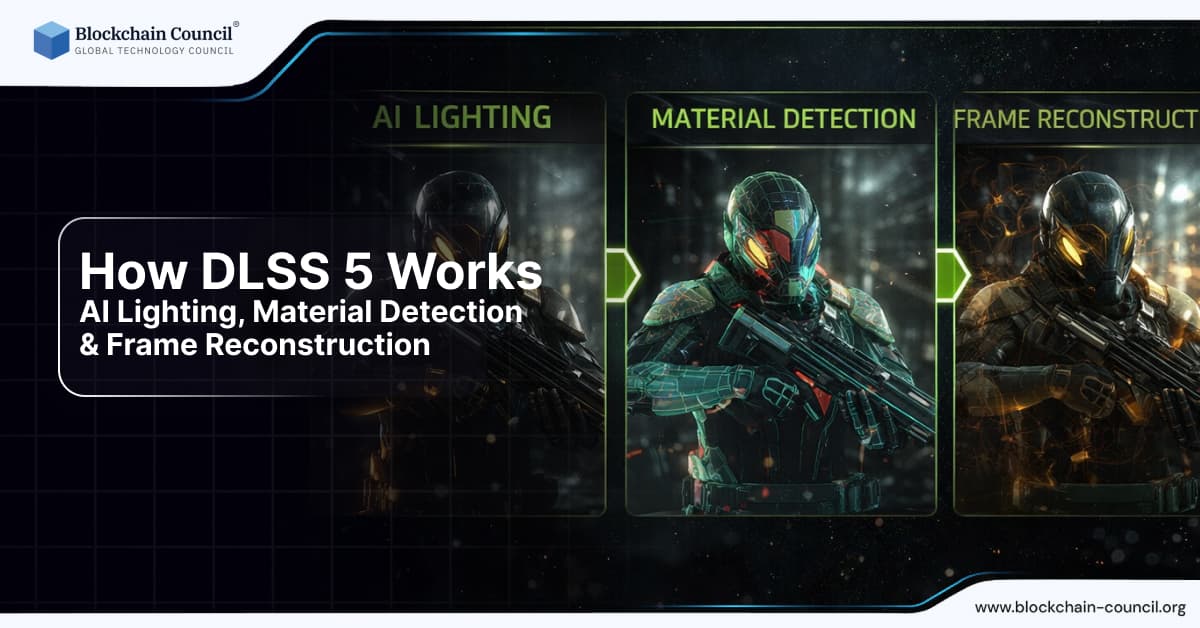
Unlike earlier versions that focused mainly on upscaling, DLSS 5 introduces a deeper AI-driven pipeline involving:

AI lighting enhancement
Material detection
Frame reconstruction
These three components work together to create high-quality visuals while maintaining exceptional performance.
In this guide, we will break down how DLSS 5 works, step by step, in a way that is easy to understand yet technically strong.
If you are exploring modern AI systems through an Agentic AI Course, Python Course, or an AI powered marketing course, this will give you a real-world understanding of AI in graphics.
The Core Idea Behind DLSS 5
Traditional rendering works like this:
GPU calculates every pixel
Lighting is simulated mathematically
Frames are rendered sequentially
This is computationally expensive.
DLSS 5 Approach
DLSS 5 replaces part of this pipeline with AI prediction.
Instead of calculating everything:
AI predicts visual output
Reconstructs missing details
Enhances realism
Key Insight
DLSS 5 is not just an upscaler—it is a hybrid rendering system combining traditional graphics with AI generation.
DLSS 5 Rendering Pipeline Overview
The DLSS 5 pipeline can be broken into three main components:
AI Lighting System
Material Detection Engine
Frame Reconstruction Model
1. AI Lighting in DLSS 5
What Is AI Lighting?
AI lighting refers to using neural networks to enhance and reconstruct lighting in a scene.
Traditional Lighting Challenges
Ray tracing is expensive
Lighting calculations are complex
Noise and artifacts are common
How DLSS 5 Solves This
DLSS 5 uses AI to:
Predict lighting behavior
Enhance shadows and reflections
Fill missing lighting details
Process
Input lighting data from engine
AI analyzes scene structure
Neural network enhances lighting
Output is cleaner and more realistic
Benefits
Improved global illumination
Better reflections
Reduced noise
Example
In a dark scene:
Traditional rendering → noisy shadows
DLSS 5 → smooth, realistic lighting
2. Material Detection in DLSS 5
What Is Material Detection?
Material detection allows DLSS 5 to identify surfaces in a scene and render them appropriately.
Why It Matters
Different materials behave differently under light:
Metal → reflective
Skin → soft and detailed
Water → transparent and dynamic
How DLSS 5 Handles This
DLSS 5 uses AI to classify materials:
Analyzes texture patterns
Identifies surface properties
Applies appropriate rendering logic
Materials Detected
Skin
Metal
Glass
Water
Foliage
Benefits
More realistic surfaces
Accurate reflections
Improved texture quality
Example
A character model:
Skin appears natural
Armor reflects light correctly
3. Frame Reconstruction in DLSS 5
What Is Frame Reconstruction?
Frame reconstruction is the process of generating a high-quality frame from incomplete or lower-resolution data.
Traditional Approach
Render full frame
High GPU load
DLSS 5 Approach
Render at lower resolution
AI reconstructs full frame
How It Works
Input:
Current frame
Previous frame
Motion vectors
AI processing:
Predicts missing pixels
Enhances details
Output:
High-resolution frame
Frame Generation Extension
DLSS 5 also:
Generates additional frames
Improves smoothness
Benefits
Higher FPS
Reduced rendering cost
Smooth gameplay
Combined Workflow: End-to-End Process
Step-by-Step Flow
Game engine provides input data
AI lighting enhances illumination
Material detection identifies surfaces
Frame reconstruction builds final image
Output is displayed
Key Insight
DLSS 5 combines multiple AI systems into a unified rendering pipeline.
Role of Tensor Cores in DLSS 5
DLSS 5 relies heavily on NVIDIA Tensor Cores.
What They Do
Run neural networks
Process AI models
Accelerate rendering
Why They Matter
Without Tensor Cores:
AI processing would be too slow
Real-time rendering would not be possible
DLSS 5 vs DLSS 3 Pipeline
DLSS 3
Upscaling
Frame generation
DLSS 5
AI lighting
Material detection
Full frame reconstruction
Comparison
Feature | DLSS 3 | DLSS 5 |
Upscaling | Yes | Yes |
Frame Generation | Yes | Advanced |
AI Lighting | No | Yes |
Material Detection | No | Yes |
Performance Impact
Positive Effects
Higher FPS
Lower GPU load
Better efficiency
Trade-Offs
Slight latency
Possible artifacts
Visual Quality Impact
Improvements
Better lighting
Sharper textures
Realistic materials
Limitations
Over-smoothing
Occasional ghosting
Real-World Applications
Gaming
Enhanced visuals
Smooth performance
Virtual Reality
Real-time rendering improvements
Simulation
Realistic environments
Why DLSS 5 Matters
1. Redefines Rendering
Moves from:
Pixel-based → AI-based
2. Improves Efficiency
Less GPU load, more performance
3. Enables Next-Gen Graphics
Makes advanced visuals accessible
Future of DLSS Technology
What Comes Next
Full AI-generated frames
Real-time neural rendering
Reduced reliance on traditional pipelines
Learning Perspective
Understanding how DLSS 5 works helps you grasp:
AI systems in real-world applications
Graphics engineering
Neural networks in production
To go deeper:
Study AI systems via an Agentic AI Course
Learn coding through a Python Course
Apply AI in business using an AI powered marketing course
Final Thoughts
DLSS 5 is a major step forward in AI-driven graphics.
By combining:
AI lighting
Material detection
Frame reconstruction
It creates a powerful system that balances performance and visual quality.
This is not just an improvement—it is a transformation in how graphics are built.
Quick Recap
DLSS 5 uses AI to enhance rendering
AI lighting improves illumination
Material detection adds realism
Frame reconstruction boosts performance
FAQs: How DLSS 5 Works
1. What is AI lighting in DLSS 5?
It enhances lighting using neural networks.
2. What is material detection?
AI identifies surfaces like metal or skin and renders them accordingly.
3. What is frame reconstruction?
AI generates high-quality frames from lower-resolution input.
4. Does DLSS 5 improve FPS?
Yes, significantly.
5. Is DLSS 5 better than DLSS 3?
Yes, it introduces advanced AI rendering features.
6. What hardware is required?
NVIDIA GPUs with Tensor Cores.
7. Can DLSS 5 replace traditional rendering?
It reduces reliance but works alongside it.
8. Is DLSS 5 used in all games?
Not yet, adoption is ongoing.
9. What are the drawbacks?
Artifacts and hardware dependency.
10. Which course helps understand this?
Related Articles
View All
AI & ML
What Is NVIDIA DLSS 5?
NVIDIA DLSS 5 is a next-gen neural rendering technology that uses AI to improve performance and image quality in modern games.

AI & ML
DLSS 5 Performance vs Visual Quality
DLSS 5 balances performance and image quality, offering cinematic visuals but raising debates about realism vs AI enhancement.

AI & ML
How OpenClaw Works
OpenClaw works using a gateway system that connects messaging apps and executes commands locally on your machine.
Trending Articles

The Role of Blockchain in Ethical AI Development
How blockchain technology is being used to promote transparency and accountability in artificial intelligence systems.

AWS Career Roadmap
A step-by-step guide to building a successful career in Amazon Web Services cloud computing.

Top 5 DeFi Platforms
Explore the leading decentralized finance platforms and what makes each one unique in the evolving DeFi landscape.