Google’s Deep Research Agent

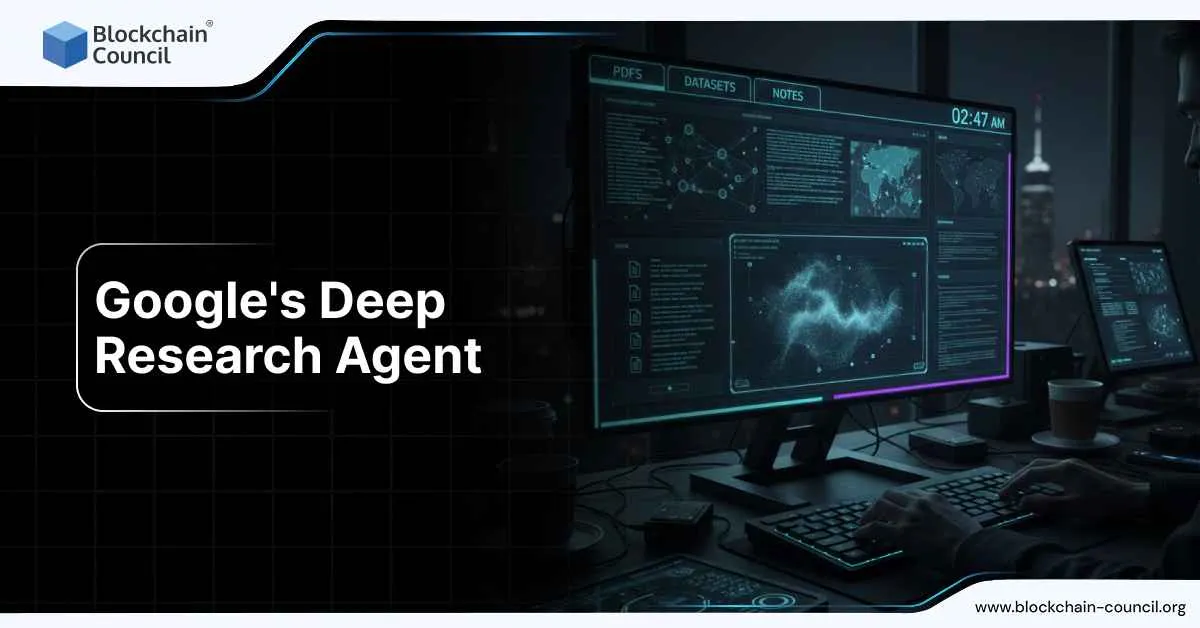
Google’s Deep Research Agent is designed for situations where quick answers are not enough. It is built to handle long, multi-step research tasks that require planning, iteration, and synthesis across many sources. Instead of returning an immediate response, the agent behaves more like a research analyst that can explore a topic, identify gaps, refine its approach, and then produce a structured report.
The rise of tools like this reflects a broader shift in how professionals use AI for serious work. Understanding how advanced models reason, search, and synthesize information has become increasingly important, which is why many practitioners strengthen their fundamentals through programs such as the AI Certification to better grasp how these systems operate under the hood.

What the Deep Research Agent Is
Google’s Deep Research Agent is an autonomous research system built on the Gemini model family. It is designed to carry out complex research workflows that can span minutes rather than seconds. The agent can break a large question into sub-tasks, search across multiple sources, read and evaluate information, and then compile its findings into a coherent, long-form output.
Unlike conversational assistants, this agent does not aim to respond instantly. It runs asynchronously, allowing it to revisit sources, refine its understanding, and produce more reliable results for tasks such as market analysis, competitive intelligence, policy research, or technical due diligence.
How It Works in Practice
The agent operates through a planning-and-execution loop. First, it creates a research plan based on the user’s request. Then it performs iterative searches, reads documents, and checks for missing context. Only after this process does it synthesize the final output.
Google has positioned this system as an “analyst-style” tool rather than a chat interface. The goal is depth and structure. For example, a single research run can involve dozens of searches and document reads before the final report is generated.
This approach reduces superficial answers and improves consistency, especially for topics that require careful comparison or historical context.
Gemini Models and Agent Architecture
As of 15 December 2025, Google confirmed that the Deep Research Agent is powered by Gemini 3 Pro, an upgraded reasoning model optimized for long-context understanding and multi-step planning. This upgrade improved the agent’s ability to track sources, manage complex prompts, and maintain coherence across lengthy outputs.
The agent is accessible through Google’s Interactions API, which allows developers to embed deep research capabilities into their own tools and workflows. It also integrates with Google AI Studio, making it easier to experiment with agent-driven research tasks.
From a technical perspective, this architecture combines large language models with orchestration logic that decides when to search, when to read, and when to synthesize.
Integration Across Google Products
Google has been steadily expanding where Deep Research appears. By 8 December 2025, Google announced deeper integration of Gemini Deep Research into Workspace tools such as Gmail, Drive, and Chat. This allows the agent to incorporate a user’s own documents and communications as context when generating research reports.
This is particularly useful for internal research, where external sources need to be combined with proprietary data. The agent can scan relevant files, extract key points, and blend them with public information in a single report.
There have also been strong signals that Deep Research will become more visible inside consumer-facing Gemini experiences, blurring the line between productivity tools and research assistants.
Developer Access and Use Cases
Developers can access Deep Research through Google’s APIs to build custom research workflows. Common use cases include:
- Market and competitive analysis for strategy teams
- Scientific and technical literature reviews
- Policy and regulatory research
- Due diligence and background analysis
Because the agent can operate autonomously for extended periods, it is well suited to tasks that would normally require hours of manual research.
Building and deploying such systems requires a solid understanding of platforms, APIs, and data pipelines. Many developers and technical teams approach this through structured learning paths such as the Tech Certification to strengthen their ability to design and integrate complex AI-driven systems.
Accuracy, Reliability, and Guardrails
One of Google’s stated goals with the Deep Research Agent is to reduce hallucinations and shallow synthesis. By forcing the system to plan, search, and verify before writing, the agent is less likely to rely on unsupported assumptions.
Google has also emphasized guardrails around source evaluation and transparency. While the agent can work autonomously, it is designed to make its reasoning and structure clearer to users, especially in professional settings where trust and traceability matter.
Benchmarks released alongside the December 2025 upgrade showed improved performance on long-context reasoning and multi-source synthesis tasks compared to earlier Gemini-based tools.
Why This Matters for Professionals
The introduction of Google’s Deep Research Agent signals a shift in how AI is used for knowledge work. Instead of acting as a fast answer engine, AI is moving toward the role of a research collaborator that can handle complexity and depth.
For organizations, this changes how research teams operate. Time spent gathering and summarizing information can be reduced, allowing experts to focus on judgment and decision-making instead.
From a business perspective, adopting such tools requires aligning technology capabilities with workflow design, compliance, and strategic goals. That alignment is often guided by frameworks like the Marketing and Business Certification, which help leaders connect advanced technology adoption with real-world business outcomes.
The Broader Direction of AI Research Tools
Google’s Deep Research Agent is part of a wider movement toward agentic AI systems. These systems do not just generate text. They plan, act, and adapt based on feedback and context.
As more organizations experiment with these tools in 2026 and beyond, the distinction between research, analysis, and execution will continue to blur. The tools themselves will not replace expertise, but they will change how expertise is applied.
In that sense, Google’s Deep Research Agent is less about replacing human researchers and more about redefining what effective research looks like in an AI-assisted world.