
Google ADK

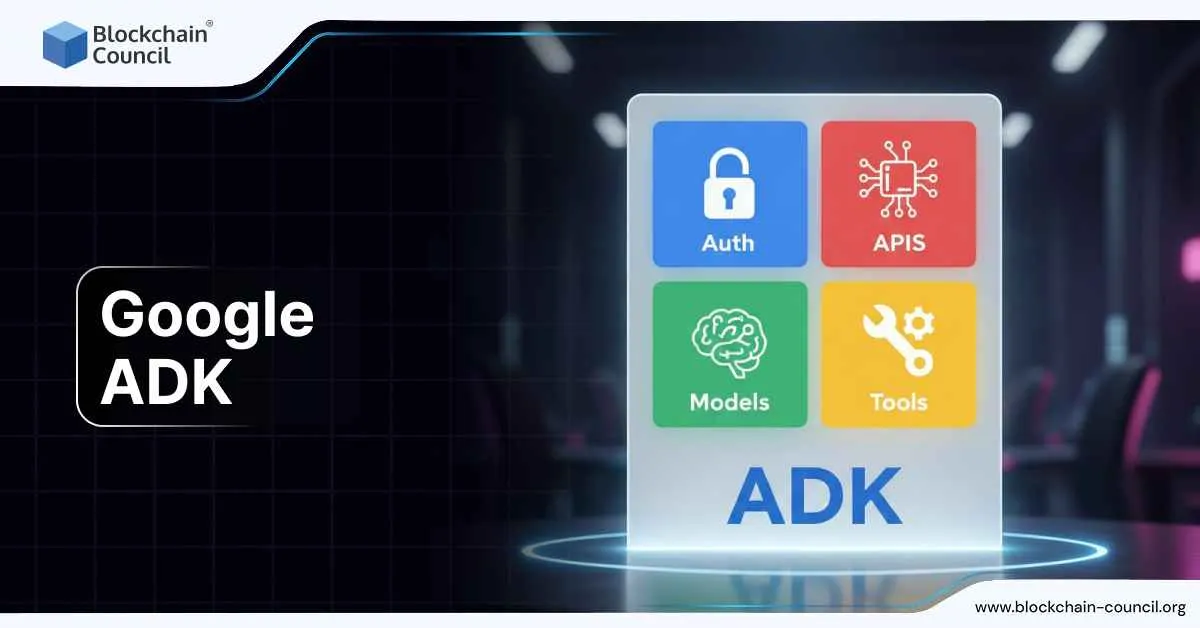
Google’s Agent Development Kit, known as Google ADK, has quickly become one of the most important tools for anyone building advanced AI systems. It is not a simple prompt framework or a playground for experiments. It is a full engineering kit designed for building complex, reliable and production ready agents. These agents can coordinate with tools, other agents and external services, all while maintaining state, memory and structured workflows. For professionals exploring how modern agent systems work, programs like the AI certification offer a strong foundation in how AI reasoning, tool usage and structured intelligence combine. Developers who want to go even deeper into multi agent collaboration can explore advanced pathways such as the Agentic AI certification since agentic systems are becoming the next frontier of applied AI.
Google ADK is powerful because it moves AI development into a familiar engineering structure. Instead of building one huge prompt that tries to do everything, you break your system into agents, tools and workflows. Each piece is modular, testable and easy to maintain. This shift allows businesses to treat AI systems like real software applications.
What Google ADK Actually Is
Google ADK is an open source framework that helps developers build single agents or entire multi agent ecosystems. It is model agnostic, so it works with Gemini models as well as other large language models through connectors. It is also deployment agnostic. You can run ADK on a laptop, in your own cloud servers or inside Vertex AI’s managed Agent Engine.
ADK is not a chatbot toolkit. It is a full stack approach to designing agents that can think, remember, reason, act and collaborate. With ADK you can design an agent that solves a research problem, another agent that analyzes data and a third agent that calls APIs or interacts with your internal systems. Then you can create a workflow that connects all of them into a single coordinated pipeline.
How ADK Works Under the Hood
Agents
An agent in ADK can:
- Receive a user query
- Interpret the query using an LLM
- Call tools to gather information or perform actions
- Maintain short term and long term memory
- Collaborate with other agents in a sequence or parallel workflow
Each agent has its own role or specialty. One might be a summarizer agent, a second might handle research and a third might handle data extraction.
Tools
Tools give agents real world power. A tool can be:
- A function in your code
- An external API
- A database query
- A knowledge retrieval service
- A cloud product such as Gmail, Drive, GitHub or Kubernetes through OpenAPI integration
Tools allow an agent to go beyond text reasoning. For example, an agent can call a tool to check the status of a server, pull financial data, execute code or retrieve documents. This breaks the limits of purely text based models.
Workflows
Workflows define how agents work together. ADK includes primitives for:
- Sequential flows
- Parallel branches
- Loops and retries
- Conditional routing
- Multi agent orchestration
Because of these workflows, you can design systems where agents divide tasks among themselves. One agent can extract data, another can process it and another can summarize the results. This makes ADK ideal for research agents, automation pipelines and enterprise scale intelligence systems.
Memory and State
Memory is one of the most important features of ADK. It separates memory into two types:
- State: Temporary information your agent needs for the current task
- MemoryService: Long term memory that persists across sessions
This separation makes agents more reliable. They do not lose context, and they do not overload the prompt window with irrelevant information. Developers can store user preferences, project details or knowledge chunks that the agent can recall later.
Multi Language Support
ADK supports:
This is helpful for enterprise teams that use Java or Go in production. The agent logic remains consistent across all languages.
Deployment Flexibility
ADK can run:
- Locally
- In Docker containers
- In Kubernetes
- In Vertex AI’s managed Agent Engine
Enterprises can start local and then move into a full production environment without rewriting their agent code.
Why ADK Matters
Agents Are Becoming the Next Evolution of AI
LLMs started as chatbots, grew into copilots and now are becoming autonomous agents. ADK gives developers the structure to build real agentic systems instead of disconnected prompts. With growing interest in agentic intelligence, certifications like the Agentic AI certification help teams understand how these multi agent ecosystems behave.
ADK Makes AI Development Feel Like Software Engineering
Prompts are powerful, but they are not scalable. ADK introduces modules, version control, unit testing and clean architecture. This makes it easier for teams to maintain, audit and improve AI systems.
Enterprise Adoption
Companies want reliable systems, not experiments. ADK helps:
- Ensure predictable agent behavior
- Separate logic into modules
- Enforce tool contracts
- Support monitoring and observability
This makes ADK attractive for customer support, devops automation, research workflows and enterprise knowledge systems.
Integration With Google Cloud
ADK plugs into Google’s ecosystem:
- Vertex AI
- BigQuery
- Cloud Functions
- Cloud Run
- Agent Engine
Organizations that already use Google Cloud can build deeply integrated agent systems. Teams exploring how these integrations work often benefit from foundational training such as the Tech certification to understand the underlying infrastructure.
Real Use Cases Emerging From ADK
Deep Research Agents
These agents can generate queries, gather data, filter sources, extract insights and synthesize findings. Multiple agents work together to reduce hallucinations and verify information.
Developer Tools and Automation
Agents that use GitHub or Kubernetes OpenAPI tools can:
- Create issues
- Analyze repositories
- Manage deployments
- Monitor clusters
This pushes AI into real engineering workflows.
Customer Support Automation
Agents can pull data from CRM tools, summarize customer history, analyze sentiment and provide recommended responses.
Lead Generation and Market Intelligence
Multi agent systems can browse websites, extract structured data, classify leads, prioritize opportunities and prepare reports.
Education and Tutoring
Agents can track student progress, store long term learning data and personalize explanations.
Strengths of Google ADK
- Clear architecture
- Reusable modules
- Strong memory system
- Multi agent orchestration
- Deep tool integration
- Production scalability through Vertex AI
- Support for multiple programming languages
These strengths make ADK one of the most complete frameworks for enterprise agent systems.
Limitations and Challenges
- Best suited for teams already using Google Cloud
- More complex than simple prompt engineering
- Requires engineering discipline
- Not ideal for quick hobby experiments
- Multi agent coordination can become expensive in production
Still, for teams that need reliability and scale, the trade offs are worth it.
The Future of ADK and Agentic Systems
Google is positioning ADK as the foundation for future AI systems. The shift toward agentic design is clear. Instead of one model trying to do everything, multiple specialized agents cooperate to solve complex tasks. As this structure grows, businesses will need strategic frameworks to evaluate workflows, customer impact and market positioning. Programs like the Marketing and business certification help teams understand how to communicate AI capabilities, build adoption strategies and align agent driven products with customer needs.
Conclusion
Google ADK represents a major step in AI development. It turns large language models into real-world agents capable of performing tasks, collaborating with other agents, using tools, remembering information and running at enterprise scale. By moving away from monolithic prompts and toward structured agent ecosystems, AI development becomes more reliable, modular and production ready. With the rise of agentic AI, frameworks like ADK will shape how businesses build automation, research systems, assistants and intelligent workflows.