Gen AI vs AI Agents vs Agentic AI

The AI landscape is evolving at a speed that even seasoned professionals find difficult to keep up with. New models appear almost weekly, new capabilities unlock every quarter, and entire workflows that once needed teams of people are now powered by autonomous systems. Inside this rapid evolution, three terms create the most confusion: Gen AI, AI agents, and agentic AI. They appear related, yet they represent completely different capabilities.
This comparison matters for anyone building real world AI workflows. When companies try adopting these tools without knowing how each one behaves, they end up with fragile chains, expensive prompts, and disappointing automation. Teams that want to understand these distinctions more deeply often explore an AI Certification to gain a strong foundation in how these systems function. You can also go with an Agentic AI program.

This article explains what each category does, how they differ, and when each one fits into modern production environments.
Gen AI vs AI Agents vs Agentic AI: Why the Distinction Matters
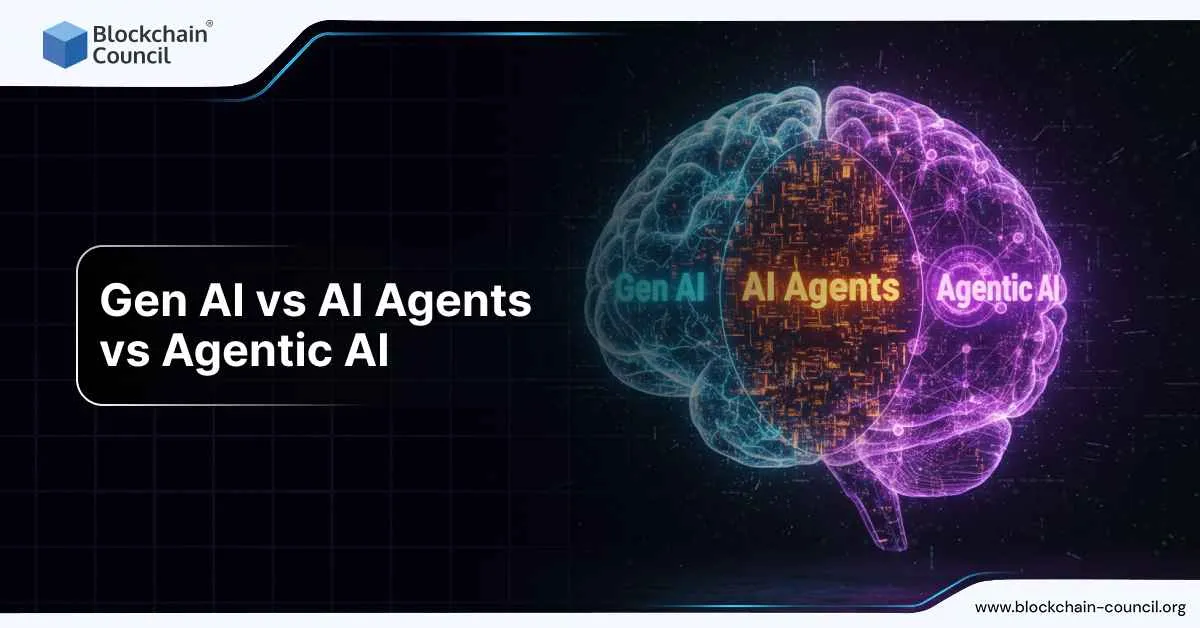
There has never been a single type of AI suitable for every workflow. Generative AI is powerful at creating text and images, but it struggles with planning or multi step goals. AI agents extend the model by giving it tools and structure. Agentic AI goes even further by giving systems autonomy, memory, reflection, and the ability to complete tasks without supervision.
The Rise of Three AI Categories
These three categories emerged because businesses needed different layers of intelligence. A single generative model is great for content and conversation. An agent is better for tasks. An agentic system is needed for real operations at scale.
Why Teams Struggle Without This Understanding
Most failed automation attempts happen when teams assume Gen AI alone can act like an autonomous system. Without planning, tool access, or memory, Gen AI becomes unpredictable. AI agents and agentic systems solve these gaps with structure and autonomy.
What Is Gen AI and What Can It Do Today
Generative AI models produce text, images, audio, and structured responses based on patterns. They excel at creativity and language, but they cannot independently plan multi step tasks. They react to prompts rather than initiate decisions.
Strengths of Generative AI
Gen AI shines in roles like writing, summarization, brainstorming, research guidance, and content creation. It responds quickly and delivers high quality outputs when prompts are clear. For learners who want to master prompt structure itself, a prompt engineer course helps unlock better results.
Limitations of Gen AI
The model does not remember previous tasks unless explicitly told. It cannot monitor goals. It does not coordinate tools unless you wrap it inside a system. These limitations paved the way for AI agents.
How AI Agents Extend the Power of Generative Models
AI agents are systems built on top of generative models. They follow instructions, call tools, interact with APIs, retrieve data, and perform tasks step by step. They understand goals, not just immediate prompts.
What Makes an AI Agent Different From Gen AI
An agent can:
- Break goals into tasks
- Use tools like databases, browsers, calculators, or email clients
- Maintain internal steps during execution
- Decide what action to perform next
- Return results shaped by external data
Gen AI cannot do any of these without additional logic.
Use Cases Where AI Agents Excel
Agents work well in customer support automation, scheduling, email triage, research tasks, report generation, and multi step workflows. Developers who want to build robust agent architectures benefit from an AI coding course that teaches the engineering behind these systems.
What Is Agentic AI and Why It Represents the Next Leap
Agentic AI goes one level beyond agents. It introduces autonomy. These systems are built to pursue goals, monitor progress, self correct, reason, and make decisions with minimal human involvement.
Key Capabilities of Agentic AI
Agentic AI includes:
- Long term memory
- Real time feedback loops
- Planning and re planning
- Reflection and self improvement
- Ability to pursue objectives across sessions
- Multi agent collaboration
- Environment interaction
This is closer to how humans approach tasks. It is not simple prompting. It is not just tool calling. It is continuous goal driven behavior.
Where Agentic AI Fits in Production
Agentic AI is ideal for operations, analytics monitoring, autonomous research, data pipelines, and background workflows that run without human triggers. These systems are complex to design, which is why professionals invest in advanced programs such as a Tech Certification to understand these architectures fully.
Gen AI vs AI Agents vs Agentic AI: Practical Examples
Comparing all three becomes easier through real examples.
Example: Drafting a Report
- Gen AI writes a clean draft.
- An AI agent gathers live data, checks sources, updates charts, and formats the report.
- Agentic AI monitors business metrics daily, identifies trends, predicts issues, and generates reports without being asked.
Example: Automating Customer Support
- Gen AI replies to messages.
- An AI agent retrieves order data, checks shipping systems, and processes returns.
- Agentic AI identifies recurring issues, updates internal documentation, and suggests workflow improvements.
Example: Running an Analytics Pipeline
- Gen AI summarizes the dataset.
- An AI agent extracts the data, filters it, and performs actions.
- Agentic AI manages the whole system, detects anomalies, runs forecasts, and alerts teams.
Strengths and Weaknesses of Each AI Approach
Understanding both advantages and limitations helps companies avoid mismatched expectations.
Strengths of Gen AI
- Creative reasoning
- Natural language fluency
- Fast idea generation
- Best choice for conversational tasks
Weaknesses of Gen AI
- No memory
- No tool access
- No planning
- Cannot work autonomously
Strengths of AI Agents
- Multi step reasoning
- Tool and API access
- Structured workflows
- Better for consistent results
Weaknesses of AI Agents
- Dependent on the quality of tools
- Requires careful testing
- Can still get stuck in loops without guardrails
Strengths of Agentic AI
- Autonomous decisions
- Continuous learning
- Real time adaptation
- Best for large scale operations
Weaknesses of Agentic AI
- Complex to design
- Requires strong safety checks
- Needs governance at scale
These tradeoffs shape how enterprises adopt each layer of intelligence. Business leaders exploring where AI fits into their operations often choose a Marketing and business certification to understand the strategic impact of these technologies.
How These Three AI Categories Fit Inside Real Workflows
In modern systems, all three categories can coexist. They complement each other.
The Role of Gen AI
Gen AI serves as the creative and linguistic engine. It produces the raw content, ideas, insights, and explanations.
The Role of AI Agents
Agents orchestrate actions. They decide what to do next, call tools, and process structured tasks based on inputs.
The Role of Agentic AI
Agentic AI oversees goals. It acts as the autonomous controller that monitors outcomes, drives improvements, and adapts workflows dynamically.
Choosing Between Gen AI, AI Agents, and Agentic AI
There is no single best category. The right choice depends on the workflow.
Choose Gen AI When
- You need content
- You need conversation
- You need quick answers
- Creativity matters more than precision
Choose AI Agents When
- You need repeatable steps
- You need tool usage
- You need structured tasks
Choose Agentic AI When
- You need autonomous systems
- You need operations running without requests
- You need continuous monitoring or long term goals
The Future of AI Autonomy and Multi Agent Systems
AI is shifting from isolated prompts to entire societies of agents working together. Gen AI fuels the reasoning. AI agents bring structure. Agentic AI introduces decision making and persistence. Together, they form the architecture of next generation intelligent systems.
The real unlock will happen when companies combine all three layers in a single workflow. This is how AI becomes reliable, scalable, and production ready.
Final Verdict
Gen AI vs AI Agents vs Agentic AI is not a competition. It is a spectrum. Gen AI creates. AI agents execute. Agentic AI advances toward autonomy. The companies that understand these differences will build systems that are more stable, more efficient, and far more capable than those depending on a single model or tool.