
Explainable AI Systems
 Michael Willson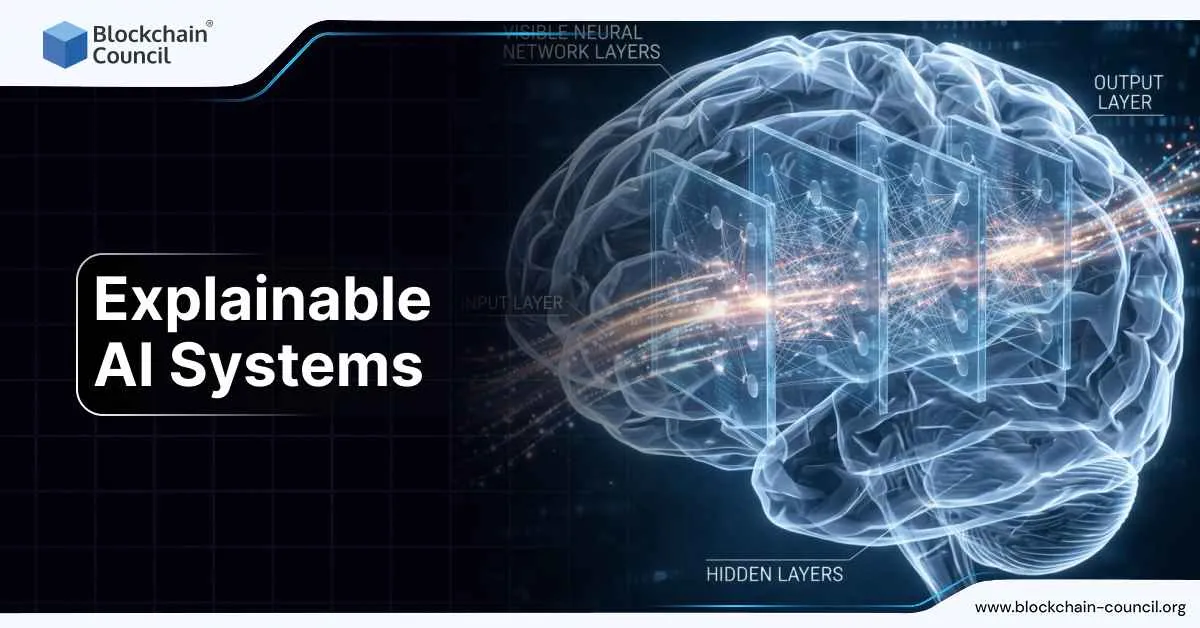
Ai Systems
Explainable AI systems are AI models and decision tools designed so humans can understand how and why they produce a result. In simple terms, they do not just output an answer, score, or prediction. They also provide reasons, signals, or evidence that help users interpret the outcome. This matters because many AI systems now influence hiring, lending, healthcare triage, insurance pricing, fraud detection, and customer support. When a system affects people in high-impact settings, “the model said so” is not good enough anymore.
The need for explainability is also reflected in policy and governance. The EU AI Act emphasizes transparency and a risk-based approach, and the European Commission explicitly notes that AI decisions can be difficult to understand in contexts such as hiring and benefits. International frameworks also reinforce this direction, including OECD principles on transparency and explainability and UNESCO guidance calling for auditable and traceable AI systems.
AI Systems and its Types
Explainability supports trust, accountability, and better decisions. If a bank uses AI to reject a loan application, the applicant and the bank both benefit from knowing which factors contributed to the result. If a hospital uses AI to flag sepsis risk, clinicians need to know whether the alert is linked to clinically relevant signals or to noisy correlations.
It also helps teams improve model quality. Explanations can reveal hidden bias, data leakage, unstable behavior, or reliance on irrelevant features. For example, an image classifier might appear highly accurate during testing but actually base predictions on background patterns instead of the object itself. An explainability review can expose that issue before deployment, saving money and embarrassment, which is more than many enterprise projects can claim.
Core Types of Explainability
Global Explanations
Global explainability describes how a model behaves overall. It answers questions like: Which features generally matter most? What patterns does the model learn across the full dataset? What kinds of inputs lead to higher or lower risk scores?
This is useful for model validation, governance reviews, and executive oversight. It is especially important in regulated domains where organizations must document system behavior and limitations.
Local Explanations
Local explainability focuses on one prediction at a time. It explains why a specific transaction was flagged as fraud or why a specific patient received a high-risk score. Local explanations are often what business users need in daily operations.
For example, a fraud analyst may see that a transaction was flagged because of an unusual device, location mismatch, and rapid spending pattern. That is much more actionable than a generic “high risk” label.
Intrinsic vs Post-Hoc Explanations
Some models are naturally interpretable, such as decision trees, linear regression, and rule-based systems. Others, like deep neural networks and complex ensembles, are harder to understand directly. For these, teams often use post-hoc techniques that explain behavior after the model has made a prediction.
Both approaches have value. In some settings, a slightly less accurate but clearer model is the right choice. In other cases, a complex model is necessary, and strong post-hoc explainability becomes the practical compromise.
Common Methods Used Today
SHAP
SHAP is one of the most widely used explainability methods. The SHAP documentation describes it as a game-theoretic approach that explains model output using Shapley values. It is popular because it works across many model types and can produce both local and global insights.
In practice, data teams use SHAP plots to show which features push a prediction higher or lower. For example, in credit risk scoring, income stability may decrease risk while recent delinquencies increase it.
LIME
LIME is another widely used model-agnostic method. The LIME project explains that it can help explain predictions of black box classifiers, assuming the model can output probabilities. LIME builds a simpler local surrogate model around a single prediction, making it easier to interpret that result.
This can be helpful in text classification, such as showing which words most influenced a spam detection outcome.
Model Cards and Documentation
Explainability is not only about math and plots. Documentation matters too. Google’s model card framework was introduced to encourage transparent model reporting, including intended use, evaluation context, and subgroup performance. Model cards are now a common best practice in responsible AI programs.
A strong explainable AI system often combines technical explanations with clear documentation, usage boundaries, and human oversight procedures.
Real-World Examples
Healthcare Decision Support
A hospital using AI to prioritize radiology scans can improve workflow, but clinicians need confidence in the system. Explainable AI can highlight which image regions or patient variables influenced a prioritization score. This does not replace medical judgment, but it gives doctors a way to challenge and verify the recommendation.
Banking and Lending
Financial institutions increasingly use AI for credit scoring and fraud detection. Explainability helps banks justify decisions to regulators and customers, identify biased outcomes, and improve internal governance. It also supports faster case review by analysts who need reasons, not just risk scores.
Manufacturing and Predictive Maintenance
Factories use AI to predict equipment failures. An explainable system might show that a risk alert is driven by abnormal vibration patterns, temperature spikes, and maintenance history. Engineers can then act earlier and target the likely cause instead of checking everything at once, which is how most maintenance budgets disappear.
Recent Developments in Explainable AI
The biggest recent development is that explainability is moving from a “nice-to-have” data science feature to a governance requirement in many AI programs. The EU AI Act, now part of the regulatory baseline in Europe, reinforces transparency and risk-based controls, while ongoing implementation work and related guidance continue to shape expectations for providers and deployers.
Another major trend is explainability for generative AI. NIST published a Generative AI Profile as a companion resource to the AI Risk Management Framework, specifically addressing risks that are novel to or worsened by generative AI and offering actions across governance, mapping, measurement, and management. This is important because explaining a large language model response is different from explaining a tabular risk score. Teams now need layered explanations, system documentation, and usage controls rather than a single feature-importance chart.
Skills and Certifications for Professionals
As explainable AI becomes central to trustworthy AI programs, professionals are building cross-domain skills. An AI certificate can help practitioners learn model development, evaluation, and responsible deployment practices. For teams working in Web3 and data integrity contexts, a Blockchain certificate may complement AI knowledge by supporting traceability and audit-friendly workflows. These are all part of a broader Tech Certification path for modern digital roles.
There is also growing demand for explainability outside engineering. Product managers, compliance professionals, and growth teams benefit from a Marketing Certification or business-focused credential when communicating AI decisions, customer disclosures, and trust messaging clearly.
If readers want structured training options, they can explore programs and resources from Blockchain Council, Global Tech Council, and Universal Business Council. For a domain-specific example, the Certified Artificial Intelligence (AI) Expert® program is one route for learners seeking an AI-focused credential.
Best Practices for Building Explainable AI Systems
Keep explanations audience-specific. A data scientist, regulator, customer service agent, and end user do not need the same level of detail.
Document intended use and limits. Explainability is weak if users do not know where the model should and should not be applied.
Validate explanations. Not every explanation method is reliable in every context. Teams should test consistency and usefulness, not just generate charts.
Combine human oversight with automation. UNESCO’s guidance on auditability, traceability, and oversight is a useful reminder that explainability supports human responsibility, not its removal.
Conclusion
Explainable AI systems are no longer optional in modern AI deployment. As AI tools influence decisions in finance, healthcare, manufacturing, and customer-facing services, organizations must ensure that outputs are understandable, verifiable, and aligned with human oversight. Explainability improves trust, supports compliance, and helps teams detect bias, errors, and weak model behavior before they create real-world harm.
From methods like SHAP and LIME to governance practices such as model documentation and risk controls, explainable AI combines technical and operational discipline. It also plays a growing role in generative AI, where transparency and accountability are becoming even more important.