The Ethics of Autonomous Investment Systems


What Are Autonomous Investment Systems and Why Do Ethics Matter Now?
Autonomous investment systems are software platforms and algorithms that handle investment decisions, trade execution, portfolio rebalancing, or advisory actions with minimal human oversight. They can deploy machine learning, reinforcement learning, or other artificial intelligence methods in securities markets, crypto markets, or hybrid asset classes.
In 2024 and 2025 the ethical dimension of these systems has become central because regulators, investors, and institutions increasingly rely on machines for decisions that once required human judgement. The shift raises questions of accountability, fairness, transparency, and systemic risk that were less visible when humans made nearly all decisions.

If you want to understand how the mechanics of intelligent algorithms and regulatory expectations align, starting with an AI certification is a strong first step.
How Do Autonomous Investment Systems Work?
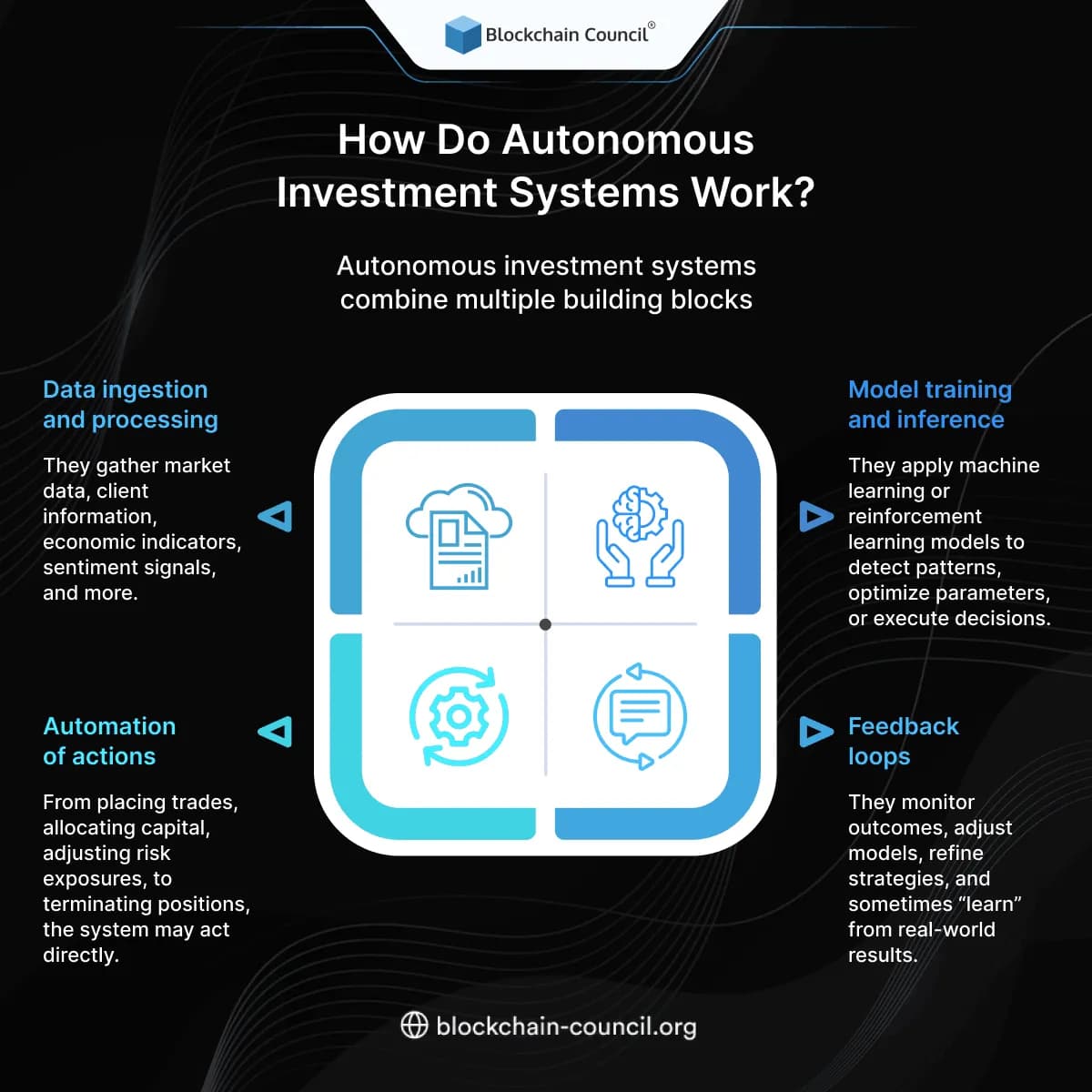
Autonomous investment systems combine multiple building blocks:
- Data ingestion and processing: They gather market data, client information, economic indicators, sentiment signals, and more.
- Model training and inference: They apply machine-learning or reinforcement-learning models to detect patterns, optimize parameters, or execute decisions.
- Automation of actions: From placing trades, allocating capital, adjusting risk exposures, to terminating positions, the system may act directly.
- Feedback loops: They monitor outcomes, adjust models, refine strategies, and sometimes “learn” from real-world results.
Because these systems operate at machine speed, they introduce new dimensions of scale, complexity, and risk. Ethical oversight becomes crucial when automation touches real money, clients’ portfolios, and market behavior.
What Ethical Risks Arise From Autonomous Investing?
Several interlinked risks stand out when machines manage investments.
1. Explainability and Accountability
When an automated strategy causes losses, who is responsible—the designer, the vendor, the model, or the investment firm? Algorithms can be opaque and decisions difficult to trace. A key ethical requirement is to provide understandable explanations of how decisions were made.
2. Conflicts of Interest and Fiduciary Duty
If an autonomous system is optimized to maximize platform revenue rather than individual client outcomes, it may conflict with fiduciary duty. Algorithms may route orders to providers from which the firm benefits, or favor internal liquidity. Ethical systems must align objectives with client welfare.
3. Fairness and Bias
Training data may embed bias—historical data might reflect inequities or unfair patterns. Autonomous systems may perpetuate discrimination in investment access, credit allocation, or pricing. Responsible design must consider fairness across client segments.
4. Herding and Model Monoculture
If many firms use similar models or shared data vendors, strategies may converge. That increases systemic risk: many firms reacting identically can amplify market shocks. Regulators flag this risk as concentration risk for financial stability.
5. Surveillance, Privacy, and Data Rights
Autonomous investment systems often rely on large volumes of personal or behavioral data. Users may not know how their data is used or how decisions are made. Ethical design must include consent, data minimization, transparency, and protection.
6. Market Integrity and Manipulation
Automated systems may engage in practices that appear fair but create hidden harms—such as algorithmic collusion, exploitative order routing, or front-running. A 2025 study found AI trading bots can coordinate implicitly and drive up costs for retail investors.
Which Regulations Are Emerging Around AI in Investment Systems?
Regulatory Frameworks
- The EU Artificial intelligence Act entered into force on 1 August 2024 in many respects and lays down obligations including for high-risk AI systems in financial services.
- The Organization for Economic Co‑operation and Development (OECD) reviewed regulatory approaches across 49 jurisdictions in 2024 and found many jurisdictions rely on existing finance laws, but gaps remain for AI-specific issues.
- In the United States, the U.S. Department of the Treasury published a December 2024 report on AI in financial services that emphasizes risk management frameworks, third-party oversight, and periodic reevaluation of AI systems.
- Financial authorities emphasize that human boards remain responsible even when decisions are made by AI systems. For example, the European Securities and Markets Authority (ESMA) said management must understand AI use and remain accountable.
Key Requirements for Autonomous Systems
- Human-in-the-loop control or human oversight mechanisms.
- Model documentation, auditability, and traceability.
- Governance over third-party model providers and data vendors.
- Transparency obligations to clients about how systems operate.
- Monitoring, testing, and validation across deployment life-cycles.
- Focus on data quality, model risk, resilience, concentration risk, and market integrity.
How Should Firms Design Ethical Autonomous Investment Systems?
Here is a practical checklist for firms building or deploying autonomous investment platforms:
Purpose and Objective Clarity
- Define clearly whose interests the system serves (clients, firm, both).
- Encode objective functions aligned with client welfare, not just profit.
- Document the purpose and guardrails at design stage.
Data Governance and Fairness
- Ensure datasets are representative, unbiased, and updated regularly.
- Apply fairness testing across client segments (age, income, region, background).
- Secure client data, obtain consent, and keep usage transparent.
Explainability and Auditability
- Use interpretable models when possible or add explanation layers for complex models.
- Retain logs of decisions, inputs, and outputs for audit trails.
- Allow human review and manual override of decisions.
Governance and Oversight
- Establish independent model risk teams and red-team simulations.
- Manage vendor risks and avoid over-reliance on a single provider (monoculture risk).
- Create escalation protocols for model failure or market disruption.
Fail-Safe Mechanisms
- Include kill switches to halt autonomous actions during abnormal conditions (market flash, data feed failure).
- Use throttles and limiters on risk exposures, leverage, or execution speed.
- Transition protocols into safe fallback mode if data or connectivity is compromised.
Client Transparency and Consent
- Provide plain-language disclosures of how systems work, main risks, and limitations.
- Offer client opt-out or exemption mechanisms for automated decisions.
- Report performance of systems in client-facing terms and highlight model changes.
Continuous Monitoring and Adjustment
- Run back-testing, scenario-analysis, and stress-testing regularly.
- Track metrics like drift, bias changes, performance deviation, unexplained outcomes.
- Adjust models proactively and document updates.
Ethical Culture
- Train teams on ethics, bias awareness, and safety-by-design principles.
- Promulgate an organizational culture where automation does not replace critical human judgement.
What Have We Learned From Past Failures?
The 2010 Flash Crash
The joint CFTC-SEC 2010 report on the Flash Crash highlights how automated trading, fragmented liquidity and rapid algorithmic responses caused extreme intra-day dislocations. SSRN
Key lessons:
- Need for circuit breakers and kill switches.
- Importance of stress-testing and monitoring algorithms.
- The cost of ignoring human oversight and model resilience.
The 2012 Knight Capital Case
In 2012, a trading error triggered by flawed software caused over $440 million in losses within minutes.
Take-aways:
- Deployment mistakes in complex automation systems can cascade fast.
- Strong governance and rollback mechanisms are essential.
Recent AI Collusion Findings
A 2025 study found that AI trading bots can independently produce collusive behaviour, raising costs for everyday investors and reducing competition. This underscores the need for monitoring not only single models, but how fleets of models interact across firms.
What Ethical Dilemmas Are Emerging as Systems Mature?
Autonomy versus Control
How much autonomy should investment systems have? Greater autonomy boosts efficiency but reduces human oversight and raises accountability gaps.
Explainability versus Performance
Highly complex models (deep learning) may outperform simpler ones but offer less clarity. Firms must decide how much performance they trade for transparency.
Personalization versus Privacy
Tailoring strategies to clients improves outcomes but requires sensitive data. The balance between customization and data rights is crucial.
Innovation versus Stability
Rapid innovation can bring gains but also escalate systemic risk. Firms and regulators must weigh growth against resilience.
Profit versus Purpose
Autonomous systems must embed ethical values: client benefit, fairness, integrity—not just profit maximization.
How Can Professionals Prepare for Ethical Autonomous Systems?
- Build a foundational understanding of algorithmic systems, model risk, and governance.
- Consider pursuing a Data Science Certification to deepen analytical and ethical awareness.
- Track regulatory developments such as the EU AI Act, OECD guidance, and regional AI frameworks.
- Develop skills in interpretability, auditability, model-risk management, and vendor governance.
- Cultivate ethical judgement: separating what systems can do from what they should do.
What Role Does AI Play in Enabling Autonomous Investment Systems?
Autonomous investment systems are powered by artificial intelligence and machine learning. AI analyses large datasets, learns patterns, predicts outcomes, and executes automatically. As AI models evolve, they enable more sophisticated strategies, faster decisions and broader reach.
For professionals managing automation in finance, earning an AI certs credential helps clarify how models work, their risks and how to govern them effectively.
Important AI Governance Principles
Here is a list of governance principles tailored for autonomous investment systems:
- Human oversight: Senior management remains accountable for system actions.
- Model transparency: Decisions and logic should be auditable by both internal teams and regulators.
- Risk minimization: Systems must include controls for model drift, vendor failure, and systemic feedback loops.
- Fairness and inclusion: Model outcomes must be monitored for bias and discrimination.
- Data integrity: Data sources and feeds must be verified, fallbacks in place, and lineage traceable.
- Vendor management: Critical AI components from third parties must adhere to governance, vendor risk and auditability.
- Incident response: Any anomaly must trigger escalation, human review and, if needed, system suspension.
- Continuous review: Systems must evolve with markets, update modelling assumptions, and monitor real-world impacts.
Taking a structured approach to governance ensures that autonomous systems remain ethical, compliant and aligned with organizational values.
How Should Organizations Establish Ethical Frameworks?
Step 1: Define ethical purpose and values
Define key values: fairness, transparency, accountability, client benefit. Align design and objectives accordingly.
Step 2: Map system lifecycle
From design, procurement, model building, training, deployment, production monitoring, retirement. At each stage embed ethical checkpoints.
Step 3: Conduct ethical risk assessment
Evaluate risks such as bias, opacity, collusion, data misuse, vendor concentration. Prioritise high-impact areas.
Step 4: Build control architecture
Incorporate kill switches, throttles, human-in-loop review, transparency dashboards, audit logs, vendor oversight.
Step 5: Engage stakeholders
Include product teams, compliance, legal, risk, ethics, client advisory and external auditors. Governance must span across functions.
Step 6: Monitor and adjust
Track outcomes, drift, complaints, model degradation. Use feedback to adjust systems continually.
Step 7: Report and document
Maintain documentation of objectives, model changes, control enhancements, incidents, remediation actions. Regulators expect evidence of compliance and oversight.
What Are Practical Use Cases Where Ethics Matter?
Automated Trading Platforms
AI-powered trading platforms execute high-frequency strategies. Ethical issues: front-running, hidden preference routing, market manipulation.
Robo-Advisors
Autonomous advisory systems recommend portfolios. Ethical issues: suitability, transparency of fee structure, model bias, data privacy.
Algorithmic Credit and Investment Allocation
AI systems decide credit lines or investment allocations. Risks: discrimination, fairness, informational asymmetries, lack of recourse.
Fund-of-Funds Using AI
Funds rely on meta-models selecting sub-funds or strategies. Ethics: model opacity, concentration of risk, lack of diversification oversight.
Crypto and DeFi Autonomous Strategies
Decentralized finance platforms use autonomous vaults and bots. Ethical issues: code transparency, governance, risk of model drift, liquidity cascades.
What Does the Future Hold for Ethics in Autonomous Investing?
Hybrid Human-Machine Governance
Future systems will combine autonomous agents with human oversight. Humans will set purpose and boundaries, machines will execute.
Smart Regulation and Standards
Regulators are moving from technology-blind rules to AI-specific mandates. The EU AI Act sets a precedent. Firms must adopt compliance frameworks proactively.
Ethical Investment as Competitive Advantage
Firms that embed ethics may win client trust, improve retention, reduce litigation risk and gain reputational advantage. Studies show investment in AI ethics yields returns. arXiv
Proactive Systemic Risk Monitoring
Regulators and firms will monitor model herding, vendor concentration, and systemic feedback loops. Technology may shift from single-firm monitoring to ecosystem-wide oversight.
Transparency and Client Empowerment
Clients will demand more visibility into how systems operate, disclosures on models, and ability to challenge decisions. Thus explainability will become a core product feature.
Ethical AI and Autonomous Investing Education
Professionals will need new skills. For example, an Agentic AI certification† (note – you may need to check specifically) can help teams understand how autonomous agents operate, the governance required and ethical guardrails. (Note: Replace † with actual certificate link if available.)
Why Ethical Design Matters for Long-Term Success?
Ethics in autonomous investment systems is not merely about compliance—it is about trust, resilience and value creation. When systems act fairly, transparently and responsibly, they preserve investor confidence, avoid regulatory blowback, and reduce systemic risk. Poor ethics can lead to client harm, reputation damage, legal consequences and broader market dislocation.
For professionals looking to deepen their competency, explore Tech certifications that span AI governance, data ethics, model risk and digital asset management.
How Can Investors Protect Themselves When Dealing With Autonomous Systems?
As an investor or advisor interacting with autonomous investment systems, you should:
- Ask for disclosures on how the algorithm works, its objective function and how your data are used.
- Verify human-in-the-loop structures, oversight and escalation mechanisms.
- Confirm vendor governance and audit protocols if the system uses third-party models.
- Monitor performance, ask about model changes and request explanation of outcomes.
- Consider risk-averse approaches and diversification in case of model failure or systemic shocks.
What Are Key Questions to Ask When Evaluating an Autonomous Investment Platform?
- Does the system align its objectives with client interests or platform profit?
- How is data used, stored, protected and audited?
- What human oversight, kill switches or escalation procedures exist?
- How transparent are model decisions and how are clients informed?
- What controls prevent model herding, vendor lock-in or collusive behavior?
- What incident history, audit reports or governance documentation are available?
- How are biases tested, fairness monitored and inclusive outcomes ensured?
Conclusion: Ethics Are the Foundation of Autonomous Investing
Autonomous investment systems represent a profound shift in how finance is conducted. They offer speed, scale and efficiency—but they also introduce complexity, risk and the potential for unintended harm. Ethics provide the guardrails.
Designing systems with accountability, fairness, transparency and resilience is not optional—it is essential. Firms, regulators and professionals must work together to ensure that automation does not replace human values but enhances them.
In this context, autonomous investing succeeds not because machines replace humans, but because machines enable humans to act fairly, rationally and responsibly. The future of investment is not just algorithmic—it is ethical.