How Enterprises Scale L&D with AI Training Networks
 Michael Willson
Enterprises are turning to AI training networks to scale learning and development. The reason is clear: traditional L&D methods are too slow, too expensive, and not flexible enough for the pace of today’s business. AI makes training faster, more personalized, and easier to deliver across thousands of employees at once. It also helps companies close skills gaps and keep workers ready for the future.
For professionals who want to explore how AI shapes the future of learning, the AI Certification offers a strong starting point. It shows how AI is applied in practice, including in training and education systems.

This article explains how enterprises scale their L&D with AI, the main technologies involved, real-world examples, and the challenges that remain.
Why AI Training Networks Are Transforming L&D
AI training networks are systems that combine generative AI, adaptive learning, and enterprise platforms. They can create, deliver, and update learning content at scale. Companies use them to provide training that fits each employee’s role, pace, and learning style.
Instead of static modules that take weeks to design, AI can build interactive tutorials, role-specific guides, or immersive simulations in minutes. This saves time, reduces cost, and increases learner engagement.
Generative AI for Training Content
One of the biggest shifts is in how training content is made. Generative AI tools produce videos, simulations, and modules quickly. Enterprises report cutting costs by up to 70 percent and saving up to 90 percent of the time it usually takes to create training. Learner engagement improves too, often by more than 30 percent.
Retailers and global brands are using AI-generated content to train large, diverse teams in different locations. The result is consistent, high-quality learning delivered faster than ever.
Adaptive Learning at Scale
AI training networks also use adaptive learning. This means training programs adjust in real time to each learner’s strengths, weaknesses, and pace. An employee who struggles with a concept gets more practice, while someone who masters it quickly moves on.
Adaptive learning improves retention because employees get training that feels relevant. It also helps organizations make sure employees are job-ready, not just trained on theory.
Enterprise Platforms for AI-Driven Training
Large organizations need platforms that can handle training at scale. AI-powered enterprise L&D platforms manage content delivery, track progress, and automate updates. This allows learning teams to shift from spending time on manual tasks to focusing on strategy.
These platforms connect with HR systems, performance management tools, and even project dashboards. They help align training directly with business goals.
Closing Skills Gaps with AI
Skill gaps are one of the biggest challenges for enterprises. Many L&D leaders say the slow pace of AI adoption makes these gaps worse. To solve this, more than half of organizations now train non-technical teams in AI.
Customer service, HR, and operations staff are learning how to use AI tools in daily work. This widens adoption and makes businesses more efficient. It also ensures that employees at every level understand how AI fits into their role.
Real-World Examples of AI in L&D
Several companies are already scaling training with AI:
- Indeed launched AI training programs with tutorials and role-specific learning. Developers now generate about one-third of their code with AI, compared to only 7 percent before training. Employees set goals, learn by doing, and track productivity gains.
- Pharmaceutical companies like J&J, Merck, and Eli Lilly have built large-scale AI literacy programs. These programs are mandatory, immersive, and expected to save billions. Many senior leaders have AI Certifications.
- Johnson & Johnson and DHL use AI tools to assess skills and plan training. Bank of America has introduced AI-made simulations that allow safe practice for customer-facing teams.
These examples show how industries as different as tech, pharma, logistics, and finance are adopting AI training networks.
Scaling L&D with AI Training Networks
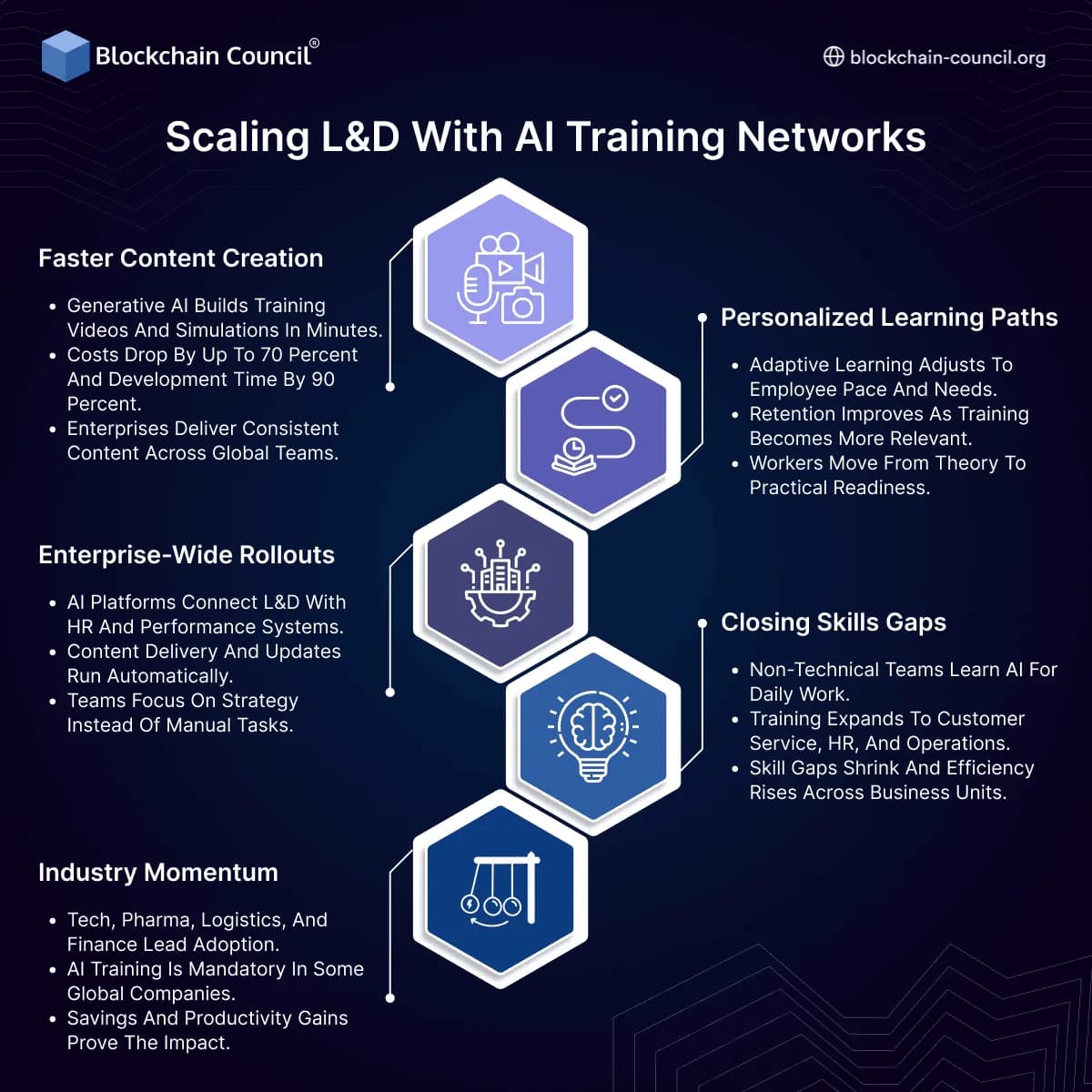
Faster Content Creation
Generative AI builds training videos and simulations in minutes.
Costs drop by up to 70 percent and development time by 90 percent.
Enterprises deliver consistent content across global teams.
Personalized Learning Paths
Adaptive learning adjusts to employee pace and needs.
Retention improves as training becomes more relevant.
Workers move from theory to practical readiness.
Enterprise-Wide Rollouts
AI platforms connect L&D with HR and performance systems.
Content delivery and updates run automatically.
Teams focus on strategy instead of manual tasks.
Closing Skills Gaps
Non-technical teams learn AI for daily work.
Training expands to customer service, HR, and operations.
Skill gaps shrink and efficiency rises across business units.
Industry Momentum
Tech, pharma, logistics, and finance lead adoption.
AI training is mandatory in some global companies.
Savings and productivity gains prove the impact.
Challenges to Consider
Scaling with AI training networks is not without challenges. AI adoption can be uneven, and employees may resist change. There are also risks around data privacy and bias in AI-driven assessments. Organizations need strong governance and human oversight to avoid these issues.
It is also important to train leaders as well as staff. Without leadership buy-in, scaling AI-driven training becomes harder.
Building Skills for the Future
The rise of AI training networks means that both technical and non-technical professionals need new skills. AI certs provide a foundation. For those working directly with data and analytics, the Data Science Certification is highly valuable. Leaders who want to connect training with business outcomes can benefit from the Marketing and Business Certification.
Conclusion
AI training networks are reshaping enterprise learning and development. They speed up content creation, personalize learning paths, and allow training to scale across global organizations. From Indeed’s AI programs to pharmaceutical giants rolling out literacy courses, real examples show how much impact this shift is already having.
At the same time, challenges remain. Governance, oversight, and leadership commitment are essential. But the direction is clear. AI training networks will be central to how enterprises prepare their people for the future. With the right skills and certifications, professionals can stay ahead and help organizations succeed in this new learning era.