Edge AI Projects

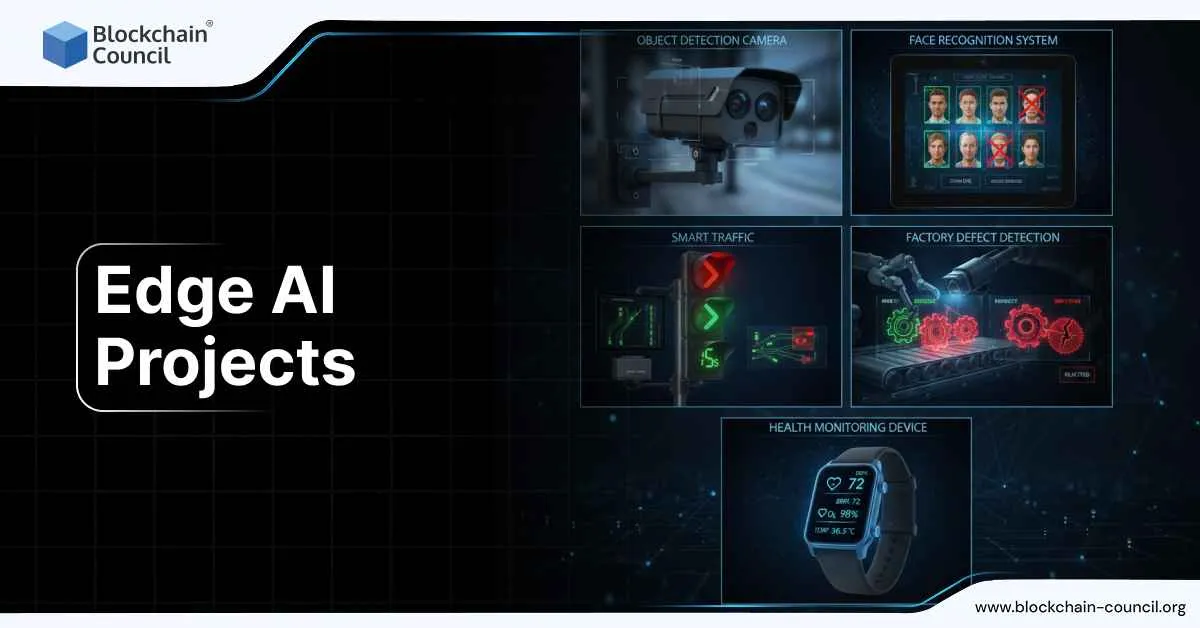
Edge AI projects are where AI stops being theory and starts doing real work. These are projects where models run directly on devices like cameras, microphones, sensors, and small computers instead of waiting on the cloud. The moment people see AI reacting instantly, offline, and in real environments, Edge AI becomes interesting even to beginners.
If someone wants to understand Edge AI properly, the fastest way is to build one working project end to end. Before that, learning core AI concepts through a structured AI Course helps make sense of what the model is actually doing when it runs on a device.

This article walks through Edge AI projects that are practical, beginner-friendly, and realistic enough to reflect how Edge AI is used in the real world.
Camera based Edge AI projects
Computer vision is the most popular starting point for Edge AI because the results are visual and easy to understand.
Image classification on a small device
This project uses a camera connected to a small computer like a Raspberry Pi or an edge GPU device.
What the project does:
- Captures images locally
- Runs a classification model on the device
- Outputs a label and confidence score instantly
Why this project matters:
- It proves that AI inference can happen fully on-device
- It introduces latency, memory, and performance constraints early
- It mirrors how real edge deployments are built
This project is ideal for beginners because it has a clear input, a clear output, and immediate feedback.
Real time object detection
Instead of labeling a single image, this project detects objects continuously from a live camera feed.
What the project does:
- Streams video from a camera
- Runs object detection in real time
- Draws bounding boxes or triggers alerts locally
Why this project matters:
- Shows how performance and hardware acceleration matter
- Demonstrates real-time constraints
- Teaches optimization tradeoffs
This is the moment many learners realize why Edge AI exists. Sending video to the cloud simply cannot compete with local inference speed.
Full video analytics pipeline
This project moves beyond a single model and builds a pipeline.
What the project does:
- Ingests video
- Runs detection or classification
- Generates events instead of raw video
- Stores or sends only meaningful results
Why this project matters:
- Looks and feels like production software
- Teaches pipeline thinking instead of model thinking
- Introduces deployment and monitoring concepts
This type of project is common in retail, factories, and security systems.
Audio and voice Edge AI projects
Audio projects are powerful because they work even on very small devices.
Keyword spotting
This project listens for a few predefined words such as “start,” “stop,” or “on.”
What the project does:
- Continuously listens to audio
- Detects keywords locally
- Triggers an action immediately
Why this project matters:
- Demonstrates low-latency inference
- Works well on microcontrollers
- Introduces power and memory constraints
Keyword spotting is widely used in smart devices and voice-activated systems.
Small vocabulary speech recognition
This project goes one step further by recognizing short spoken phrases.
What the project does:
- Converts audio into features
- Runs a compact speech model locally
- Produces text output
Why this project matters:
- Shows how preprocessing impacts performance
- Teaches how audio pipelines differ from vision
- Reinforces why edge processing protects privacy
Audio Edge AI projects are especially useful for understanding real-time inference.
Sensor and anomaly detection projects
These projects show how Edge AI works beyond cameras and microphones.
Motion and gesture recognition
This project uses accelerometer or gyroscope data.
What the project does:
- Reads motion sensor data
- Classifies known gestures
- Flags unknown patterns as anomalies
Why this project matters:
- Introduces time-series data
- Shows how edge AI handles uncertainty
- Mirrors wearable and industrial use cases
This is a classic Edge AI problem where sending raw sensor data to the cloud is inefficient.
Predictive maintenance using vibration data
This project focuses on detecting early signs of machine failure.
What the project does:
- Analyzes vibration patterns locally
- Detects abnormal behavior
- Generates alerts before failure happens
Why this project matters:
- Demonstrates real business value
- Shows how edge inference prevents downtime
- Explains why latency and reliability matter more than raw accuracy
Predictive maintenance is one of the strongest real-world Edge AI applications.
Logistics and shipment monitoring
This project tracks motion during shipping.
What the project does:
- Classifies shipment states like moving or stationary
- Detects unusual movement
- Logs only critical events
Why this project matters:
- Combines classification and anomaly detection
- Works on compact, battery-powered devices
- Reflects how Edge AI is used in supply chains
This type of project makes Edge AI feel practical and commercial.
What these projects teach
Edge AI projects are not just about models. They teach system thinking.
Every solid project forces learners to deal with:
- Latency from sensor to decision
- Memory and power limits
- Local failures and noisy inputs
- Deployment and update strategies
That is why Edge AI skills are valuable across industries.
How to choose the right project?
The best first project depends on the outcome, not the technology.
Choose vision projects if:
- Visual feedback helps learning
- Hardware acceleration is available
Choose audio or sensor projects if:
- Power efficiency matters
- The device is very constrained
Choose pipeline projects if:
- The goal is production readiness
- Deployment and monitoring are important
Pairing technical projects with business context through a Marketing and Business Certification helps explain why these projects matter beyond engineering.
What a strong Edge AI project portfolio looks like
Hiring teams and technical reviewers look for patterns, not perfection.
A strong portfolio includes:
- One real-time vision or audio project
- One optimization story with clear tradeoffs
- One deployment or update strategy
- One failure case and how it was handled
Edge AI projects stand out because they prove the ability to ship AI into the real world.
Conclusion
Edge AI projects are where AI meets reality. They force models to work under constraints, interact with physical systems, and deliver results instantly.
That is why Edge AI projects are more memorable, more practical, and more valuable than purely cloud-based demos.