Edge AI Examples

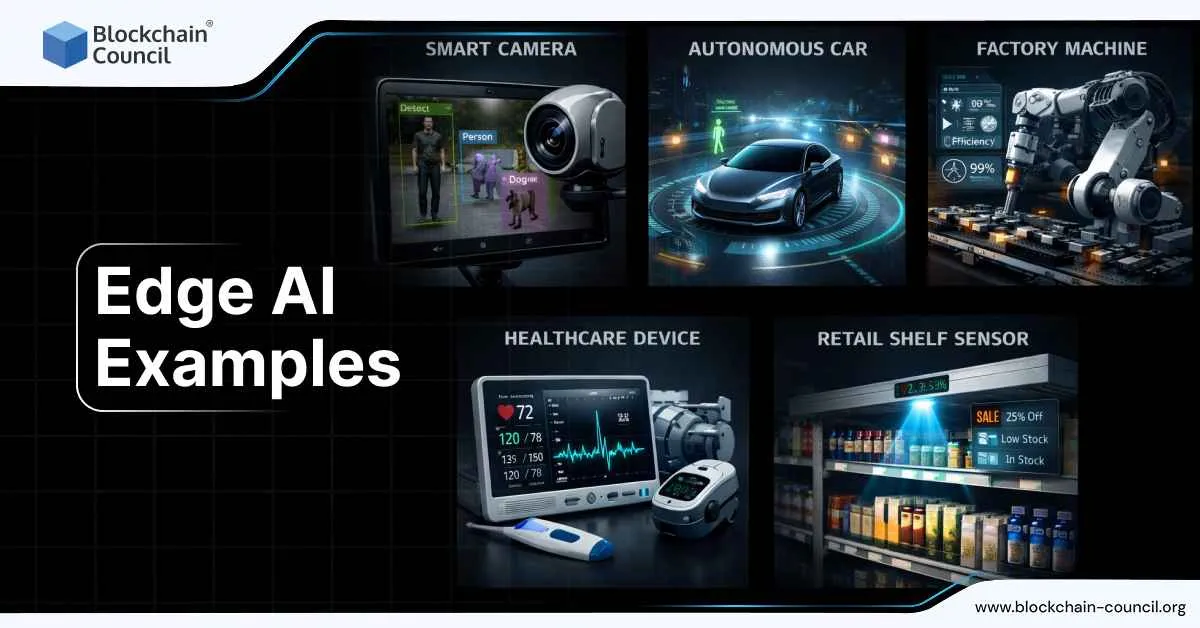
Edge AI examples answer one basic question people usually have. Where does AI actually run in real life, and what does it do?
Edge AI is used when decisions need to happen immediately, privately, and reliably, right where the data is created. Instead of sending everything to the cloud, the AI model runs on the device or very close to it. That is why Edge AI shows up most in phones, cameras, machines, and systems that cannot afford delay.

If someone is learning AI through an AI Certification, Edge AI examples are often the moment when AI stops feeling abstract and starts feeling practical.
Below are clear, real Edge AI examples people already interact with, explained in plain language.
Edge AI examples on phones and personal devices
Phones are the easiest place to see Edge AI working.
Live captions on phones are a direct example. When audio plays and text appears instantly, the speech recognition model is running on the phone itself. The device captures sound, processes it locally, and shows captions without sending audio to a server. This keeps latency low and protects privacy.
Real time speech to text for conversations works the same way. The phone listens, converts speech to text on the device, and displays it immediately. If this depended on cloud calls, delays and connectivity issues would make it unusable.
Face unlock is another everyday Edge AI example. The device camera captures facial data, a local model verifies identity, and the phone unlocks in milliseconds. This process happens entirely on the device to ensure speed, offline access, and security.
On device language features such as smart replies and typing suggestions also rely on Edge AI. Small language models run locally so responses feel instant and personal data stays on the device.
Edge AI examples in smart homes and IoT
Smart devices need to work even when networks are unstable. That is why Edge AI is used.
Smart cameras often analyze video locally to detect motion, objects, or unusual activity. Instead of streaming raw video continuously, the camera runs inference on the device and sends alerts only when something important happens.
Local face recognition in home security systems is another example. The system identifies familiar faces on the device itself, reducing false alerts and avoiding the need to upload sensitive biometric data.
Edge AI examples in retail environments
Retail environments are fast moving and data heavy. Edge AI helps stores react in real time.
In store cameras use Edge AI to analyze foot traffic, shelf availability, and customer movement. These models run on local edge boxes so decisions happen instantly without flooding cloud systems with video data.
This is also where Edge AI connects directly to business performance. Faster decisions affect staffing, inventory, and customer experience, which is why many professionals pair technical AI skills with a Marketing and Business Certification to understand how these systems impact operations and revenue.
Edge AI examples in manufacturing and industry
Factories rely heavily on Edge AI because delays cost money.
Vision systems inspect products on production lines to detect defects. Cameras capture images, models analyze them locally, and machines respond immediately. Sending this data to the cloud would introduce unacceptable latency.
Edge AI is also used to analyze patterns in production issues. Visual models running near machines help teams identify problems faster and reduce downtime.
Edge AI examples in robotics and automation
Robots depend on Edge AI to function safely.
Robots use local AI models to see obstacles, recognize objects, and make movement decisions in real time. These actions cannot wait for cloud responses because even small delays can cause errors or accidents.
Some systems also use advanced vision language models on edge devices to detect anomalies without retraining for every scenario. Even here, the priority remains local inference with minimal external dependency.
More Edge AI examples
These one line explanations help make Edge AI clear:
- Edge AI enables live captions that work instantly on a phone
- Edge AI powers face unlock without sending facial data to the cloud
- Edge AI detects defects on factory lines in real time
- Edge AI lets robots see and react without internet delays
Conclusion
All these examples show the same pattern.
- Data is created locally.
- AI runs close to that data.
- Decisions happen fast.
- Only necessary information leaves the device.
That is what Edge AI looks like in the real world. It is not futuristic, flashy, or abstract. It is practical AI solving everyday problems quietly and efficiently.