
DLSS 5 vs FSR vs XeSS

The competition between DLSS 5, FSR 4, and XeSS has become one of the most important factors shaping gaming performance in 2026. As modern games push the limits of ray tracing, 4K rendering, and high frame rates, traditional rendering alone is no longer sufficient.
Upscaling technologies powered by AI are now central to how games are built and experienced.

But which technology truly stands out?
In this guide, we break down the core differences, performance benchmarks, developer adoption, and real-world impact of DLSS 5, FSR, and XeSS to help you understand which is best—and why it matters.
If you are learning through an Agentic AI Course, Python Course, or an AI powered marketing course, this comparison will help you understand how AI systems are applied in real-world products.
Upscaling Technology
Upscaling is a technique where a game renders at a lower resolution and reconstructs it to a higher resolution using advanced algorithms or AI models.
Why Upscaling Is Essential in 2026
4K and ray tracing are now standard expectations
Native rendering is too resource-intensive
AI-based reconstruction enables 2x–4x performance improvements
Key Insight
Upscaling is no longer a performance trick—it is a core component of modern rendering pipelines.
Tech Comparison
DLSS 5 (NVIDIA)
DLSS 5 represents a major shift toward neural rendering, where AI plays a direct role in generating frames.
Key Features
AI-driven rendering using Tensor Cores
Frame generation and ray reconstruction
Deep integration with RTX hardware
Strength
Superior image reconstruction using trained models
FSR 4 (AMD)
FSR focuses on accessibility and scalability across hardware ecosystems.
Key Features
Hybrid upscaling (spatial + temporal + AI enhancements)
Works across multiple GPU brands
Open and developer-friendly
Strength
Maximum compatibility and ease of adoption
XeSS (Intel)
XeSS combines AI acceleration with fallback support for broader compatibility.
Key Features
AI-based upscaling using XMX cores
DP4a fallback for non-Intel GPUs
Balanced performance model
Strength
Flexible approach with cross-platform support
Key Insight
DLSS focuses on AI precision, FSR on accessibility, and XeSS on balance between both.
Image Quality Comparison
DLSS 5: Leading Visual Fidelity
Best detail reconstruction in complex scenes
Minimal ghosting and artifacting
Strong performance in ray-traced environments
FSR 4: Rapidly Improving Quality
Comparable visuals in static scenes
Slight instability in motion-heavy scenarios
Minor shimmering in performance mode
XeSS: Consistent but Hardware Dependent
Better than earlier-generation upscalers
Performance varies based on GPU support
Stable but not industry-leading
Key Insight
DLSS 5 delivers the most consistent and high-quality output, especially in motion and lighting-heavy scenes.
Performance and FPS Gains
Real-World Performance Overview
Technology | FPS Boost | Stability | Best Use Case |
DLSS 5 | High + Frame Generation | Excellent | 4K + Ray Tracing |
FSR 4 | Very High | Good | Cross-platform gaming |
XeSS | Moderate–High | Good | Intel ecosystem |
Performance Analysis
DLSS provides the best balance of performance and visual stability
FSR often delivers higher FPS on unsupported DLSS hardware
XeSS performs best when optimized for Intel GPUs
Key Insight
Performance differences are shrinking—but efficiency and consistency still define the winner.
Game Support and Industry Adoption
Adoption Trends (2026)
DLSS dominates AAA titles
FSR is expanding rapidly due to open integration
XeSS is growing but still behind in adoption
Expansion Outlook
Launch Phase: Limited flagship titles
6–12 Months: Broad multi-platform support
1–2 Years: Industry-wide standardization
Key Insight
FSR may scale faster, but DLSS continues to lead in premium game experiences.
Hardware Compatibility
DLSS 5
Requires NVIDIA RTX GPUs
Optimized for Tensor Core performance
FSR 4
Works across AMD, NVIDIA, and Intel GPUs
Supports older hardware
XeSS
Best performance on Intel Arc GPUs
Compatible with other GPUs via fallback mode
Key Insight
FSR is the most accessible, while DLSS is the most optimized for high-end systems.
Developer Integration and Challenges
Integration Complexity
Technology | Integration Difficulty | Flexibility |
DLSS 5 | High | High control |
FSR 4 | Low | Very flexible |
XeSS | Medium | Moderate |
Key Challenges
Technical
Pipeline restructuring (DLSS)
AI model tuning
Debugging visual artifacts
Creative
Maintaining artistic intent
Avoiding over-processed visuals
Ensuring consistency across scenes
Key Insight
DLSS offers the most advanced capabilities but requires deeper engineering effort, while FSR enables faster deployment.
Before vs After: The Shift to AI Rendering
Before Upscaling
High GPU dependency
Limited ray tracing
Performance bottlenecks
After AI Upscaling
AI-driven frame generation
Improved scalability
Reduced hardware constraints
Why This Comparison Matters
For Gamers
Better performance without hardware upgrades
Enhanced visual experience
Access to next-gen graphics
For Developers
Reduced rendering workload
Faster development cycles
Greater creative flexibility
For Industry
Transition toward AI-first pipelines
Redefinition of rendering standards
Learning Perspective
Understanding DLSS, FSR, and XeSS helps you see how advanced AI systems are deployed in real-world environments.
Learn how AI models scale through an Agentic AI Course
Build technical foundations with a Python Course
Apply AI in practical domains using an AI powered marketing course
These technologies demonstrate how AI moves from research to large-scale implementation.
Final Verdict: Which Is Best in 2026?
DLSS 5
Best for users who want the highest image quality and advanced AI rendering capabilities.
FSR 4
Best for users who prioritize compatibility and accessibility across hardware.
XeSS
Best suited for Intel users seeking a balanced solution.
Key Insight
There is no universal winner—each technology serves a different purpose based on hardware and use case.
Final Thoughts
DLSS 5, FSR, and XeSS represent more than just performance tools—they mark a shift toward AI-driven rendering ecosystems.
DLSS leads in innovation and quality
FSR leads in accessibility and adoption
XeSS provides a flexible middle ground
As AI continues to evolve, these technologies will become standard across all modern game engines.
To stay ahead in this space:
Explore AI systems through an Agentic AI Course
Strengthen programming knowledge with a Python Course
Understand real-world applications via an AI powered marketing course
Quick Recap
DLSS 5 delivers the best visual quality
FSR 4 offers the widest compatibility
XeSS balances performance and flexibility
AI upscaling is now essential for modern gaming
FAQs: DLSS vs FSR vs XeSS
1. Which is the best upscaling technology in 2026?
DLSS 5 currently leads in quality and consistency.
2. Is FSR catching up to DLSS?
Yes, especially in accessibility and performance.
3. What makes XeSS unique?
Its dual-mode design allows broader compatibility.
4. Do all games support these technologies?
Not all, but adoption is rapidly increasing.
5. Is DLSS hardware-dependent?
Yes, it requires NVIDIA RTX GPUs.
6. Which technology gives the highest FPS?
FSR often provides higher FPS on non-RTX systems.
7. Is AI upscaling the future?
Yes, it is becoming the standard rendering approach.
8. Can developers control these systems?
Yes, each technology offers configurable settings.
9. Will one replace the others?
Unlikely—they serve different ecosystems.
10. How can I learn this technology?
Through AI, programming, and real-world application-based courses.
Related Articles
View All
AI & ML
NVIDIA GTC 2026 Breakdown: DLSS 5, NemoClaw & the Future of AI Platforms
NVIDIA GTC 2026 introduced groundbreaking innovations like DLSS 5 and NemoClaw, signaling a major leap in AI platforms, automation, and GPU-powered intelligence.
AI & ML
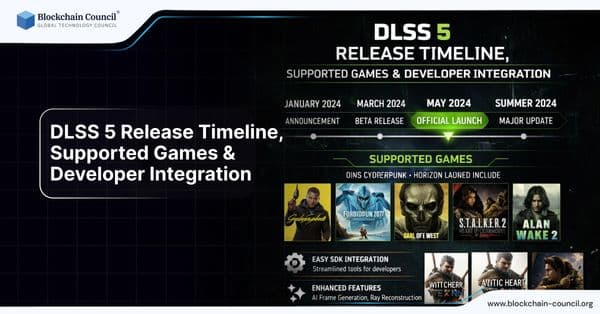
DLSS 5 Release Timeline, Supported Games & Developer Integration
DLSS 5 is expected to launch with next-gen GPUs and will be integrated into major game engines and supported titles.
AI & ML
What Is NVIDIA DLSS 5?
NVIDIA DLSS 5 is a next-gen neural rendering technology that uses AI to improve performance and image quality in modern games.
Trending Articles

The Role of Blockchain in Ethical AI Development
How blockchain technology is being used to promote transparency and accountability in artificial intelligence systems.

AWS Career Roadmap
A step-by-step guide to building a successful career in Amazon Web Services cloud computing.

Top 5 DeFi Platforms
Explore the leading decentralized finance platforms and what makes each one unique in the evolving DeFi landscape.