
DeepMind AI Translates Ancient Texts

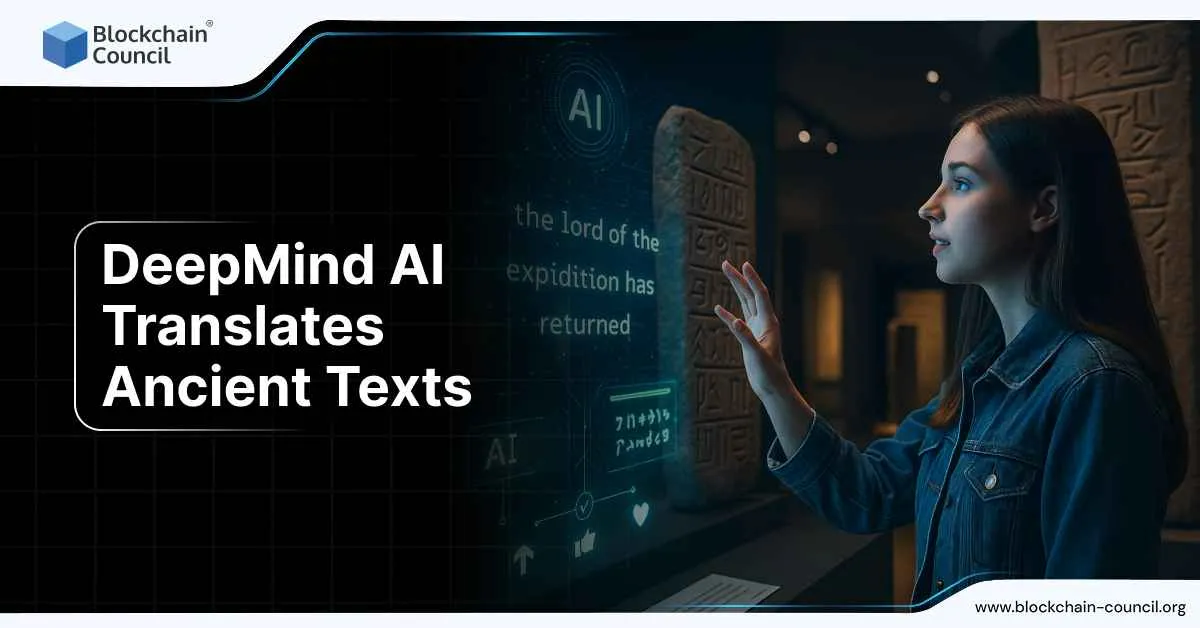
DeepMind has introduced Aeneas, a powerful AI model that can translate and restore ancient Latin texts. Built in partnership with leading universities, Aeneas helps historians reconstruct missing words, date inscriptions, and even determine their geographic origin. It does all of this in seconds, giving researchers a new tool to explore the past.
This article explains what Aeneas is, how it works, and why it matters. You’ll also see how it compares with past models and what it means for the future of historical research.

What Is Aeneas?
Aeneas is an artificial intelligence model developed by DeepMind to work on ancient Latin inscriptions. It builds on the success of earlier models like Ithaca and Pythia, which focused on Greek texts. Unlike those, Aeneas supports both text and image inputs, giving it broader use in archaeology, museums, and academic research.
The AI model doesn’t just translate. It can:
- Restore missing or damaged words
- Predict when and where the text was written
- Find similar inscriptions from a massive dataset
This is a major leap forward in how we study ancient history.
How Aeneas Works
Aeneas was trained on thousands of Latin inscriptions. When given a damaged or incomplete piece of text, it uses deep learning to fill in the blanks. It can also scan visual images of inscriptions carved into stone, coins, or metal.
Three Main Capabilities
- Restoration
Aeneas can restore heavily damaged inscriptions by suggesting likely words or phrases. It works even when the length of the missing text is unknown. - Attribution
The model predicts where the inscription came from and when it was written. It can narrow the location down to one of 62 Roman provinces and estimate the date within 13 years. - Parallel Search
It searches a large database to find similar texts, helping historians better understand context and usage patterns.
Core Abilities of Aeneas AI
| Capability | Description | Use Case Example |
| Text Restoration | Fills in gaps in damaged Latin inscriptions | Repairing broken tablets |
| Geolocation | Identifies one of 62 Roman provinces | Matching text to regions like Gallia or Asia |
| Date Estimation | Predicts time with 13-year average accuracy | Dating anonymous grave inscriptions |
| Parallel Retrieval | Finds similar inscriptions across database | Linking laws, prayers, or tributes |
| Multimodal Input | Accepts both written and image-based texts | Reading from stone, metal, or papyrus |
Real-World Results from Historians
To test Aeneas, DeepMind ran a study involving 23 professional historians. In 90% of cases, the model provided valuable insights. It also increased historians’ confidence in their interpretations by 44%.
One major test involved the Res Gestae Divi Augusti, a famous Roman text. Aeneas successfully predicted the dating range debated by scholars. This showed it could support both beginner researchers and experts working on complex texts.
Comparison With Earlier AI Tools
Aeneas isn’t the first AI tool built for ancient languages. DeepMind’s previous models, Pythia and Ithaca, worked on Greek inscriptions. But Aeneas improves on both by offering faster results, higher accuracy, and the ability to process visuals.
It also moves beyond simple word prediction. By linking texts across history and geography, Aeneas helps researchers build bigger stories.
Aeneas vs Previous AI Models
| Model Name | Language Focus | Input Type | Output Type | Primary Improvement |
| Pythia | Ancient Greek | Text-only | Word restoration | First deep learning model |
| Ithaca | Ancient Greek | Text | Restoration + geolocation | Added historical prediction |
| Aeneas | Latin | Text + Images | Restoration, location, time | Multimodal + faster reasoning |
Who Can Use Aeneas?
Aeneas is already available for free to the academic community. Historians, archaeologists, museum curators, and students can use it to speed up research. The tool is also open-sourced, so others can build on it or apply similar models to new languages.
This shift shows that AI is not just for developers or tech companies. It’s becoming a practical resource for education, cultural heritage, and the arts.
Why This Matters
Aeneas is important for two big reasons:
- It saves time and labor. Instead of spending weeks decoding a damaged tablet, historians can now get a reliable starting point within seconds.
- It broadens access. Students and early-career researchers can now work with advanced tools that were once reserved for senior experts.
For those interested in working with AI tools like this, now is the time to get skilled. The AI Certification teaches how AI models are trained and used. If you’re analyzing large datasets of historical texts, the Data Science Certification gives you the statistical tools to interpret the results. And if you’re applying AI to museum marketing or cultural outreach, the Marketing and Business Certification offers strategies to connect research with public engagement.
Final Takeaway
DeepMind’s Aeneas is more than just a translation tool. It’s a breakthrough in how we connect with the past. By restoring lost words, dating texts, and linking inscriptions across the Roman world, it brings history back to life with speed and accuracy.
For researchers, educators, and cultural professionals, Aeneas offers a new way to uncover meaning from ancient artifacts. And for AI professionals, it’s proof that large models can do more than just chat—they can protect and explore human history.
Related Articles
View All
AI & ML
AWS Career Roadmap
Cloud computing has transformed the way businesses build and deliver digital products. Today, companies no longer need to invest in expensive physical servers to run their applications. Instead, they rely on cloud platforms that provide scalable computing power over the internet. One of the most…
AI & ML
What is AWS? A Beginner’s Guide to Cloud Computing and Career Opportunities
Cloud computing has become the backbone of modern technology. From streaming services and online shopping platforms to AI applications and mobile apps, most digital services today run on cloud infrastructure. One of the most powerful platforms leading this transformation is Amazon Web Services…
AI & ML
How to Start an AWS Career Using AI: A Modern Beginner’s Guide
Cloud computing has become one of the most important technologies powering the digital world. From streaming platforms and mobile apps to artificial intelligence systems and large-scale business applications, most modern services rely on cloud infrastructure. Among the many cloud platforms…
Trending Articles
The Role of Blockchain in Ethical AI Development
How blockchain technology is being used to promote transparency and accountability in artificial intelligence systems.
AWS Career Roadmap
A step-by-step guide to building a successful career in Amazon Web Services cloud computing.
Top 5 DeFi Platforms
Explore the leading decentralized finance platforms and what makes each one unique in the evolving DeFi landscape.