
Claude Code in Slack

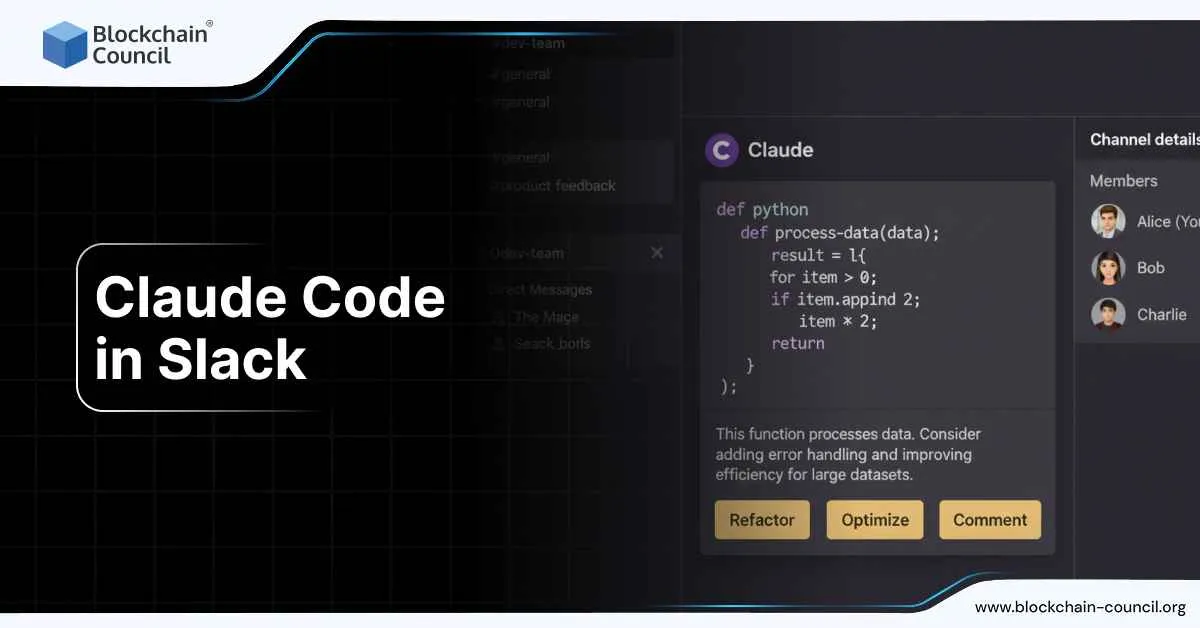
Anthropic has brought its agentic coding tool Claude Code directly into Slack, so developers can turn bug reports and feature requests in chat into full coding sessions without leaving their channels. The integration launched on December 8, 2025 as a research preview, building on the existing Claude app for Slack and adding automatic routing of coding tasks to Claude Code on the web. Many teams preparing for this kind of deep AI automation start by building their fundamentals with programs like the AI Certification so they understand what an agentic coding system is actually doing under the hood.
What Claude Code in Slack Actually Does
Claude Code in Slack is not just a chatbot that replies with code snippets. It is an orchestration layer that:

- Listens for @Claude mentions in channels and threads
- Detects whether the message is a coding related request
- Pulls context from the Slack conversation
- Chooses an authenticated repository
- Spins up a remote Claude Code session on claude.com/code
- Runs an agentic coding loop that can read, edit, and test code
- Posts progress updates and final results back to the same Slack thread
Previously, Claude in Slack could answer programming questions and generate small snippets. Now, when the message looks like “fix this production bug” or “refactor this service and update tests,” Claude can actually open the repo, modify multiple files, run tests, and prepare a pull request, all initiated from Slack.
How a Slack Message Becomes a Claude Code Session
Anthropic’s product design describes a consistent pipeline from Slack to code:
- Mention in Slack
A user tags @Claude in a channel or thread with a request such as “customer webhooks are failing, find the bug in the payments service and patch it.”
- Intent detection
The Claude Slack app classifies whether this is a coding task. If it is, the message is routed to Claude Code instead of returning a simple chat answer. Users can also manually tell Claude to treat a request as code if the classifier misfires.
- Context gathering
Claude gathers recent messages from the channel or thread, including stack traces, log fragments, error screenshots converted to text, and earlier discussion. Critical context around engineering work often lives only in Slack, and the integration is designed to capture that automatically.
- Repository selection
Based on the repositories the user has authenticated in Claude Code, plus hints in the Slack text such as service names or file paths, the system automatically picks which repo to operate on.
- Remote session creation
A session is started on claude.com/code with tools enabled for file operations and shell commands, and the Slack context supplied as the initial task description.
- Agentic coding loop
Inside this session, Claude Code can read files, search directories, run tests and other CLI tools, apply edits, and iterate until it believes the request has been satisfied.
- Updates and pull request
As it works, Claude posts status messages back into Slack such as “found the failing test,” “running integration tests,” or “proposed fix ready.” When finished, it shares a link to the full Claude Code session and a direct link to open a pull request from the generated changes.
The result is a workflow where the conversation in Slack drives the coding session, but the heavyweight work still happens in a dedicated, auditable environment.
Prerequisites and Setup Details
Claude Code in Slack only activates if several conditions are met:
- Plan
You need a Claude plan with Claude Code access enabled, such as Pro, Max, Team, or Enterprise.
- Claude Code on the web
Access to Claude Code in the browser must be turned on in the organization’s admin settings. An owner or primary owner has to enable it.
- Slack app installation
The Claude app must be installed from the Slack App Marketplace into the workspace.
- Account linking
Each user who wants to trigger Claude Code must open the Claude app in Slack, go to the App Home tab, click “Connect,” and complete an authentication flow that links their Slack identity with their Claude account.
- Repository connection
The user must connect a GitHub account and at least one repository to Claude Code on the web, since Slack can only route tasks to repositories that Claude Code already knows about.
These constraints mean Slack never directly controls codebase access. All repo permissions, shell access, and tool use are governed by Claude Code’s own security and configuration. Many engineers and architects study broader infrastructure patterns with resources like the Tech Certification so they can design permission models, CI gates, and rollback strategies that make sense when AI agents are allowed to modify code.
Real Development Workflows It Supports
Demos and early adopter reports highlight several concrete workflows that become easier with Claude Code in Slack:
- Incident response channels
In a production incident channel, a support or SRE engineer can paste a stack trace, describe the behavior, and tag @Claude. Claude Code will trace through the repository, locate the failing path, apply a patch, and propose a pull request, all while reporting back in the same thread.
- Bug triage and maintenance
For recurring issues that surface during team standups or bug triage, people can turn decisions into immediate code updates rather than filing tickets and waiting for a separate cycle.
- Small feature requests
Product managers or designers can describe small changes, such as “add CSV export to this report” or “add a tooltip to this button,” and developers can let Claude Code generate the initial implementation before review.
- Documentation and comment coverage
Teams can ask Claude to read an entire module and generate docstrings, comments, or architectural summaries, driven directly from Slack questions.
Anthropic has reported that engineers are delegating a meaningful share of their daily tasks to Claude, and that a notable portion of Claude assisted work involves new or expanded tasks that would not have happened without the tool. That gives a quantitative sense of how much work can be shifted into this kind of agent.
Key Facts About Claude Code in Slack
| Dimension | Specifics | Why It Matters |
| Launch status | Research preview announced in December 2025 and delivered through the existing Claude Slack app | Confirms it is live but still evolving rather than a frozen product |
| Trigger | @Claude mentions in channels or threads, with automatic detection of coding intent | Makes coding support part of everyday conversation instead of a separate tool |
| Context source | Recent Slack thread messages, logs, bug reports, and engineering discussion | Uses real collaboration context instead of requiring manual prompt reconstruction |
| Backend engine | Full Claude Code sessions on claude.com/code with repo access and shell tools | Ensures the Slack integration has the same capabilities as terminal and IDE flows |
| Requirements | Claude Code enabled plan, Slack app installed, account linking, GitHub repo authenticated | Shows that security and governance live in Claude Code, not in Slack alone |
This snapshot works well as a standalone infographic for readers who just want the critical facts.
Limitations, Risks, and Governance Concerns
Even with impressive capabilities, several real constraints exist:
- Classification errors
Intent detection is not perfect. Sometimes Claude responds as a chat assistant when a user expected a code session, which requires a follow up instruction to correct.
- Complex codebases
Performance is best on reasonably structured repositories. In very large monoliths or tangled legacy systems, automated refactors and fixes can be brittle without careful scoping.
- Need for strong review discipline
Claude Code can create complete patches, but merging them without human review risks technical debt and hidden bugs. Mature teams keep CI pipelines and code review as hard gates.
- Skill and collaboration impacts
Engineers can feel more productive, but there is a risk that over reliance on Claude reduces opportunities for mentorship and deep debugging practice if not managed carefully.
These issues mean organizations have to treat Claude Code in Slack as an automation layer that still lives inside a human controlled development process.
Why This Integration Matters Strategically
Claude Code has quickly become a major product in Anthropic’s ecosystem, and the Slack integration shows where the product is heading next: away from isolated tools and into the collaboration surfaces where engineers already spend most of their time. The new competitive frontier is not just model benchmarks, but how deeply AI is embedded inside workflows like Slack, where engineering decisions and context actually live.
Teams that want to deploy this responsibly need to think across engineering, security, and product strategy. That is why many leaders look beyond purely technical courses and combine them with strategic programs such as the Marketing and Business Certification so they can understand how agentic coding affects product velocity, team design, and competitive positioning in the wider market.
Claude Code in Slack is not just an integration feature. It is a sign that software development is moving toward a model where the primary interface is a conversation, and code changes are executed by agents that sit behind that conversation, supervised by humans who understand both the power and the limits of the tools they are using.
Related Articles
View All
AI & ML
Claude for Excel
How Anthropic’s AI Assistant Is Transforming Spreadsheet Work For decades, Microsoft Excel has reigned as the undisputed king of spreadsheets, powering financial models, data analyses, and business reports across industries. Yet for all its power, Excel has always demanded a steep learning…

AI & ML
NemoClaw + Open Models: Nemotron, OpenShell & Self-Evolving Agents
Discover how NemoClaw works with open AI models like Nemotron.

AI & ML
NemoClaw Deployment Guide: Cloud, RTX PCs, Edge & Data Centers
Learn how to deploy NemoClaw across environments.
Trending Articles

The Role of Blockchain in Ethical AI Development
How blockchain technology is being used to promote transparency and accountability in artificial intelligence systems.

AWS Career Roadmap
A step-by-step guide to building a successful career in Amazon Web Services cloud computing.

Top 5 DeFi Platforms
Explore the leading decentralized finance platforms and what makes each one unique in the evolving DeFi landscape.