How to Become an Edge AI Engineer
 Michael Willson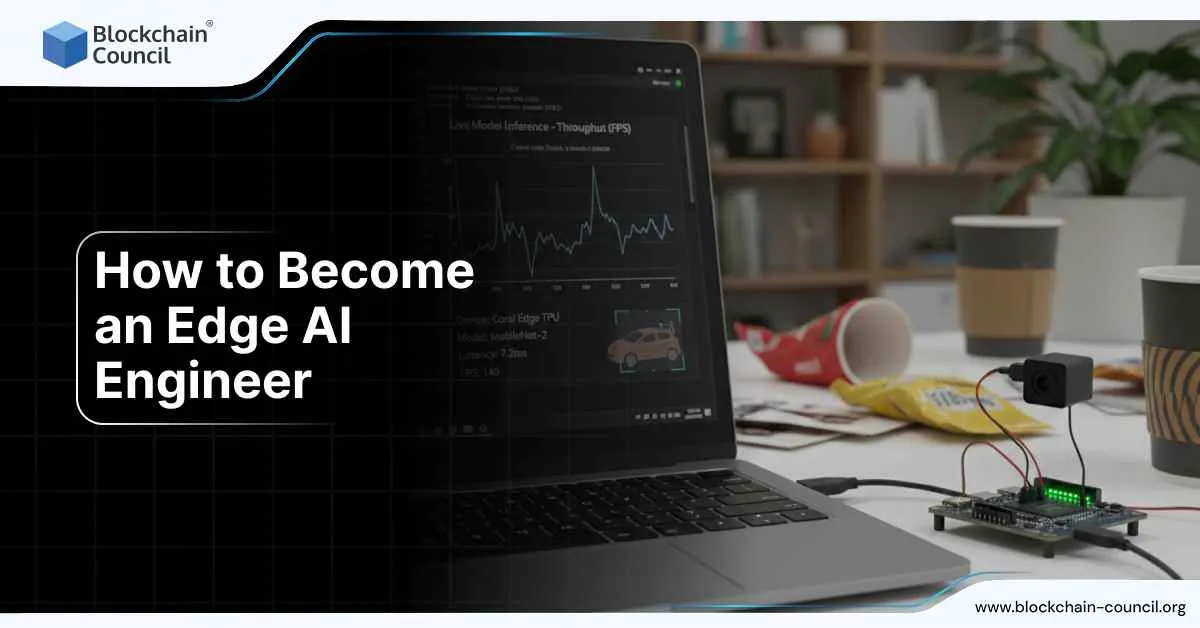
An edge AI engineer builds AI systems that run on devices like cameras, robots, gateways, kiosks, medical devices, and vehicles. The goal is simple: make AI work fast, reliably, and safely where the data is created, even when the internet is slow or unavailable.
A strong starting point is building core ML thinking through an AI Certification because edge work still depends on model quality, evaluation discipline, and real-world failure analysis.

Know the job before learning the tools
Edge AI engineering is not just “train a model and export it.” Employers hire for the full system outcome.
An edge AI engineer is expected to:
- Take a trained model and make it run on constrained hardware
- Hit real targets like latency, memory footprint, battery, thermals, and uptime
- Integrate inference into an application pipeline that handles messy inputs
- Ship updates safely across many devices and recover quickly when something breaks
- Keep security, privacy, and permissions practical and enforceable
This is why the role sits at the overlap of ML engineering, embedded systems, and deployment operations.
Pick one domain to start
Edge AI is broad, and beginners win by choosing one track early. Each track teaches the same core concepts but with different constraints.
Good starting tracks:
- Computer vision on cameras and edge boxes
- Industrial sensors for anomaly detection and predictive maintenance
- Audio and keyword spotting for low-power control
- Robotics perception plus action loops
- Mobile on-device AI for phones and tablets
A track is not a lifetime commitment. It is a shortcut to faster progress and a stronger portfolio.
Build ML fundamentals that edge projects depend on
Edge AI fails more often because of data and evaluation than because of hardware. The model may look great in a notebook and then collapse in real conditions like low light, motion blur, new accents, or sensor drift.
Focus on these fundamentals:
- Dataset quality checks and labeling consistency
- Splits that match reality, not random splits that leak similar samples
- Metrics that reflect real harm, like false alarms and missed detections
- Error analysis that explains exactly which inputs break the model and why
A practical way to accelerate this foundation is pairing hands-on study with a Tech Certification because edge projects demand comfort with systems basics like logs, packaging, and device constraints.
Learn one on-device runtime properly
Most people slow down by collecting tools instead of mastering one end-to-end stack. Edge hiring rewards engineers who can ship a working demo on real hardware and explain tradeoffs clearly.
Pick one runtime stack and learn it deeply:
- Mobile runtime path for Android or iOS deployments
- Gateway path for edge boxes and IoT-style deployments
- GPU acceleration path for high-performance vision and robotics devices
- Microcontroller path for ultra-low power sensing tasks
What mastery looks like:
- The same model runs locally on the target device without cloud help
- Latency is measured end to end, not guessed
- Failures are debugged with logs and reproducible test inputs
- Performance is improved with changes that can be explained and repeated
Master optimization because that is the edge signature
Optimization is the skill that turns a “working model” into a “working product.” Edge devices have strict budgets, so an edge AI engineer must know how to trade accuracy for speed safely and intentionally.
Core optimization skills:
- Quantization workflows and when accuracy drops
- Model size reduction strategies and memory budgeting
- Operator compatibility pitfalls across runtimes
- Hardware acceleration basics across CPU, GPU, and NPU
- Throughput versus latency tuning depending on the use case
This is also where agentic systems are starting to matter. An Agentic AI certification can be useful once the basics are stable, because more edge deployments are moving from single-model inference to multi-step workflows that choose tools, verify outputs, and log decisions.
Build the full pipeline, not a model demo
Edge AI is a pipeline. A model alone is not a deployable system.
A complete edge pipeline includes:
- Input capture from a camera, mic, or sensor
- Pre-processing like resize, normalization, decoding, filtering, or feature extraction
- Inference on the device or local gateway
- Post-processing like thresholds, tracking, smoothing, or business rules
- Action logic like alerts, control signals, storage, or UI updates
- Logging that is minimal but enough to debug failures in the field
A portfolio becomes credible when it shows the pipeline staying stable across messy real inputs, not just curated test samples.
Learn deployment and fleet habits early
Edge AI is rarely one device. Real deployments are fleets. That means a working solution must handle updates, versioning, rollback, and offline behavior.
Skills that show up repeatedly in real work:
- Model and config versioning with clear naming and release notes
- Staged rollouts so failures do not brick the whole fleet
- Rollback mechanisms that work even when connectivity is unreliable
- Health checks that confirm inference is running, not just that the process exists
- Device-safe defaults when the model fails or confidence is low
This is where many prototypes die, so learning it early becomes a career advantage.
Add monitoring and feedback loops
Edge systems drift because the world changes. Lighting shifts, sensors age, environments change, and user behavior evolves. A professional edge AI engineer assumes drift will happen and designs feedback loops that fix it without collecting unnecessary sensitive data.
Practical monitoring habits:
- Log predictions, confidence scores, and a small set of failure signals
- Upload only events and a limited sample set when needed
- Track performance trends by device type, location, and environment
- Use retraining to target the specific failure buckets discovered in the field
A monitoring mindset is also valuable for business outcomes, because leadership cares about reliability, cost, and measurable impact. A Marketing and Business Certification helps connect technical decisions to KPIs like downtime avoided, false alarms reduced, bandwidth saved, and support tickets lowered.
Make security and privacy default
Edge AI often touches sensitive environments. Even a simple camera project can carry risk if data handling is sloppy.
Practical security and privacy practices:
- Secure model delivery so artifacts cannot be tampered with
- Protect secrets and device identities
- Limit what leaves the device and define retention rules
- Gate risky actions with approvals or safe fallbacks
- Keep logs useful without capturing raw personal data unnecessarily
Security also affects buyer confidence in enterprise deployments, so it should be treated as a core feature, not a bonus.
Build a portfolio that hiring teams recognize
A strong edge AI portfolio proves four things: inference works, optimization is real, deployment is thought through, and the engineer understands real-world failure.
Portfolio checklist:
- One project running inference locally on real hardware
- One optimization story showing before and after benchmarks
- One deployment story with update and rollback logic
- One monitoring plan that explains what is logged and why
- One failure write-up that shows what broke and how it was fixed
A simple way to stand out is to include a one-page “engineering brief” for each project:
- Problem and constraints
- Device target and runtime choice
- Benchmarks for latency, memory, and accuracy
- Failure modes observed and mitigations
- Deployment plan and monitoring signals
Common learning path that works
A practical sequence that keeps momentum:
- Start with one small model and run it locally
- Measure latency and memory from day one
- Optimize only after a baseline is stable
- Build the pipeline around the model, not the other way around
- Add deploy and update logic once the pipeline works
- Add monitoring and security once more than one device exists
For deeper system-building exposure across modern engineering topics, a Deep Tech Certification can support the broader skill set edge roles expect, especially when the work involves production constraints, infrastructure decisions, and cross-team delivery.
What to expect in interviews
Edge AI interviews often test practical engineering judgment more than fancy theory.
Common evaluation themes:
- Explaining tradeoffs between latency, accuracy, and power
- Debugging a performance bottleneck in a pipeline
- Choosing a runtime and deployment strategy for a device constraint
- Designing a safe update plan for a fleet
- Handling bad inputs and defining fallbacks
- Showing evidence through benchmarks, not opinions
The best candidates talk in concrete terms: measured numbers, clear constraints, and specific failure cases they solved.
Bottom line
Becoming an edge AI engineer is about turning AI into a dependable device-level system. The path is clear when the focus stays on shipping outcomes: local inference, optimization, a stable pipeline, safe deployment, monitoring, and security.
A beginner becomes hire-ready faster by mastering one stack end to end, proving optimization with benchmarks, and building projects that show real-world thinking instead of just model screenshots.