
Automation and the Changing Nature of Employment
 Michael Willson
What Is the Real Impact of Automation on Jobs Today?
Automation isn’t just about robots in factories anymore. It’s about algorithms that draft emails, schedule meetings, and even make hiring decisions. Across industries, machines and software are now doing parts of jobs once handled only by humans. But here’s the key point: automation isn’t simply replacing workers—it’s reshaping what work means.
Studies from global organizations like the World Economic Forum (WEF), International Monetary Fund (IMF), and International Labour Organization (ILO) show a consistent trend. Roughly 40% of global jobs now include tasks that could be automated. In advanced economies, where jobs rely heavily on data and digital tools, the number jumps to nearly 60%. Yet most of these changes don’t erase entire roles—they alter task structures.

This is why professionals across industries are upskilling through programs such as an AI certification. Understanding automation and artificial intelligence gives workers a competitive advantage, helping them stay relevant as technology evolves.
Automation, in short, doesn’t mean mass unemployment. It means a massive redistribution of work. Machines are taking over the repetitive parts of jobs, while humans focus on creativity, strategy, and empathy—the things AI still can’t replicate.
What Do the Newest Reports Say About Automation and Jobs in 2025?
The WEF Future of Jobs Report 2025 highlights a clear pattern. Automation is accelerating, but its impact is uneven. Employers expect to automate about 40–50% of repetitive tasks by the end of the decade. However, most companies also expect to hire for new, AI-supported roles.
These findings echo IMF research, which suggests automation brings both risk and opportunity. Advanced economies, with their higher concentration of white-collar work, are more exposed but also more adaptable. Developing nations, by contrast, rely more on manual labor—so automation may hit slower but with more dramatic consequences when it does arrive.
The ILO’s 2025 update goes further. It breaks exposure down by task, not job title. For example, in clerical and administrative work, data entry and report compilation are at high risk of automation. But customer communication and complex scheduling remain primarily human-led. The ILO’s refined “automation exposure index” shows that in most roles, around 30–40% of tasks can be automated, while the rest require decision-making or human contact.
The conclusion? Automation changes how people work more than whether they work.
How Exposed Are Different Countries and Sectors?
Automation’s reach isn’t uniform. In countries like the United States, Germany, and Japan, where technology adoption is high, automation is reshaping professional services, finance, and manufacturing simultaneously. In developing regions—such as Southeast Asia, Africa, and parts of South America—the pace is slower, limited by infrastructure and digital access.
Sectors vary even more dramatically. Manufacturing and logistics continue to lead in physical automation through robotics and predictive maintenance. Meanwhile, the service sector is catching up fast. Retail uses AI-driven inventory systems, healthcare relies on diagnostic automation, and education integrates adaptive learning software.
The IMF’s 2025 analysis identifies four categories of exposure:
- High automation risk (routine, repetitive tasks): manufacturing, data entry, and clerical work.
- Medium exposure (rule-based professional work): accounting, banking, and customer service.
- Low exposure (creative and interpersonal roles): healthcare, design, teaching.
- Emerging augmentation fields: engineering, marketing, and data science, where AI boosts rather than replaces human skills.
Interestingly, some of the safest roles are the ones that blend human empathy with digital literacy. Teachers using AI to customize lessons, or doctors supported by diagnostic algorithms, will likely thrive.
What Tasks Are Actually Being Automated Now?
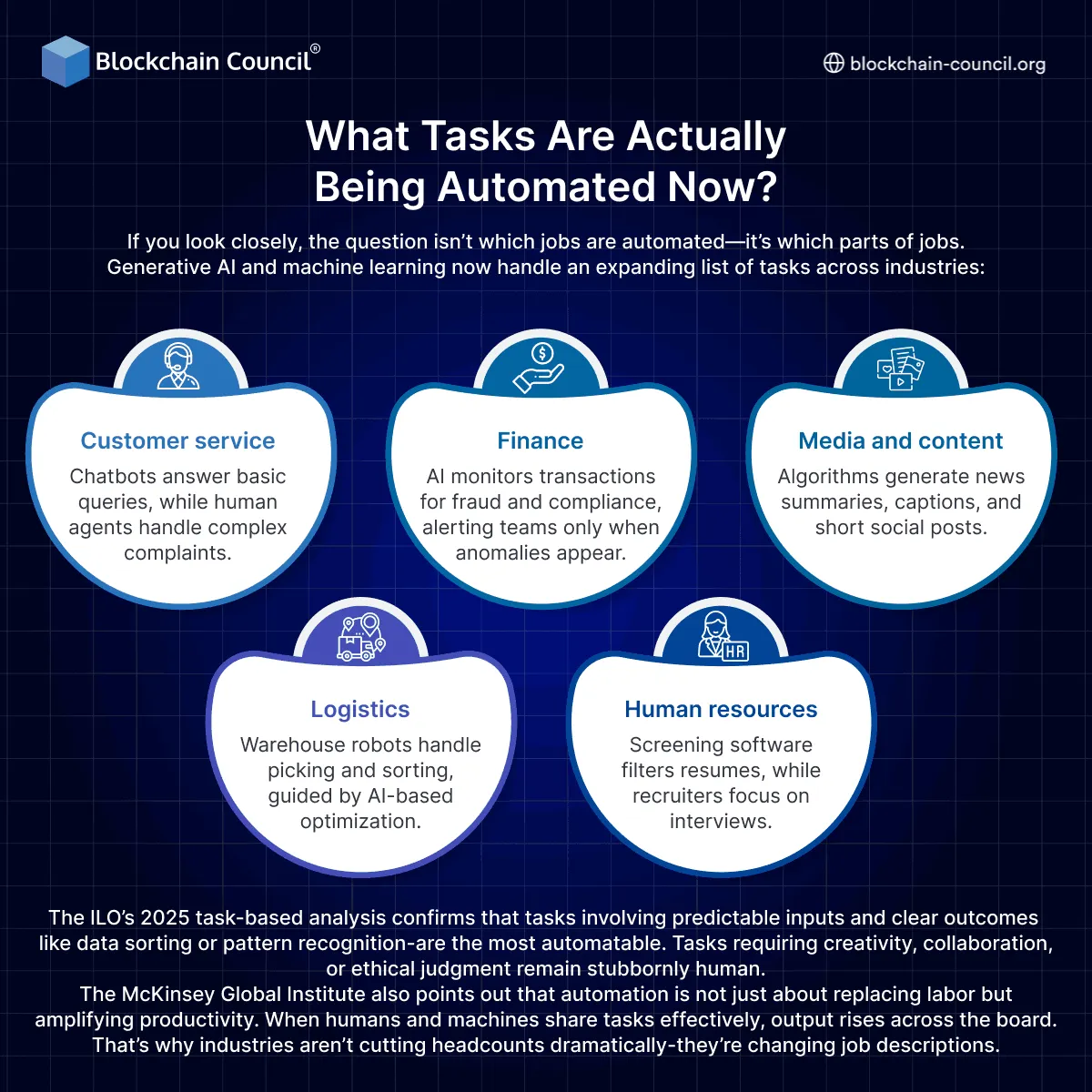
If you look closely, the question isn’t which jobs are automated—it’s which parts of jobs. Generative AI and machine learning now handle an expanding list of tasks across industries:
- Customer service: Chatbots answer basic queries, while human agents handle complex complaints.
- Finance: AI monitors transactions for fraud and compliance, alerting teams only when anomalies appear.
- Media and content: Algorithms generate news summaries, captions, and short social posts.
- Logistics: Warehouse robots handle picking and sorting, guided by AI-based optimization.
- Human resources: Screening software filters resumes, while recruiters focus on interviews.
The ILO’s 2025 task-based analysis confirms that tasks involving predictable inputs and clear outcomes—like data sorting or pattern recognition—are the most automatable. Tasks requiring creativity, collaboration, or ethical judgment remain stubbornly human.
The McKinsey Global Institute also points out that automation is not just about replacing labor but amplifying productivity. When humans and machines share tasks effectively, output rises across the board. That’s why industries aren’t cutting headcounts dramatically—they’re changing job descriptions.
What Do Employers Plan to Do in the Next 24 Months?
Corporate plans tell an interesting story. According to the WEF’s 2025 survey, 75% of global employers are introducing AI or automation in some form. However, only 40% have a structured reskilling plan for employees. This mismatch is a problem. Without training, productivity gains are limited, and morale drops.
The companies succeeding are those that treat automation as a partnership, not a replacement strategy. They start by identifying workflows where automation saves time without reducing quality. Then they retrain employees to handle oversight, troubleshooting, or customer-facing tasks.
For instance, one global logistics company replaced manual tracking with an AI-driven dashboard but reassigned staff to manage exceptions and customer service. The result: faster operations and higher satisfaction rates—without layoffs.
The McKinsey 2025 report warns that automation pilots often stall because managers underestimate change management. Firms that plan early for training, communication, and data governance see smoother transitions and stronger returns.
That’s where professional learning platforms come in. Courses such as the Data Science Certification and the agentic ai certification help workers develop data and automation literacy—skills now critical for every industry.
What Does the 40% Exposure Number Really Mean for Workers?
The figure often causes anxiety, but it doesn’t mean 40% of people will lose their jobs. It means that 40% of current jobs contain tasks that could be automated if technology were fully implemented and cost-effective—which rarely happens overnight.
In practice, this means workers will share their workload with AI systems. A financial analyst might spend less time on spreadsheet modeling and more on interpreting insights. A journalist may use AI to gather background data but still write final stories. Automation exposure translates to task shift, not job extinction.
That said, the impact depends heavily on skills. Workers with data literacy, digital communication, and critical reasoning adapt easily. Those without these skills risk being left behind. This is why continuous education online platforms is becoming essential.
It also changes what employers look for. Instead of asking “Can you use Excel?” they ask “Can you collaborate with AI tools?” Technical skills are merging with human judgment as the new baseline for employability.
How Is Automation Redefining Career Growth?
Career ladders are giving way to career networks. In traditional structures, workers advanced step by step through fixed roles. Automation disrupts this model. As tasks evolve faster than titles, professionals now move horizontally—into new specialties, hybrid jobs, or project-based work.
The OECD’s 2024 research shows that career flexibility is now a marker of resilience. Employees who switch roles every few years to learn new tools or functions are less likely to be displaced. Many companies encourage “internal mobility” programs where employees cross-train in analytics, automation, and digital operations.
Automation also expands entrepreneurship. Small business owners use AI-driven systems for marketing, design, and logistics, allowing them to compete globally. Courses like the Marketing and Business Certification teach entrepreneurs how to integrate automation into campaigns, customer insights, and growth strategies.
In short, automation doesn’t kill ambition—it rewires it. The most valuable workers are those who adapt, learn, and collaborate with machines to do things faster and better.
What Are the Gender and Inequality Dimensions of Automation?
Automation affects groups differently. The ILO’s 2025 findings reveal that jobs dominated by women—especially clerical and administrative roles—face higher automation risks. These tasks often involve predictable digital inputs, making them easier to replace with software.
However, there’s also opportunity. Remote and flexible AI-powered jobs make it easier for women and caregivers to participate in the workforce. Digital freelancing, online teaching, and design work are expanding rapidly.
The challenge lies in access. Not everyone has equal digital infrastructure or training opportunities. The IMF warns that automation could widen income inequality if only high-skilled workers benefit. Governments and organizations must make reskilling affordable and inclusive.
One approach gaining traction is public-private collaboration. Governments fund digital learning programs while companies provide technology and mentorship. This model helps close gender gaps and ensures a fair transition.
How Can Workers Prepare for the Automation Wave?
Preparation starts with awareness. Workers need to identify how automation affects their daily tasks. Once they know what’s changing, they can focus learning efforts effectively.
Start by improving data literacy and AI fluency. Even basic understanding of machine learning or data analytics can make a big difference. Courses and programs in blockchain technology courses offer practical foundations for understanding automation ecosystems.
Next, develop soft skills that AI can’t replace: communication, negotiation, empathy, and creative thinking. Pairing technical and human skills makes professionals indispensable.
Finally, adopt a mindset of lifelong learning. Automation won’t stop evolving, and neither should you. Companies now favor employees who treat upskilling as a habit, not a reaction. Whether it’s exploring the latest technology or joining online workshops, continuous learning is your insurance policy in an automated world.
How Does Automation Affect Job Satisfaction?
Interestingly, automation can make work more fulfilling when implemented right. Employees often report higher satisfaction when AI removes repetitive chores. The Microsoft Work Trend Index 2025 found that 31% of workers using automation tools felt less burnout and more creativity in their roles.
However, poor communication about automation can backfire. When companies automate without transparency, workers fear replacement and disengage. Successful firms are upfront. They explain how automation helps employees rather than replaces them.
Some companies even co-design automation systems with workers. This collaborative approach increases trust and reduces resistance. When employees help shape the tools they’ll use, they’re more likely to embrace change.
How Is Automation Changing the Way Companies Operate?
Automation is transforming how organizations function from the inside out. Companies once focused on hiring more people to scale operations. Now, they focus on scaling through intelligent systems that work alongside humans. Whether in logistics, marketing, healthcare, or software, automation is changing every step of business—from planning to execution.
The biggest shift is in how tasks are distributed. Instead of assigning all duties to employees, companies now design workflows that mix human judgment with machine precision. Algorithms handle repetitive steps like data entry or tracking, while people step in to make sense of patterns and act on insights. This partnership means that the quality of work improves while time and cost drop.
For example, in retail, predictive algorithms decide what inventory to restock before shelves are empty. In finance, automation verifies transactions and flags risks instantly. In marketing, AI tools write content drafts or suggest campaign improvements. The pattern is clear: automation doesn’t eliminate the human—it gives them better leverage.
The challenge for companies is integration. Many businesses launch pilot projects but never scale them. The ones that succeed treat automation as a strategic transformation, not a quick tech upgrade. They redefine job roles, retrain staff, and make automation part of their core operations.
How Can Companies Build Smarter Automation Workflows?
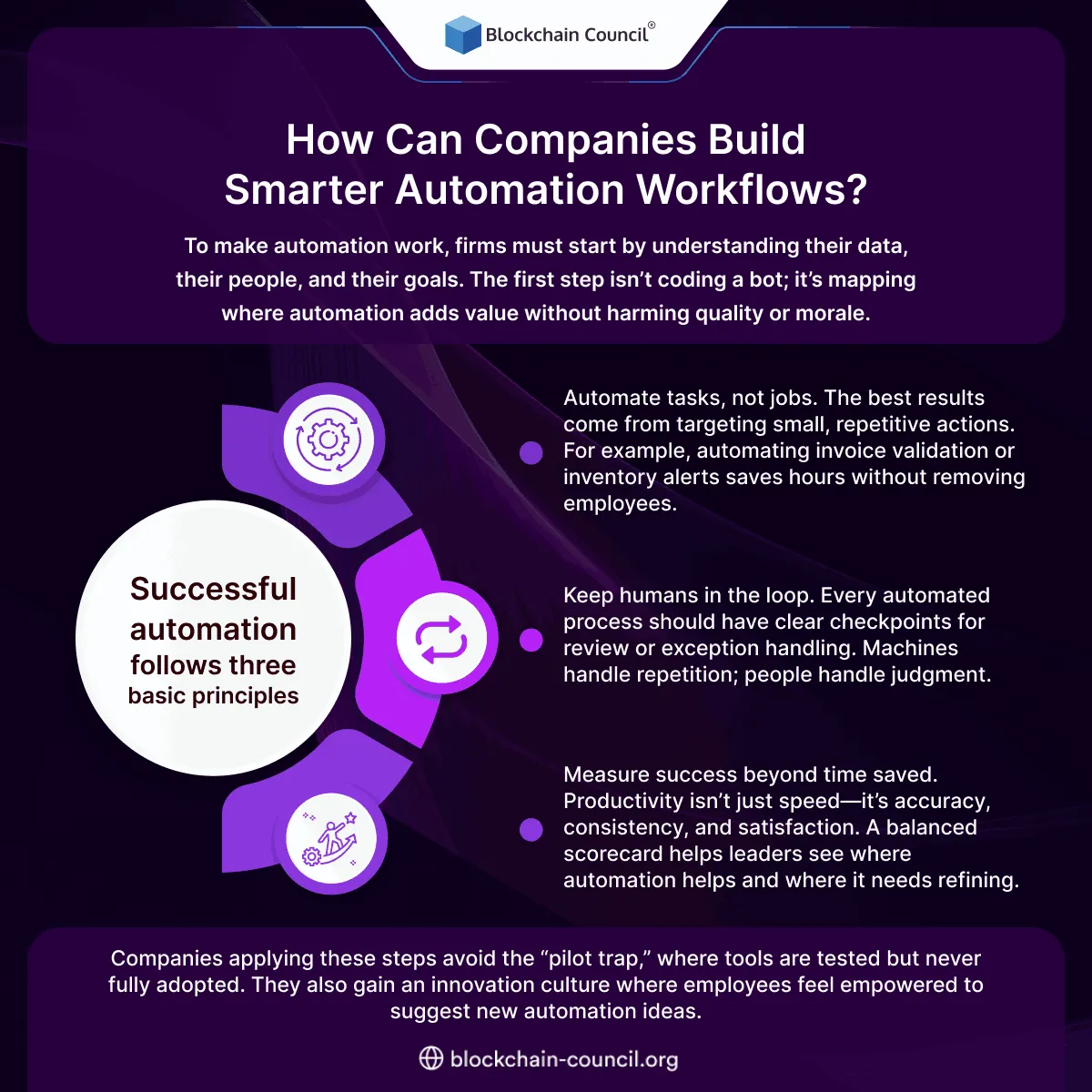
To make automation work, firms must start by understanding their data, their people, and their goals. The first step isn’t coding a bot; it’s mapping where automation adds value without harming quality or morale.
Successful automation follows three basic principles:
- Automate tasks, not jobs. The best results come from targeting small, repetitive actions. For example, automating invoice validation or inventory alerts saves hours without removing employees.
- Keep humans in the loop. Every automated process should have clear checkpoints for review or exception handling. Machines handle repetition; people handle judgment.
- Measure success beyond time saved. Productivity isn’t just speed—it’s accuracy, consistency, and satisfaction. A balanced scorecard helps leaders see where automation helps and where it needs refining.
Companies applying these steps avoid the “pilot trap,” where tools are tested but never fully adopted. They also gain an innovation culture where employees feel empowered to suggest new automation ideas.
Leaders who understand how to combine technical tools with human oversight often enroll in programs like the AI certification. This helps them align AI strategies with real business needs instead of chasing trends.
What Does Agentic Automation Mean for Businesses?
Agentic automation goes beyond simple task scripts or chatbots. It involves AI agents—digital entities that can plan, make decisions, and coordinate across multiple systems. Think of them as proactive assistants that handle entire workflows, not just single commands.
For example, in a logistics company, one AI agent could monitor shipment delays, another could contact vendors automatically, and a third could update the dashboard for managers. Together, they create an automated loop that runs around the clock.
Agentic automation also connects multiple departments. In finance, an agent can prepare compliance reports by pulling data from accounting software, verifying entries, and sending updates to auditors. In customer service, another can track unresolved tickets and generate follow-up plans.
Workers who understand how to design or manage these systems are in high demand. The agentic ai certification trains professionals to work with multi-agent systems that can handle reasoning, delegation, and feedback. It’s not about coding—it’s about managing a digital workforce intelligently.
When businesses implement agentic systems, they free employees to focus on innovation and customer relationships. It turns automation from a cost-saving measure into a value-creation engine.
How Do Companies Avoid the Pitfalls of Automation?
Automation fails when it’s rushed or poorly communicated. Employees fear replacement, managers struggle with unclear goals, and processes break down without oversight. The most common pitfalls are:
- Lack of transparency: Workers need to know what automation is doing and why. Hidden changes create mistrust.
- Poor data quality: AI systems are only as reliable as the data they receive. Inconsistent inputs lead to wrong outputs.
- Skill gaps: Without training, employees can’t adapt or supervise the new systems.
- Short-term focus: Businesses that chase immediate cost savings often miss long-term benefits like quality improvement and scalability.
To avoid these issues, companies should pair automation with a strong change management strategy. They should involve employees early, set clear performance metrics, and communicate benefits frequently. Upskilling programs play a major role here. Offering pathways such as Data Science Certification helps workers develop confidence and control in automation-heavy environments.
Firms also benefit from internal AI councils or governance teams. These groups oversee data ethics, workflow consistency, and risk management. A transparent system builds trust among both workers and customers.
How Is Automation Redefining Leadership and Management?
Managers once focused on controlling people and processes. Now, they manage hybrid teams made of humans and algorithms. The role of leadership is changing from supervision to orchestration.
Modern leaders must balance three things: technology, talent, and trust. They need to understand automation tools well enough to judge their reliability. They must nurture talent by reskilling staff. And they must build trust by being open about how AI influences decision-making.
Programs like the Marketing and Business Certification are increasingly popular among leaders adapting to this change. They focus on using automation ethically and effectively, aligning AI strategies with customer experience and brand goals.
In data-driven environments, leaders rely on real-time insights rather than gut instinct. AI dashboards show performance metrics instantly, helping them make faster, smarter decisions. But emotional intelligence still matters. People follow leaders who can explain technology in human terms.
Automation doesn’t remove leadership—it demands better leadership.
How Does Automation Affect Employees’ Well-Being and Motivation?
Automation can either relieve stress or increase it—it depends on how it’s implemented. When used thoughtfully, it eliminates monotonous tasks, reducing burnout and freeing employees for creative work. When handled poorly, it can make workers feel replaced or monitored.
The best companies use automation to enhance job satisfaction. They redesign roles to give employees more control over high-value activities. For example, when customer service agents use AI to handle FAQs, they have more time to solve complex cases and build relationships.
Employees report higher motivation when they feel AI helps rather than hinders them. Surveys show that staff who use automation tools daily are more optimistic about their careers. They see technology as an enabler, not a threat.
To sustain this positive impact, firms should invest in training and well-being. Providing access to online learning or hosting internal “automation labs” keeps morale high and skills current.
How Is Automation Transforming Small Businesses and Startups?
Small businesses once struggled to compete with large enterprises due to limited manpower. Automation is closing that gap. Affordable tools for marketing, bookkeeping, and inventory management now allow startups to operate globally with minimal staff.
A small e-commerce brand, for example, can use AI-powered systems to manage product listings, process orders, and even run ad campaigns automatically. The owner focuses on creative direction and customer engagement rather than routine tasks.
Automation also makes scaling easier. When business grows, digital systems handle the extra workload without adding new employees immediately. This flexibility lets entrepreneurs focus on strategy and innovation.
However, responsible use of automation remains vital. Small businesses must follow privacy rules, avoid bias in algorithms, and ensure human oversight. Learning from blockchain technology courses helps in building transparent and tamper-proof systems, especially when handling sensitive data.
Automation doesn’t just boost efficiency—it builds credibility by delivering consistent, accurate results.
What Role Does Data Play in Automation?
Data is the lifeblood of automation. Every automated process depends on data quality, availability, and interpretation. Whether it’s customer records, financial logs, or inventory updates, the accuracy of automation outcomes depends entirely on what goes in.
Clean, well-structured data enables better decision-making. Companies now invest in data governance frameworks to maintain this standard. These frameworks define how data is collected, stored, and used. They also include guidelines for privacy and ethical AI.
The rise of automation has made data literacy a universal skill. Employees who can interpret trends or spot anomalies are invaluable. This is where training in tech certifications becomes essential. Understanding how data flows through systems allows employees to collaborate with AI confidently and responsibly.
In the near future, data accuracy may become part of every employee’s performance review. Everyone—from analysts to marketers—will be expected to ensure data integrity.
How Is Automation Creating New Career Paths?
While automation changes existing jobs, it also creates entirely new ones. Roles like AI trainer, prompt engineer, automation analyst, and data ethicist didn’t exist a few years ago. Today, they are among the fastest-growing positions in the global job market.
Each of these roles sits at the intersection of technology and human insight. AI trainers, for instance, fine-tune machine behavior. Automation analysts monitor system performance and suggest improvements. Data ethicists ensure AI decisions remain fair and explainable.
These careers offer high stability because they combine technical understanding with judgment—something automation cannot replace.
Educational institutions and online platforms are already adjusting. Courses in technology and applied AI prepare students for hybrid roles that combine logic and creativity. Workers who invest in these programs now will lead the next phase of the digital economy.
How Can Governments and Policymakers Support Fair Automation?
Governments play a crucial role in ensuring automation benefits society, not just corporations. They can support workers through reskilling programs, incentives for lifelong learning, and social safety nets for those in transition.
Public-private partnerships are especially effective. Governments provide funding and infrastructure, while companies offer practical training. This collaboration ensures workers stay employable even as industries evolve.
Some countries are experimenting with tax benefits for companies that reskill employees instead of laying them off. Others are introducing grants for small firms adopting ethical AI. Policies that encourage human-AI collaboration help economies grow sustainably.
Governments also need to update labor laws to include protections for digital workers and freelancers. As automation enables more gig-based work, fair pay and data rights become essential to prevent exploitation.
What Does the Future of Employment Look Like in an Automated World?
The future of employment will be more fluid, project-based, and global. People will work in teams where AI handles logistics, analysis, and routine decisions. Employees will focus on innovation, empathy, and creative problem-solving.
Automation will also change how success is measured. Instead of counting hours worked, companies will evaluate impact—how much value an individual contributes through insight and creativity.
Workers who keep learning will find endless opportunities. Those who resist change will struggle. The formula is simple: adaptation equals security.
Related Articles
View All
AI & ML
OpenClaw: The Local AI Agent Changing No-Code Automation
OpenClaw is a local-first, open-source AI agent for Telegram and WhatsApp automation. Learn about the latest updates, use cases, and how OpenClaw compares to Claude.
AI & ML
What is OpenAI API?
Technology continues advancing and artificial intelligence is becoming an essential part of everyday activities. From virtual assistants to automatic writing apps, AI now handles tasks that used to require human effort. Many people interact with AI without even thinking about it: whether it's getting recommendations online or using a chatbot for quick support.
AI & ML
Learning AI with Microsoft Copilot
Microsoft Copilot is a powerful AI tool designed to enhance productivity and creativity across various applications, making it essential for professionals in today's AI-driven landscape.
Trending Articles

The Role of Blockchain in Ethical AI Development
How blockchain technology is being used to promote transparency and accountability in artificial intelligence systems.

AWS Career Roadmap
A step-by-step guide to building a successful career in Amazon Web Services cloud computing.

Top 5 DeFi Platforms
Explore the leading decentralized finance platforms and what makes each one unique in the evolving DeFi landscape.