Apple Vision Pro
 Michael Willson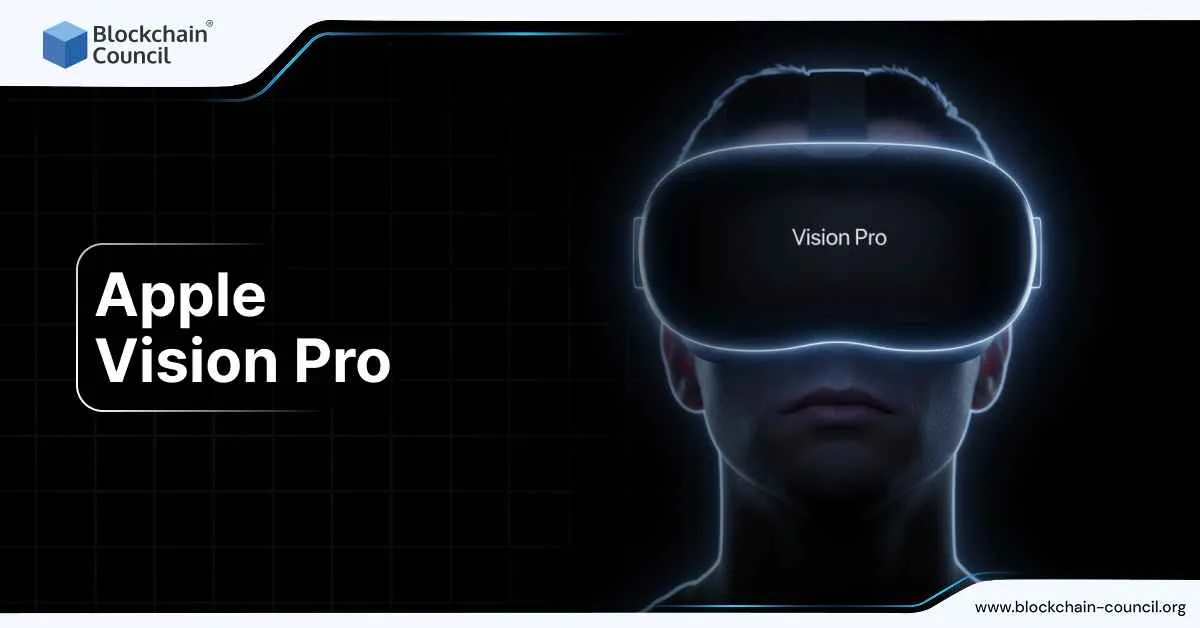
What is Apple Vision Pro?
Apple Vision Pro represents Apple’s most ambitious move into spatial computing so far. Rather than positioning it as a gaming headset or a productivity accessory alone, Apple has framed Vision Pro as a new category of personal computer that blends digital content directly into the physical world. Since its announcement and subsequent updates, the device has become a reference point for how augmented reality and virtual reality hardware may evolve over the next decade.
As spatial interfaces move from experimental labs into consumer and professional use, understanding how immersive systems are designed, built, and interacted with has become increasingly relevant. This shift has driven growing interest in structured learning paths such as an AR VR certification, especially for developers and designers working on spatial environments, gesture-based interfaces, and 3D content workflows.

Launch Date
Apple first unveiled Apple Vision Pro on 5 June 2023 during its WWDC keynote. At that time, Apple described it as a “spatial computer” rather than a traditional AR or VR headset. The initial US launch followed on 2 February 2024, with pre-orders opening on 19 January 2024.
International expansion happened in stages throughout 2024. On 28 June 2024, Vision Pro launched in China, Hong Kong, Japan, and Singapore. This was followed by releases in Australia, Canada, France, Germany, and the UK on 12 July 2024, and later in South Korea and the UAE on 15 November 2024.
A significant update arrived on 22 October 2025, when Apple released an upgraded Apple Vision Pro model powered by the new M5 chip, alongside a redesigned Dual Knit Band aimed at improving comfort during extended use.
Hardware and Display Technology
At the core of Apple Vision Pro is its display system. The headset uses dual Micro-OLED panels that together deliver approximately 23 million pixels, a figure Apple often compares to more than a 4K television for each eye. This extremely high pixel density is central to making text readable and reducing the screen-door effect common in earlier headsets.
The original model shipped with an Apple M2 chip for general computing tasks and a dedicated Apple R1 chip to process sensor input with minimal latency. The updated 2025 model moved to the Apple M5 chip, built on a 3-nanometer process, featuring a 10-core CPU, 10-core GPU, and a 16-core Neural Engine. This upgrade enabled higher sustained performance, improved thermal efficiency, and refresh rates reaching 120 Hz in supported experiences.
Sensors play an equally important role. Apple Vision Pro includes multiple world-facing cameras, inward-facing eye-tracking cameras, LiDAR, TrueDepth sensors, and inertial measurement units. Together, they allow precise tracking of head movement, hand gestures, and eye focus, forming the basis of Apple’s input system.
Interaction and Spatial Experience
Apple Vision Pro does not rely on physical controllers by default. Interaction is handled through a combination of eye tracking, hand gestures, and voice commands. Users look at an element, pinch their fingers to select it, and use subtle hand movements to scroll or manipulate objects.
This interaction model places Apple Vision Pro squarely at the intersection of augmented and virtual reality. Apple also introduced spatial photos and spatial video, allowing users to capture 3D memories that can later be viewed inside Vision Pro. These features rely heavily on Apple’s computational photography pipeline.
visionOS and Software Evolution
Apple Vision Pro runs on visionOS, a new operating system designed specifically for spatial computing. Instead of flat app windows fixed to a screen, visionOS allows apps to exist as floating elements anchored in the user’s environment.
A major software milestone came at WWDC on 10 June 2025, when Apple announced visionOS 26. This update introduced support for immersive 180-degree and 360-degree video, improved Personas for FaceTime, and deeper integration with external devices. Apple also confirmed partnerships with companies such as Sony, Canon, and GoPro to expand spatial media creation and playback.
visionOS 26 also added support for PlayStation VR2 Sense controllers, signaling Apple’s willingness to support external input hardware for certain use cases, especially gaming and simulation.
Features
Apple Vision Pro uses an external battery pack connected via cable. Battery life varies depending on usage, averaging around 2.5 hours for general tasks and up to 3 hours for video playback on the M5 model. While this design reduces headset weight, it has also been a point of debate among early adopters.
Comfort has been another area of focus. The Dual Knit Band, introduced with the 2025 update, distributes weight more evenly across the head and improves airflow. Apple made this change after feedback from users who experienced fatigue during longer sessions.
Market Reception
Apple Vision Pro entered the market at a premium price point, starting at USD 3,499 for the 256GB model. This positioned it well above mainstream VR headsets and limited early adoption.
Industry estimates suggest that fewer than 500,000 units were sold globally in the first year after launch. While this is modest by Apple standards, the company has consistently framed Vision Pro as a long-term platform rather than a mass-market product.
In 2025, reports indicated that Apple reallocated some engineering resources toward future smart glasses projects, suggesting Vision Pro is part of a broader roadmap rather than a standalone experiment.
Use Cases
Beyond entertainment, Apple Vision Pro has found traction in professional and creative fields. Medical visualization, design review, remote collaboration, and immersive training are among the areas where the device has been tested.
Academic studies published in 2025 showed that Vision Pro’s eye-tracking system achieved over 90% accuracy in controlled gaze-tracking experiments. Developers have also explored its use in digital pathology, architecture walkthroughs, and engineering simulations.
Building and deploying such applications requires not just creative skill but a solid understanding of platforms, operating systems, and performance constraints. This is where broader technical foundations, such as those covered in a Tech Certification, become relevant for teams working on spatial computing projects.
Business Strategy and Apple’s Long Game
From a business perspective, Apple Vision Pro is less about immediate sales volume and more about establishing Apple’s position in spatial computing. By controlling the hardware, operating system, and app distribution, Apple is laying the groundwork for future devices that may be lighter, cheaper, and more widely adopted.
For organizations evaluating how such technologies fit into their long-term strategy, understanding the commercial implications is as important as the technology itself. Aligning product innovation with market readiness and user demand is often guided by frameworks like the Marketing and Business Certification, which focus on turning advanced technology into sustainable business outcomes.
Conclusion
Apple Vision Pro is not a replacement for smartphones or laptops, at least not yet. It is a high-end spatial computing platform aimed at early adopters, developers, and professionals who want to explore what comes next.
Its true impact will likely be measured not by current sales figures but by how its ideas influence future hardware. Eye-based input, spatial interfaces, and immersive content are now firmly part of Apple’s ecosystem. Apple Vision Pro marks the point where those ideas moved from concept to shipping product.