
AI Skill Gap and the Growing Demand for AI Skills
 Michael Willson
The global workforce is falling behind the demand for artificial intelligence skills. Companies in every sector want employees who can work with AI, but the number of qualified professionals is far too small. This gap between demand and supply is slowing down adoption and creating one of the biggest talent shortages in technology today. For professionals looking to stay ahead, starting with an AI certification is one of the best ways to build credibility and practical skills.
Why the AI Skill Gap Exists
AI is developing faster than workers can train for it. Tools like large language models, generative AI, and autonomous systems are becoming standard across industries. Yet most employees are not equipped to use them effectively. Employers in multiple surveys report that more than half of their workforce lacks basic AI literacy. In some regions, less than 20 percent of workers have any AI training at all.

The result is that businesses compete for a limited pool of talent, driving up salaries and slowing down projects. This shortage also creates inequality, as regions with more training access pull further ahead of those with fewer resources. AI certs are now being adopted widely as a practical way to close these gaps.
AI Skill Gap and the Growing Demand for AI Skills
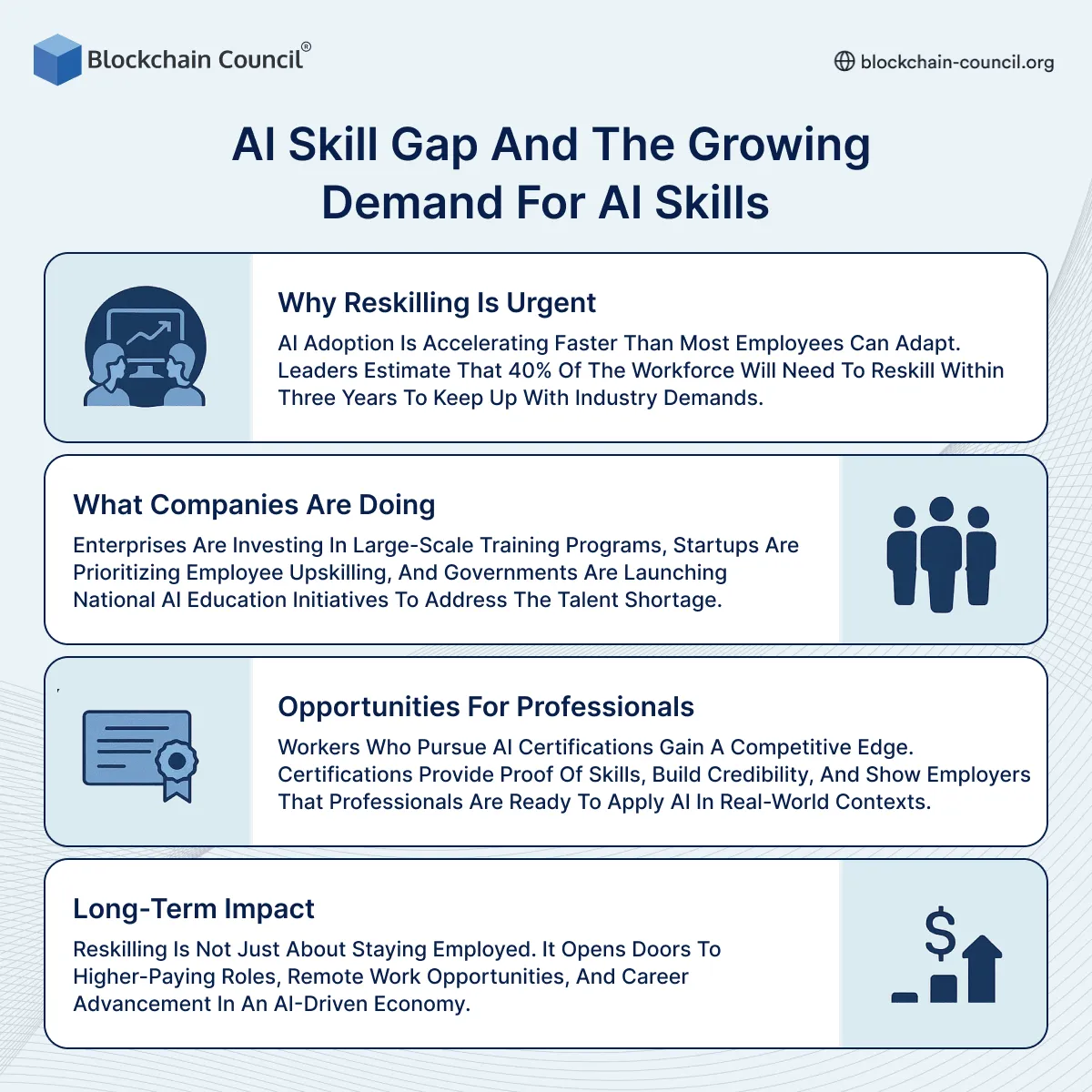
Why Reskilling is Urgent
AI adoption is accelerating faster than most employees can adapt. Leaders estimate that 40% of the workforce will need to reskill within three years to keep up with industry demands.
What Companies Are Doing
Enterprises are investing in large-scale training programs, startups are prioritizing employee upskilling, and governments are launching national AI education initiatives to address the talent shortage.
Opportunities for Professionals
Workers who pursue AI certifications gain a competitive edge. Certifications provide proof of skills, build credibility, and show employers that professionals are ready to apply AI in real-world contexts.
Long-Term Impact
Reskilling is not just about staying employed. It opens doors to higher-paying roles, remote work opportunities, and career advancement in an AI-driven economy.
Rising Demand Across Industries
The demand for AI skills cuts across every sector. Healthcare uses AI in diagnostics. Finance applies AI to detect fraud and manage risk. Manufacturing relies on predictive analytics for supply chains. Even retail and education are reshaping their services with AI-driven solutions.
As spending on AI exceeds half a trillion dollars globally, demand for talent continues to accelerate. Companies now offer higher pay, remote flexibility, and better benefits for roles involving AI skills. This shift makes AI-related jobs some of the most rewarding career paths available.
The Pressure to Reskill
Leaders estimate that around 40 percent of their employees must reskill within three years to stay relevant. Enterprises are funding training, startups are investing in employee upskilling, and governments are launching national AI education programs.
For professionals who want to focus on managing AI data pipelines, a Data Science Certification is a strong option. It teaches how to handle the large-scale datasets that fuel modern AI.
The Shift Toward Skill-Based Hiring
Employers are moving away from focusing only on degrees. They are prioritizing candidates who can prove their abilities through certifications and hands-on projects. AI jobs now offer a wage premium of over 20 percent, and companies are more willing to hire based on skill demonstration rather than traditional education.
This change creates opportunities for professionals who are willing to learn continuously. AI certs offer proof of competence and help bridge the gap between education and practice.
Balancing Technical and Human Skills
While technical knowledge is essential, companies also value human skills. Critical thinking, ethical judgment, and communication are all necessary to apply AI responsibly. Professionals who can combine soft skills with AI expertise will remain the most competitive.
For leaders and strategists, the Marketing and Business Certification offers insight into applying AI at an organizational level, aligning it with growth and customer trust.
Why Closing the Gap Matters
Bridging the AI skill gap is not just about filling jobs. It is about improving productivity, enabling innovation, and keeping economies competitive. Workers who adapt now will gain access to higher pay, more flexible roles, and opportunities in emerging industries. Businesses that invest in training will unlock the full value of AI and avoid falling behind their rivals.
Conclusion
The AI skill gap is one of the most urgent challenges in today’s job market. With rapid adoption across industries, the need for skilled workers grows sharper each year. From prompt engineering and data science to ethics and leadership, the range of skills required is expanding quickly.
Related Articles
View All
AI & ML
Freelancing with Vibe Coding Skills
Learn how vibe coding empowers freelancers to deliver faster, smarter, and more efficient AI-driven projects.

AI & ML
Top 12 Essential AI Skills
Explore the top 12 essential AI skills for 2026, including prompt engineering, RAG, edge AI, MLOps, multimodal AI, governance, and core ML foundations.

AI & ML
Essential AI Skills for 2026
Explore essential AI skills for 2026, from prompt engineering and AI agents to multimodal workflows, AI-assisted coding, automation, tool fluency, and responsible AI.
Trending Articles

The Role of Blockchain in Ethical AI Development
How blockchain technology is being used to promote transparency and accountability in artificial intelligence systems.

AWS Career Roadmap
A step-by-step guide to building a successful career in Amazon Web Services cloud computing.

Top 5 DeFi Platforms
Explore the leading decentralized finance platforms and what makes each one unique in the evolving DeFi landscape.