
AI in Shaping Collective Memory
 Michael Willson
What we remember as a society has always depended on who controls the story. For centuries, memory was curated by historians, artists, and archivists. Today, algorithms and artificial intelligence have joined that circle of influence. AI now plays a central role in shaping collective memory—not just preserving the past but reconstructing and sometimes rewriting it. As AI learns from human data and reshapes narratives across news, social media, and culture, it quietly decides which parts of our shared history endure and which fade into digital obscurity.
For professionals and learners trying to understand this shifting landscape, it’s crucial to look beyond the technical side of AI and explore its cultural and ethical dimensions. A great way to start is with an AI certification that combines technical understanding with insights into how AI affects social narratives, history, and public knowledge.

What Is Collective Memory—and Why Does AI Matter?
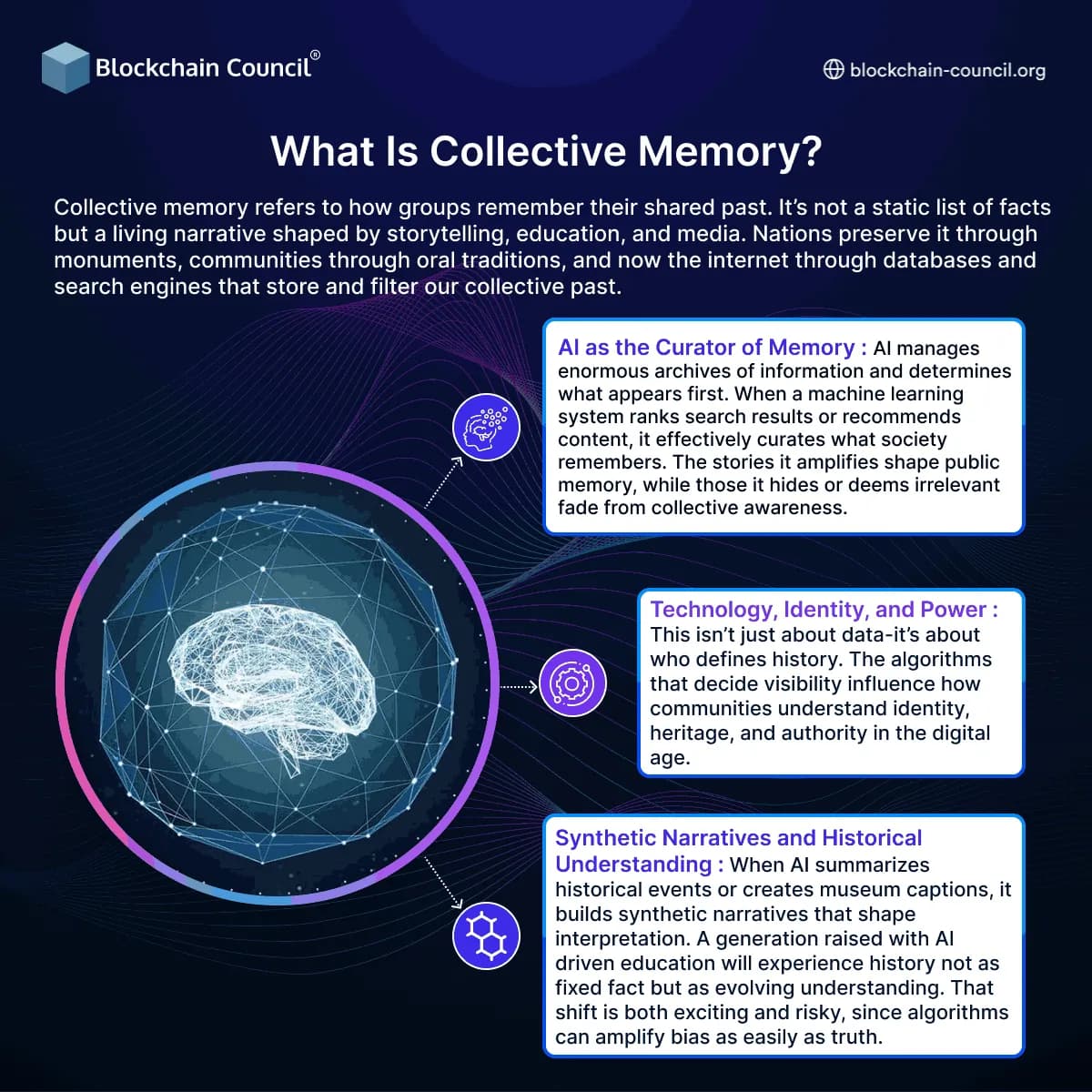
Collective memory refers to how groups of people remember their shared past. It’s not a list of facts but a living narrative shaped by storytelling, education, and media. Nations have monuments, communities have oral traditions, and now the internet has databases and search engines that store—and filter—our collective past.
AI reshapes this process because it manages enormous archives of information and decides what surfaces first. When a search engine powered by machine learning ranks results, it effectively becomes a curator of memory. The stories it amplifies define what we collectively recall, while those it hides or deems irrelevant slowly disappear from public awareness. This isn’t just about technology—it’s about identity, heritage, and power.
For example, when AI summarises historical events or generates museum captions, it creates synthetic narratives that influence understanding. A generation growing up with AI-driven education will experience history not as static fact but as dynamic interpretation. That’s both exciting and risky—because algorithms can amplify biases as easily as truths.
How Does AI Curate What We Remember?
Artificial intelligence curates memory through algorithmic selection. Systems like recommendation engines and content-ranking models determine which events, images, and stories gain visibility. This process mirrors human memory: we remember what’s repeated or emotionally powerful, while the rest fades. The difference is that AI decides these repetitions for billions of users simultaneously.
Platforms using AI for content recommendation often privilege engagement over diversity. That means emotionally charged or popular narratives are shown more often, reinforcing specific worldviews. For instance, AI summarisation tools can unintentionally prioritise dominant cultural perspectives while downplaying local or minority voices. Over time, this shapes what societies believe to be common knowledge.
This raises an uncomfortable truth: digital memory is selective by design. It depends on datasets, model training, and commercial interests. When algorithms decide what’s worth remembering, they also define what can be forgotten. That’s why scholars increasingly call AI a “memory infrastructure”—it’s not a neutral tool but a social system that governs access to history.
To understand how this happens technically, courses like the Data Science Certification teach how data pipelines, model weighting, and sampling affect what information survives in AI systems. Learning these mechanisms isn’t just for coders; it’s essential for anyone interested in preserving truth in the digital age.
How Is AI Changing Historical Preservation?
Traditionally, archives were physical spaces curated by historians. Now, AI assists in digitising, restoring, and recreating historical records. For example, machine learning models can fill gaps in damaged photographs or reconstruct lost artworks from partial fragments. In Latin America, AI tools are being used to restore portraits of individuals erased during political repression. These projects give voice to those history once silenced, demonstrating AI’s potential to recover collective memory, not just distort it.
However, the same tools can also manipulate the record. Deepfake technologies blur the line between authentic restoration and creative fabrication. An AI-generated “documentary” can appear factual even if it’s built from synthetic footage. Once such content spreads, it becomes part of public perception, which future generations might accept as real history. The result is epistemic confusion—a blend of truth and fiction woven so seamlessly that even experts struggle to separate them.
That duality defines AI’s role in memory: it can preserve justice or produce illusion. The key lies in governance and transparency. Without clear labelling, accountability, or provenance tracking, AI risks eroding trust in historical truth. Researchers and technologists are now calling for frameworks that treat digital heritage as a protected space, similar to environmental preservation laws.
Can AI Strengthen Forgotten Voices?
While much concern focuses on AI’s distortive potential, it can also democratise remembrance. Communities without formal archives can use AI tools to document oral histories, translate endangered languages, or connect scattered genealogical data. Through natural language processing, AI can analyse thousands of personal testimonies, finding recurring themes that might otherwise remain unnoticed. This transforms isolated memories into collective narratives.
In refugee and post-conflict settings, such projects are already underway. AI helps encode survivor testimonies, linking individual experiences to global databases that preserve stories for future education and reconciliation. These systems can highlight marginalised histories—provided they’re trained responsibly and audited for bias.
This is where ethical design becomes critical. Developers must decide whose memories count and how they are represented. Pursuing education through programs like the Agentic AI Certification helps professionals learn how to embed ethical awareness in AI systems, ensuring that memory curation remains inclusive rather than extractive.
How Do Algorithms Influence Forgetting?
Forgetting is as important as remembering—it’s how societies move forward. But when algorithms continuously recycle content for engagement, forgetting becomes difficult. AI-driven feeds can trap users in cycles of repetition, resurfacing traumatic or divisive content. At the same time, stories that aren’t optimised for visibility simply disappear.
This phenomenon is known as algorithmic forgetting. It’s not deliberate erasure but structural neglect. Historical injustices, local histories, and minority perspectives may fade because they don’t perform well in data metrics. When that happens, AI doesn’t just forget—it teaches us to forget.
To counter this, researchers propose embedding “ethical forgetting” into AI systems: allowing communities to request data deletion or to contextualise outdated information. It’s a digital version of cultural healing. Understanding how to implement these principles in real-world systems is one reason many professionals turn to tech certifications. They provide the foundation to translate ethical ideals into technical architectures that respect both memory and privacy.
How Does AI Shape Collective Identity and Cultural Memory?
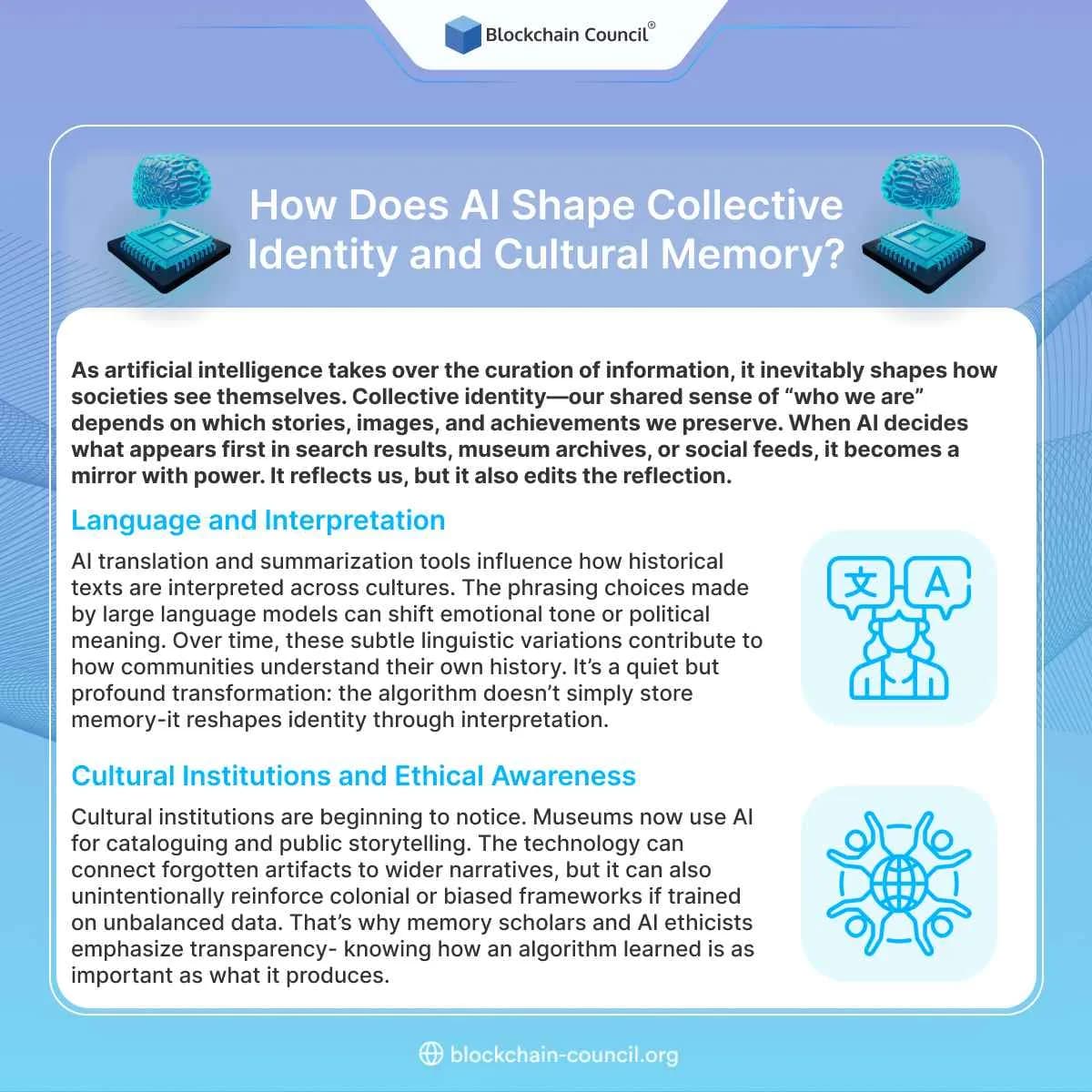
As artificial intelligence takes over the curation of information, it inevitably shapes how societies see themselves. Collective identity—our shared sense of “who we are”—depends on which stories, images, and achievements we preserve. When AI decides what appears first in search results, museum archives, or social feeds, it becomes a mirror with power. It reflects us, but it also edits the reflection.
For example, AI translation and summarisation tools influence how historical texts are interpreted across cultures. The phrasing choices made by large language models can shift emotional tone or political meaning. Over time, these subtle linguistic variations contribute to how communities understand their own history. It’s a quiet but profound transformation: the algorithm doesn’t simply store memory—it reshapes identity through interpretation.
Cultural institutions are beginning to notice. Museums now use AI for cataloguing and public storytelling. The technology can connect forgotten artefacts to wider narratives, but it can also unintentionally reinforce colonial or biased frameworks if trained on unbalanced data. That’s why memory scholars and AI ethicists emphasise transparency—knowing how an algorithm learned is as important as what it produces.
For professionals in media, education, or heritage management, developing AI literacy is now a cultural necessity. Understanding algorithmic influence through structured programs like the Data Science Certification helps ensure that machine-driven narratives reflect truth and diversity rather than distortion.
What Happens When AI Rewrites History?
The phrase “AI rewriting history” used to sound metaphorical. Now, it’s literal. Generative models can create realistic images, speeches, or entire historical reconstructions that never existed. A convincingly rendered “photo” of a past event can circulate online before experts can verify it. This raises an unsettling question: if millions believe a synthetic memory, does it become part of collective truth?
In the short term, misinformation may be the biggest risk. In the long term, the challenge is ontological—what counts as real history? If AI-generated narratives fill gaps in our knowledge, they could gradually merge with factual archives. For instance, deep-learning models used in documentary filmmaking can animate historical figures with realistic voice synthesis. This brings history to life but blurs the boundary between preservation and invention.
Some projects address this by embedding provenance metadata—digital tags that record when, where, and how AI content was generated. This approach parallels ethical labelling in journalism: audiences can see the chain of creation and judge reliability. It’s a technical solution with philosophical weight, because it reinstates accountability in an era of infinite remixing.
The discussion also extends to education. When students encounter AI summaries or reconstructions, they must learn to question how these were built. This makes critical thinking and AI literacy as vital as reading and writing. Programs like the AI certification prepare learners to evaluate not only algorithmic outputs but also their broader cultural consequences.
How Is AI Used to Reconstruct Lost Heritage?
Not all rewriting is harmful. In many parts of the world, AI is helping to reconstruct erased or damaged cultural memory. Through image restoration, linguistic modelling, and data synthesis, communities can recover elements of their past that would otherwise remain lost.
Take, for instance, archaeological sites in regions where conflict or climate change has destroyed physical heritage. AI models can rebuild digital twins of monuments or artefacts from scattered photographs. In some countries, neural networks help reconstruct indigenous oral histories by translating and organising audio archives. These tools enable people to reconnect with their cultural lineage.
Still, these reconstructions raise delicate ethical questions. Who controls the recovered data? Can digital reconstructions ever replace lived traditions? Some anthropologists argue that AI should be seen as a memory assistant, not an author. It helps humans remember but shouldn’t dictate what’s remembered. Striking that balance requires cultural sensitivity, legal clarity, and technical transparency—skills that modern governance programs and Agentic AI Certification pathways are beginning to promote.
How Does Algorithmic Memory Reinforce Power Structures?
Every society has competing versions of its history, but AI can tilt the balance in favour of dominant narratives. Algorithms trained primarily on Western or corporate data sources tend to reproduce those worldviews. When this happens, the cultural output of AI reflects global inequality—it amplifies the loudest voices while silencing others.
This phenomenon is known as algorithmic colonialism. It’s not about physical territory but about narrative territory—who gets to define truth. A chatbot describing historical events, for example, may unintentionally echo the perspective of its largest data source. If left unchecked, AI could solidify cultural hierarchies under the guise of neutrality.
To counter this, researchers advocate cognitive sovereignty—the right of communities to govern their own digital memory. This includes the ability to train AI systems on local data, use indigenous languages, and control how cultural artefacts are represented online. Countries across Africa and Latin America are already developing frameworks to achieve this autonomy, recognising memory as a strategic resource.
Governments and organisations that want to engage responsibly in these initiatives need professionals who can navigate both data governance and cultural ethics. That’s where interdisciplinary programs like tech certifications and Marketing and Business Certification play a role—they equip decision-makers with the literacy to balance innovation with inclusivity.
What Is “Collective Forgetting” in the Age of AI?
Forgetfulness used to be a natural part of cultural evolution. Myths faded, archives decayed, and societies moved on. In the digital era, forgetting has become almost impossible. Every post, photo, or conversation can live forever in the cloud, indexed and resurfaced by machine learning systems. This permanent memory can feel like immortality—but it’s also a kind of psychological burden for societies.
AI magnifies this challenge by reviving old controversies through resurfaced data. An algorithm designed to promote engagement might repeatedly resurface traumatic content or outdated stereotypes. Meanwhile, voices that challenge the algorithm’s logic can vanish, buried by relevance scores and popularity metrics.
Some ethicists suggest designing AI systems that can forget gracefully—removing outdated information while preserving historical context. This idea of algorithmic amnesty is still experimental but could become central to digital governance. It’s about curating time itself, deciding when memory should fade for healing to begin.
Understanding this balance between remembering and forgetting requires both philosophical and technical insight. Many data-governance frameworks now incorporate these ideas into policy training, often aligned with global AI ethics education. For those wanting to participate in this evolving dialogue, exploring foundational blockchain technology courses can offer useful grounding in transparency and provenance—concepts essential to trustworthy digital memory.
How Does AI-Driven Memory Affect Democracy and Public Discourse?
Collective memory isn’t just cultural—it’s political. The stories societies preserve shape how people vote, protest, and define justice. When AI systems filter, summarise, or recommend political content, they influence not only what we know but also what we believe happened. This makes AI a powerful participant in democracy, one that can either strengthen public understanding or distort it.
When search algorithms highlight some historical narratives over others, they tilt the collective memory of entire populations. Political campaigns already use machine learning to reinforce identity-based messages, subtly rewriting the emotional memory of national events. For example, algorithms can personalise historical reminders—selectively resurfacing patriotic or traumatic moments—to influence how people perceive current policies. This transforms AI from an archive tool into a memory weapon.
That’s why transparency and education are crucial. Citizens must learn to question algorithmic histories the same way they question political rhetoric. Building this awareness starts with digital literacy and structured programs such as [AI certs], which help individuals identify bias, misinformation, and manipulation within algorithmic systems. Democracy’s resilience will depend on how well people understand that collective memory is now algorithmically managed.
What Are the Ethical Responsibilities of AI Developers?
Every engineer who builds or trains an AI model is, in a sense, a historian of the future. The datasets they select, clean, and deploy will inform how generations remember the present. That’s why ethical accountability in AI development goes beyond fairness—it includes responsibility for narrative shaping. Developers are curating tomorrow’s history each time they choose what to include or exclude in a model.
Responsible AI teams are beginning to incorporate memory ethics into their workflows. This involves documenting training sources, monitoring cultural balance, and consulting historians, sociologists, or anthropologists before deploying large-scale systems. These measures help ensure that digital memory remains inclusive rather than extractive.
Ethical design also means providing users with tools to challenge or amend AI-generated content. A future archive might include correction layers—digital notes where communities can add context or alternative perspectives. This model mirrors the collaborative nature of Wikipedia but powered by AI moderation and provenance tracking.
Professionals aiming to contribute to such governance should pursue structured learning that integrates both ethics and innovation, like the Agentic AI Certification. It provides frameworks for balancing machine autonomy with moral accountability—a skill increasingly necessary as AI becomes a storyteller in its own right.
How Can Societies Protect the Integrity of Collective Memory?
Preserving the integrity of collective memory in an AI-driven world will require global coordination. Just as we have institutions that safeguard cultural heritage, there is now a need for digital memory guardianship—policies and systems that protect authenticity, context, and diversity of perspective.
International organisations are already discussing how to ensure algorithmic transparency. The United Nations and UNESCO have proposed frameworks that encourage the use of provenance tracking, watermarking, and open-access archives for digital heritage. These measures prevent misinformation from fossilising into history while maintaining accessibility for researchers and educators.
However, preservation must balance openness with privacy. Some communities might want control over how their data or oral histories are stored, especially when these records involve trauma or identity. This tension—between visibility and consent—is one of the defining ethical questions of digital memory. Addressing it will demand collaboration among technologists, human rights experts, and cultural historians.
For individuals interested in participating in this emerging field, a foundation in interdisciplinary training—such as tech certifications—offers a pathway to understand how technical infrastructures, like blockchain or AI auditing, can preserve authenticity and ownership in digital archives.
What Is the Future of Remembering in the Age of AI?
The future of memory is hybrid—part human, part machine. AI will not replace historians or storytellers, but it will become their collaborator. Imagine archives where machine learning suggests cross-cultural links between historical documents or visualises forgotten connections between global events. This kind of computational remembrance could deepen understanding rather than flatten it—if guided ethically.
At the same time, societies must remain vigilant. The convenience of AI-driven knowledge retrieval can make people forget the effort that genuine remembering requires. Memory isn’t just storage—it’s reflection, empathy, and context. When AI takes over the curation of memory, humans risk outsourcing their capacity to question. The challenge ahead is to ensure technology supports remembering without deciding what to remember.
Governance frameworks will likely evolve toward a shared custodianship model, where institutions, developers, and communities jointly oversee digital archives. This will include maintaining open databases, enabling correction mechanisms, and enforcing provenance labelling for generative media. In this future, the measure of progress will not be how much data we can store but how wisely we preserve meaning.
Why Education Is Central to Ethical Remembering
Education will determine whether AI’s influence on memory becomes empowering or manipulative. Teaching future generations how to verify digital content, question algorithmic authority, and appreciate multiple perspectives will be as vital as teaching reading or history itself.
Courses like the AI certification or the Data Science Certification equip learners with the tools to navigate this landscape responsibly. Meanwhile, disciplines like digital humanities and cognitive science are merging with AI studies, training professionals who can safeguard collective memory across cultures.
Ultimately, AI will be remembered not for the data it stored but for the stories it helped humanity tell. The more inclusive, transparent, and humane those stories become, the stronger our shared memory will be.
Conclusion
AI is no longer just a computational tool—it’s a cultural force deciding what societies remember and what they forget. Its influence extends from search results to art restoration, from education to political discourse. Whether it becomes a preserver of truth or an engine of distortion depends entirely on how we design, regulate, and interact with it.
The path forward requires awareness, ethics, and education. By understanding the mechanisms behind AI’s memory-shaping power, individuals and institutions can build systems that serve truth instead of obscuring it. Investing in learning through frameworks like the Marketing and Business Certification or blockchain technology courses prepares leaders to steer this transformation with wisdom and integrity.
In the end, collective memory is not just about the past—it’s about the future we choose to remember together. AI gives us the tools to recall more than ever before, but only human judgment can ensure those memories remain authentic, inclusive, and worth keeping.
Related Articles
View All
AI & ML
Google’s Gemma 4 Prompts
Gemma 4 prompts are instructions or inputs that you give to the Gemma AI model to generate responses. In simple words, a prompt is: A question A command Or a description of what you want For example: “Write a blog on healthy eating” “Explain digital marketing in simple terms” However, not all prompts give good results. Therefore, structured and clear prompts work best.

AI & ML
Google’s Gemma 4 Runs Frontier AI on a Single GPU
Gemma 4’s ability to run on a single GPU marks a major shift in AI accessibility. This article explains its impact on cost, scalability, and real-world AI adoption.

AI & ML
Google Launches Gemma 4 for Faster, Offline Use
Google’s Gemma 4 brings a new era of AI by enabling fast, offline performance. Designed for efficiency, it allows developers to run advanced AI models without relying on cloud infrastructure.
Trending Articles

The Role of Blockchain in Ethical AI Development
How blockchain technology is being used to promote transparency and accountability in artificial intelligence systems.

AWS Career Roadmap
A step-by-step guide to building a successful career in Amazon Web Services cloud computing.

Top 5 DeFi Platforms
Explore the leading decentralized finance platforms and what makes each one unique in the evolving DeFi landscape.