AI and the Psychological Experience of Work
 Michael Willson
What Is the Psychological Experience of AI at Work?
Artificial intelligence has entered the workplace quietly but powerfully. It’s in the tools that schedule meetings, analyse performance, filter resumes, and even measure customer sentiment. But beneath the statistics and productivity charts lies a subtler change — how AI makes people feel at work.
For many employees, AI has become both a relief and a source of stress. It lightens workloads yet raises questions about relevance and control. It speeds up decision-making but sometimes leaves workers wondering whether their opinions still matter. This emotional push and pull defines the new psychological experience of work in the AI era.

The modern worker now navigates two realities: the tangible tasks they complete and the invisible algorithms that shape how those tasks happen. This is why professionals are increasingly turning to structured learning such as an AI certification. Understanding how AI fits into workflows—and how it affects human behaviour—can make the difference between feeling empowered and feeling overwhelmed.
Recent research paints a clear picture. When designed and used responsibly, AI can make people feel more capable and engaged. It removes repetitive work, improves decision quality, and even enhances creativity. But when implemented without transparency or training, it can trigger anxiety, burnout, and distrust.
Where Does AI Reduce Burnout and Where Does It Add Pressure?
AI can be a mental health booster—or a stress multiplier—depending on how it’s introduced. Let’s look at both sides.
On the positive side, AI reduces decision fatigue. Workers spend less time on low-value tasks like checking schedules or generating reports. Tools that summarise meetings or automate data entry give employees more control over their time. When people regain autonomy, their sense of competence increases, and burnout decreases.
AI also helps with cognitive load. Employees no longer need to track every metric manually. Smart dashboards surface insights instantly. In creative roles, AI assists with idea generation, reducing the pressure of constant originality. In customer service, automation filters basic inquiries so humans handle only meaningful interactions.
However, the same technology can also create hidden stress. Constant AI suggestions or alerts can make workers feel micromanaged. If employees don’t understand how systems make decisions, they may question whether performance metrics are fair. The line between assistance and surveillance can blur quickly.
The key factor is design. When AI is framed as a partner that supports judgment, people experience relief. When it’s positioned as a monitor, they experience strain. Companies that involve staff early in the automation process—seeking their feedback and providing training—see higher satisfaction and lower turnover.
What Do Workers Fear About AI and Why Does Anxiety Spread?
Fear of AI isn’t just about losing jobs; it’s about losing control, identity, and purpose. Employees often worry that their skills will become obsolete or that machines will make them redundant. This fear grows stronger when management doesn’t communicate clearly about automation plans.
Psychologists describe this as anticipatory anxiety—stress about a change that hasn’t fully arrived. Workers might not have seen AI directly replace someone, but they sense that it could. This uncertainty erodes motivation and trust.
Another driver of anxiety is lack of transparency. If an AI system decides which leads a salesperson receives or how performance ratings are calculated, employees feel vulnerable. They may doubt the fairness of decisions they can’t question or understand. This anxiety becomes more intense when algorithms are “black boxes” with no visible logic.
Training and inclusion are the best antidotes. When employees understand how AI works—and how their roles fit alongside it—fear drops dramatically. Upskilling programs such as the agentic ai certification teach people to supervise and collaborate with AI systems rather than compete against them. Once workers see how automation complements their skills, confidence replaces insecurity.
What Does Psychological Safety Look Like During AI Adoption?
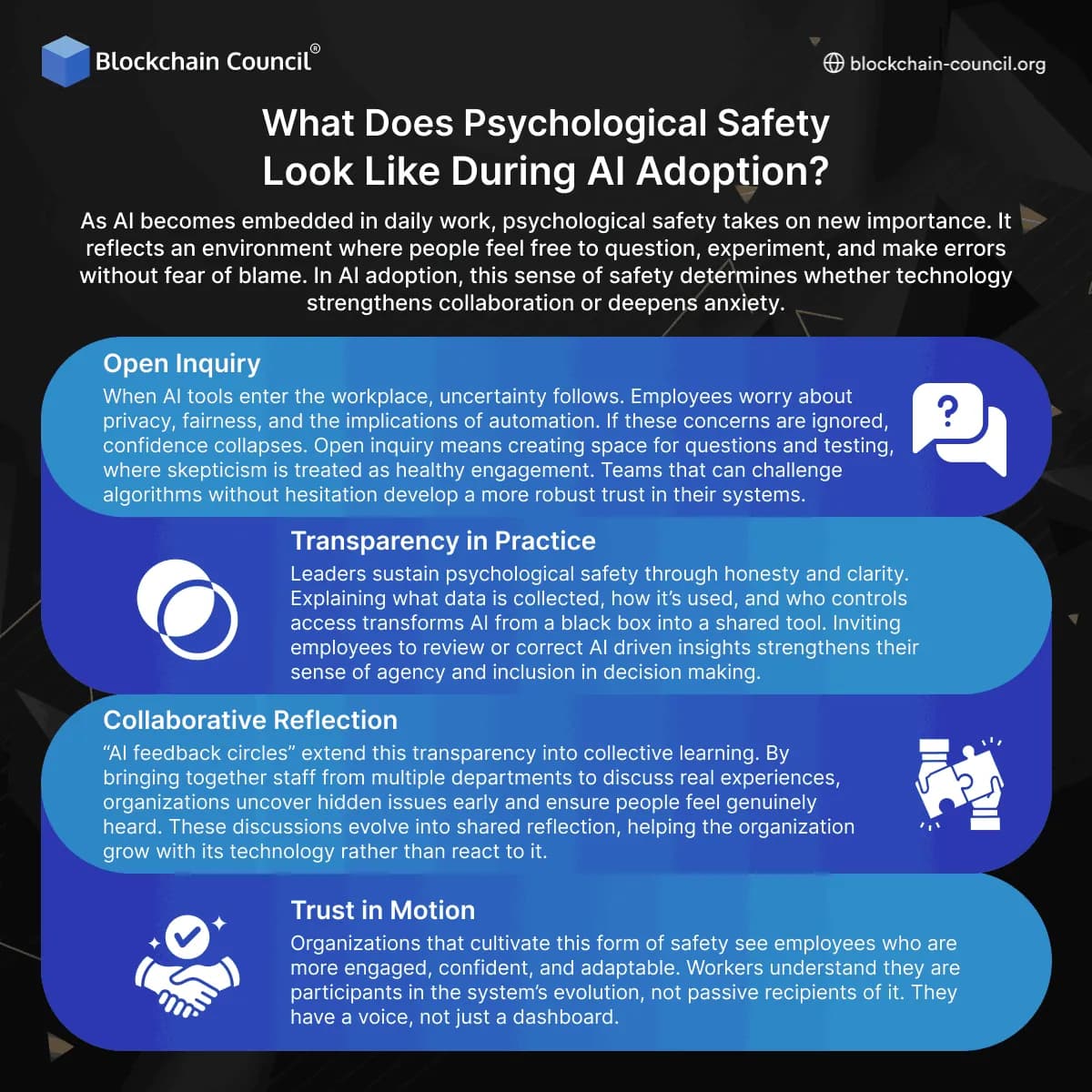
As AI becomes embedded in daily work, psychological safety takes on new importance. It reflects an environment where people feel free to question, experiment, and make errors without fear of blame. In AI adoption, this sense of safety determines whether technology strengthens collaboration or deepens anxiety.
Open Inquiry
When AI tools enter the workplace, uncertainty follows. Employees worry about privacy, fairness, and the implications of automation. If these concerns are ignored, confidence collapses. Open inquiry means creating space for questions and testing, where skepticism is treated as healthy engagement. Teams that can challenge algorithms without hesitation develop a more robust trust in their systems.
Transparency in Practice
Leaders sustain psychological safety through honesty and clarity. Explaining what data is collected, how it’s used, and who controls access transforms AI from a black box into a shared tool. Inviting employees to review or correct AI-driven insights strengthens their sense of agency and inclusion in decision-making.
Collaborative Reflection
“AI feedback circles” extend this transparency into collective learning. By bringing together staff from multiple departments to discuss real experiences, organizations uncover hidden issues early and ensure people feel genuinely heard. These discussions evolve into shared reflection, helping the organization grow with its technology rather than react to it.
Trust in Motion
Organizations that cultivate this form of safety see employees who are more engaged, confident, and adaptable. Workers understand they are participants in the system’s evolution, not passive recipients of it. They have a voice, not just a dashboard.
How Are Stress and Satisfaction Levels Changing in the Age of AI?
Surveys across industries show a complicated picture. On one hand, many employees feel that AI helps them achieve more in less time. They report fewer administrative burdens and greater creativity. On the other hand, constant digital interaction—combined with the pressure to adapt—can leave people mentally drained.
For example, in large corporations, digital assistants handle scheduling and reminders. Employees appreciate the efficiency but also report feeling tethered to screens longer each day. Productivity rises, but so does fatigue.
In contrast, companies that redesign workflows around balance, not just output, see remarkable improvements. When teams use AI to shorten meetings, filter noise, and focus on deep work, satisfaction rises. These employees report more flow and fewer burnout symptoms.
AI itself isn’t the cause or cure of stress. The real determinant is how it’s managed. Workers thrive when they control the tool; they struggle when the tool controls them.
How Does Algorithmic Monitoring Affect Mental Health?
One of the most controversial uses of AI at work is algorithmic management—systems that track, rate, and guide employees automatically. In warehouses, headsets assign tasks. In call centres, software measures tone and speed. Even in offices, email analytics can estimate “productivity.”
While these systems promise efficiency, they can erode psychological well-being. Constant monitoring creates a sense of surveillance. Workers start self-censoring, fearing mistakes will be logged or misinterpreted. The result is anxiety, decreased creativity, and a loss of intrinsic motivation.
There’s also a fairness issue. Algorithms can reinforce bias or penalise behaviour that doesn’t fit pre-set patterns. When performance reviews depend on data without human context, employees feel dehumanised.
The solution is transparency and consent. Workers should know exactly what’s being tracked and why. They should be able to appeal or correct AI-based evaluations. Involving employees in designing monitoring systems ensures balance between accountability and autonomy.
Leaders can take inspiration from privacy-focused frameworks taught in modern tech certifications. These programs emphasise ethical automation, data transparency, and the importance of human oversight in AI decision-making.
How Can Training and Ethical Leadership Improve Well-Being?
Ethical leadership acts as the emotional safety net of automation. When managers model curiosity, empathy, and fairness, AI adoption becomes less threatening. Instead of fearing job loss, workers start exploring how to grow with technology.
Training reinforces this shift. Structured programs—like the Data Science Certification—teach professionals how to interpret algorithmic decisions and validate model outputs. When employees understand how AI reaches conclusions, they trust it more and stress less.
Good leaders also encourage balance. They don’t measure success by how many tools a team adopts, but by whether those tools actually improve well-being and performance. They set boundaries—no after-hours messages, clear expectations for tool usage, and dedicated “human review time.” These practices preserve mental space in a connected world.
Most importantly, they promote open dialogue. Employees should feel free to challenge AI outputs and suggest alternatives. When people see that their judgment still matters, morale and confidence rise.
How Do Workers Find Meaning in AI-Augmented Jobs?
For many employees, meaning comes from mastery, autonomy, and purpose. Automation disrupts all three if implemented carelessly. When workers feel like they’re just pressing buttons for machines, they lose connection to their craft.
But when AI enhances their skillset, meaning grows. A teacher using AI to personalise lessons sees better outcomes for students. A designer generating early drafts with AI can explore more ideas faster. A doctor assisted by diagnostic algorithms saves more lives with less guesswork. These experiences create pride, not alienation.
Meaning also deepens when workers see AI as part of a shared mission rather than a top-down mandate. Companies that frame automation around purpose—such as improving service quality or reducing waste—make people feel part of something bigger.
This psychological shift is what separates healthy adoption from harmful disruption. AI doesn’t remove meaning; poor communication does.
How Can Employees Protect Their Own Mental Well-Being in an AI Workplace?
Workers can take proactive steps to stay mentally healthy as AI evolves.
- Learn continuously. Understanding how AI tools function reduces fear and confusion. Certifications such as the AI certification provide that foundation.
- Set boundaries. Just because tools run 24/7 doesn’t mean people should. Turn off notifications during rest periods and schedule digital breaks.
- Collaborate, don’t isolate. Talk with colleagues about how AI changes workflows. Shared experiences normalize the transition.
- Seek voice and feedback channels. If your organization introduces AI without consultation, ask questions. Constructive dialogue improves both systems and morale.
- Focus on transferable skills. Communication, creativity, and emotional intelligence are timeless. They remain valuable no matter how advanced technology becomes.
These steps create a sense of agency—a psychological buffer against uncertainty.
What Can Organizations Do to Support Psychological Health During AI Integration?
Organisations hold the biggest responsibility. They can’t prevent stress completely, but they can design environments where AI strengthens well-being instead of undermining it.
Practical steps include:
- Conducting well-being audits before deploying new systems.
- Providing clear documentation about how AI affects workloads and privacy.
- Offering continuous learning opportunities through partnerships with educational platforms that teach ethical technology.
- Creating transparent data policies supported by traceable systems inspired by lessons from blockchain technology courses.
- Encouraging employees to evaluate new tools based on their impact on satisfaction, not just speed.
When mental health becomes part of automation strategy, companies build resilience. Employees stay engaged because they feel safe, informed, and respected.
Why Does the Human Experience Still Matter Most?
Technology may be the engine of modern work, but emotion remains the fuel. Productivity without psychological well-being isn’t sustainable. Teams perform best when they feel valued, understood, and included.
AI excels at patterns and precision, but humans bring empathy, ethics, and creativity—qualities that make work meaningful. Organisations that forget this balance risk alienating their most important asset: people.
As automation advances, the future of work depends less on what machines can do and more on how humans adapt emotionally. By blending technical literacy with emotional intelligence, professionals can thrive instead of merely surviving in the AI era.
How to Design AI Workplaces That Protect Mental Health and Build Long-Term Wellbeing
How Can AI Be Designed to Support Human Psychology?
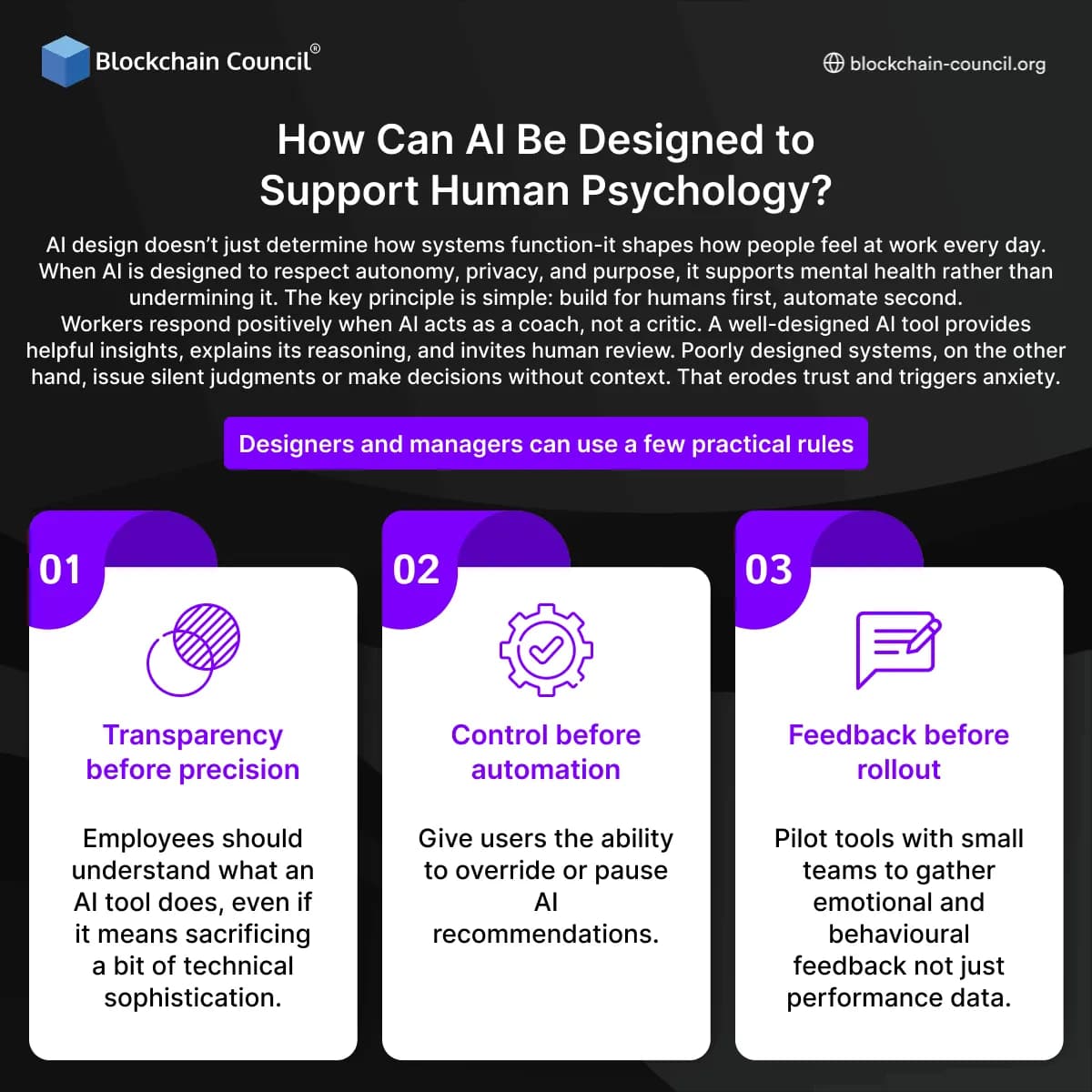
AI design doesn’t just determine how systems function—it shapes how people feel at work every day. When AI is designed to respect autonomy, privacy, and purpose, it supports mental health rather than undermining it. The key principle is simple: build for humans first, automate second.
Workers respond positively when AI acts as a coach, not a critic. A well-designed AI tool provides helpful insights, explains its reasoning, and invites human review. Poorly designed systems, on the other hand, issue silent judgments or make decisions without context. That erodes trust and triggers anxiety.
Designers and managers can use a few practical rules:
- Transparency before precision: employees should understand what an AI tools does, even if it means sacrificing a bit of technical sophistication.
- Control before automation: give users the ability to override or pause AI recommendations.
- Feedback before rollout: pilot tools with small teams to gather emotional and behavioural feedback—not just performance data.
Workers trained through an AI certification often develop this human-centred mindset. They learn how to integrate machine intelligence into workflows that amplify human potential instead of replacing it.
How Can Companies Avoid Algorithmic Harm and Protect Autonomy?
Algorithmic harm doesn’t always come from malicious intent; it often arises from neglect. When systems track keystrokes, analyze tone, or flag “low productivity,” workers feel stripped of privacy. Autonomy—one of the strongest motivators at work—begins to fade.
The solution is not to ban automation but to set boundaries. AI monitoring should be transparent, consensual, and focused on outcomes rather than surveillance. Employees should know:
- What data is being collected.
- How long it’s stored.
- Who can access it.
- How they can contest or correct it.
Organizations that respect autonomy build stronger, more loyal teams. They also avoid costly morale issues and public-relations risks linked to over-monitoring.
When managers pursue deeper technical awareness through programs such as tech certifications, they’re better equipped to evaluate vendors, assess ethical risks, and maintain fairness. Autonomy is not an obstacle to efficiency—it’s the foundation of sustainable productivity.
How Can Guardrails Be Set for Monitoring and Ratings?
AI-based performance systems are here to stay, but they need clear boundaries. Without them, employees feel like data points instead of people.
To keep performance tools healthy:
- Humanise data. Combine AI metrics with peer and self-evaluations. A number should never be the only story.
- Make algorithms explainable. Workers should be able to ask, “Why did I get this rating?” and receive a logical answer.
- Use anonymised insights for improvement, not punishment. When teams know analytics exist to guide coaching, not cutbacks, they engage openly.
- Involve workers in calibration. Let them review AI-generated summaries before they’re finalised.
Using blockchain-based verification—concepts explored in blockchain technology courses—adds transparency by creating audit trails for AI decisions. This allows organisations to prove fairness and defend against bias claims while keeping systems accountable.
How Do Training, Voice, and Leadership Shape the Emotional Impact of AI?
The emotional tone of an AI rollout depends heavily on leadership. A team led by curious, empathetic managers will experience technology as empowering. A team led by silent executives who “drop” tools without context will experience it as threatening.
Training is the bridge between fear and confidence. Employees who understand AI feel more control, which lowers stress. Leadership development programs like the Marketing and Business Certification teach managers to blend digital tools with human communication—explaining purpose, inviting feedback, and modelling openness.
“Voice” also matters. Workers must have regular forums where they can express concerns about automation—town halls, surveys, or anonymous feedback portals. When organisations act on this feedback, they signal respect. That respect builds the psychological safety needed for sustained innovation.
How Can Companies Measure Psychological Impact Beyond Productivity?
Many leaders still focus only on output metrics—how much faster teams deliver after adopting AI. Yet true success includes how people feel about the change. Measuring well-being means adding new layers to performance analysis.
Metrics that matter include:
- Perceived control: do workers feel in charge of their tasks or guided by systems they trust?
- Engagement and meaning: are they proud of what automation helps them achieve?
- Stress and burnout indicators: do absenteeism and turnover rise or fall post-automation?
- Trust in data: do employees consider AI recommendations reliable?
These metrics are easier to track when teams develop a data-savvy culture. Training through the Data Science Certification gives professionals the skills to interpret surveys, correlate behaviour with performance, and present insights clearly to leadership. Data literacy transforms well-being into something measurable and actionable.
How Can Organizations Run a “Wellbeing by Design” AI Pilot?
Before scaling automation, every organization should run a structured pilot that blends technology and psychology. Here’s a simple 90-day blueprint:
- Set objectives clearly. Define not only what task will be automated but what emotional outcomes are expected (less stress, faster decisions, better engagement).
- Select a small, diverse team. Include people with different comfort levels toward technology. Their varied feedback prevents bias.
- Measure baseline stress. Conduct an anonymous pre-survey about workload, clarity, and satisfaction.
- Introduce AI gradually. Offer training sessions and encourage open feedback. Emphasise that it’s an experiment, not a permanent replacement.
- Monitor emotions weekly. Use check-ins or short pulse surveys to capture reactions.
- Review and adjust. Discuss results transparently and fine-tune systems before scaling.
Such pilots prove that AI can raise both efficiency and morale when implemented with empathy. They also teach organisations that productivity gains mean little if psychological harm follows.
How Do Policies and Governance Safeguard Employee Wellbeing?
Policy isn’t just a legal requirement; it’s an emotional contract between companies and employees. Clear governance makes AI predictable and therefore less stressful.
Effective AI policies address:
- Ethical use: every algorithm must align with company values.
- Data protection: workers’ personal information stays secure.
- Bias control: regular audits identify unfair patterns.
- Human oversight: no critical decision about a person happens without a human reviewer.
When governments reinforce these principles through regulation, trust rises across entire industries. Internal governance councils—groups of managers, ethicists, and employee representatives—help monitor compliance.
Companies that follow transparent governance attract better talent. People want to work where technology feels like a partnership, not a power imbalance.
How Can AI Promote Inclusion and Psychological Fairness?
Automation can either amplify bias or eliminate it, depending on how it’s trained. AI models reflect the data they’re built on. If that data carries prejudice, the system will replicate it. But with proper design, AI can actively reduce bias by enforcing consistency and transparency.
Inclusive AI means considering diversity in every phase—from design to deployment. During recruitment, for example, algorithms can anonymise resumes to prevent unconscious bias. In performance reviews, AI can ensure that all employees are judged on identical criteria.
To make these systems trustworthy, workers must understand how they operate. Training programs and ethics workshops ensure transparency. By building awareness, companies replace suspicion with confidence. Fairness isn’t just a moral duty—it’s a business advantage that strengthens team cohesion.
How Can AI Tools Support Emotional Intelligence Instead of Replacing It?
AI can’t feel emotions, but it can help humans manage them. Intelligent assistants can track mood indicators, detect stress through communication patterns, and suggest wellness breaks. Virtual HR bots can check in with employees discreetly, offering mental health resources.
However, this support only works when it’s optional and private. Workers must opt in freely, and data must remain confidential. When AI becomes a wellbeing companion rather than a corporate monitor, it normalises conversations around mental health.
Managers can complement this by using AI insights as prompts for real dialogue. If data shows rising fatigue, the right response isn’t a warning email—it’s a conversation about workload balance. Technology provides signals; empathy delivers solutions.
How Should Leaders Rethink Communication in an AI Workplace?
Communication is the psychological bridge between humans and technology. In fast-paced environments, it’s easy to let automation make announcements, assign tasks, or send reminders without context. But employees interpret tone and intent emotionally.
Leaders should re-humanise communication by:
- Framing AI updates around purpose (“This tool helps you reclaim time,” not “This will increase efficiency”).
- Acknowledging mixed emotions openly.
- Encouraging questions and showing gratitude for adaptability.
Regular human check-ins remain irreplaceable. AI may optimise processes, but only genuine dialogue builds belonging.
How Can Individuals Build Emotional Resilience in AI-Heavy Workplaces?
Resilience isn’t about ignoring stress—it’s about navigating it intelligently. Workers can protect their emotional health by:
- Practising digital mindfulness. Step back from constant alerts and give your brain space to recharge.
- Understanding the systems. The more you know about how AI makes decisions, the less mysterious it feels.
- Balancing learning with rest. Continuous upskilling is important, but so is downtime.
- Finding purpose. Connect technology use to personal goals—whether learning new skills or improving teamwork.
Continuous education through programs like the agentic ai certification or leadership-focused credentials helps workers gain confidence, which directly reduces anxiety.
How Can Organisations Measure Long-Term Success in AI Wellbeing?
Sustaining a healthy AI workplace requires ongoing monitoring beyond quarterly reports. Companies should combine objective and subjective data:
- Objective: productivity, retention, sick leave, project completion rates.
- Subjective: employee satisfaction surveys, stress indicators, qualitative interviews.
The goal is balance—achieving high output and high morale. When both metrics rise together, organisations know their AI adoption is working.
Some forward-thinking firms even publish internal “AI well-being indexes,” showing transparency and accountability. It’s a powerful statement: technology is here to serve people, not the other way around.
What Does the Future of Work Feel Like in an AI World?
The future workplace will not be defined by algorithms alone—it will be defined by emotional design. AI will fade into the background, quietly enhancing experiences instead of dominating them.
Employees will work in environments where automation anticipates their needs—reducing overload, simplifying collaboration, and suggesting creative solutions. Work will feel lighter, more balanced, and more human.
But this future won’t happen automatically. It requires leaders who understand both psychology and data, teams trained to collaborate with technology, and organisations committed to fairness and inclusion.
Those who invest in people first—through education, empathy, and ethical innovation—will thrive. Those who treat AI as a shortcut will face disengagement and turnover.
The emotional future of work belongs to those who design it consciously. By blending technological skill with compassion and continuous learning, we can make AI not just a tool of productivity but a force for genuine human growth.