AI Powered Trader vs Traditional Trader

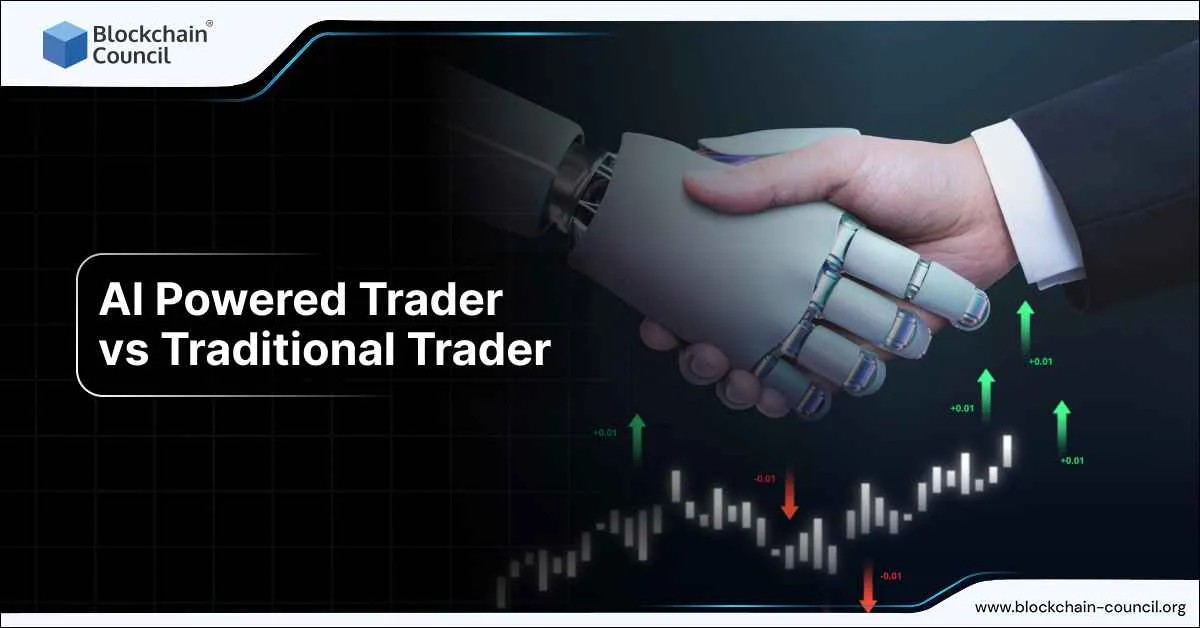
The difference between an AI trader and a traditional trader is clear. AI trading relies on algorithms to analyze massive data sets and execute trades in milliseconds. Traditional traders depend on manual research, human judgment, and experience. Both approaches have strengths, but today’s markets show that using AI to trade stocks delivers more consistent speed and accuracy. For professionals who want to build the right skills, an AI Certification is a smart way to get started.
Speed and Performance
AI Trader Advantage
AI systems can process news, price shifts, and sentiment at the same time, acting in milliseconds. They never get tired and don’t make emotional mistakes. This discipline helps capture opportunities before human traders even react.

Traditional Trader Approach
Human traders move more slowly. They evaluate charts and reports one by one, often focusing on fewer signals. Emotions like fear or greed can influence decisions. Traditional traders may add valuable context, but they cannot match the scale or consistency of AI systems.
Depth of Analysis
AI traders can work with both structured data like prices and unstructured data like news or social media. Advanced models adapt as they learn, which makes strategies stronger over time.
Traditional traders rely on experience and instinct. They may notice context that a machine might miss, but their analysis is limited to what one person can handle.
Institutional Use of AI
Institutions are leading the way in AI adoption. Banks like Goldman Sachs and UBS have built AI assistants to process data and improve strategies. Hedge funds such as Citadel and AQR are using AI to guide investment decisions. Even commodity giants like Vitol and Trafigura rely on big data and AI for competitive insights.
These examples show that AI trading is already reshaping decision-making at the highest levels of finance.
AI Trader vs Traditional Trader
| Factor | AI Trader | Traditional Trader |
| Reaction time | Executes in milliseconds | Responds in minutes or hours |
| Data handling | Analyzes millions of data points at once | Limited to charts, reports, and news |
| Consistency | Follows rules, free of emotion | Influenced by fear and greed |
| Market coverage | Operates globally, 24/7 | Limited by human capacity |
| Setup requirement | Needs systems, data feeds, maintenance | Relies mainly on human skill |
| Accessibility | Expanding through retail platforms | Widely accessible but less scalable |
| Long-term outcomes | Higher consistency, scalable efficiency | Variable results, dependent on judgment |
This table highlights the main contrasts between AI powered traders and traditional traders in a way that is easy to see at a glance.
Costs, Risks, and Limitations
AI traders need technology and data, which can be expensive to set up. If trained on poor information, models may deliver flawed results. If too many firms follow the same AI-driven strategy, herding can create volatility.
Traditional traders avoid system costs but face other issues. They lose time to manual work, cannot monitor global markets continuously, and may make emotional decisions that reduce returns.
Key Benefits of AI Powered Trading
| Benefit | Description | Who Gains Most |
| Faster execution | Enters and exits markets instantly | All traders |
| Lower costs | Cuts slippage and execution errors | Institutions, funds |
| Risk monitoring | Flags unusual activity early | Brokers, investors |
| Scalable decisions | Processes global data continuously | Retail and institutions |
| Consistent logic | Trades without emotional bias | Retail traders |
This shows how AI improves trading outcomes beyond speed by lowering costs, improving discipline, and scaling analysis.
Balancing Both Approaches
The future may not be about choosing one over the other. AI excels at speed, scale, and consistency, while traditional traders contribute judgment, intuition, and context. The most effective strategies may come from combining both—using AI for data-driven execution while humans provide oversight and direction.
Preparing for the Future
As AI becomes part of everyday trading, skills are shifting. Traders now need to understand data and automation as much as market trends. Many professionals are exploring AI certs to stay ahead. For technical expertise, the Data Science Certification is valuable. For leadership and business strategy, the Marketing and Business Certification helps connect AI with growth.
Conclusion
AI powered traders and traditional traders approach markets in very different ways. AI brings speed, precision, and scalability. Traditional trading relies on human experience and intuition. Both carry risks, but AI is proving to be more consistent and efficient.
The takeaway is clear: AI is becoming central to modern trading. Those who adopt it early—and balance it with human judgment—will be better placed to succeed as markets evolve.