
How Can Digital Marketers Thrive in the AI Age?

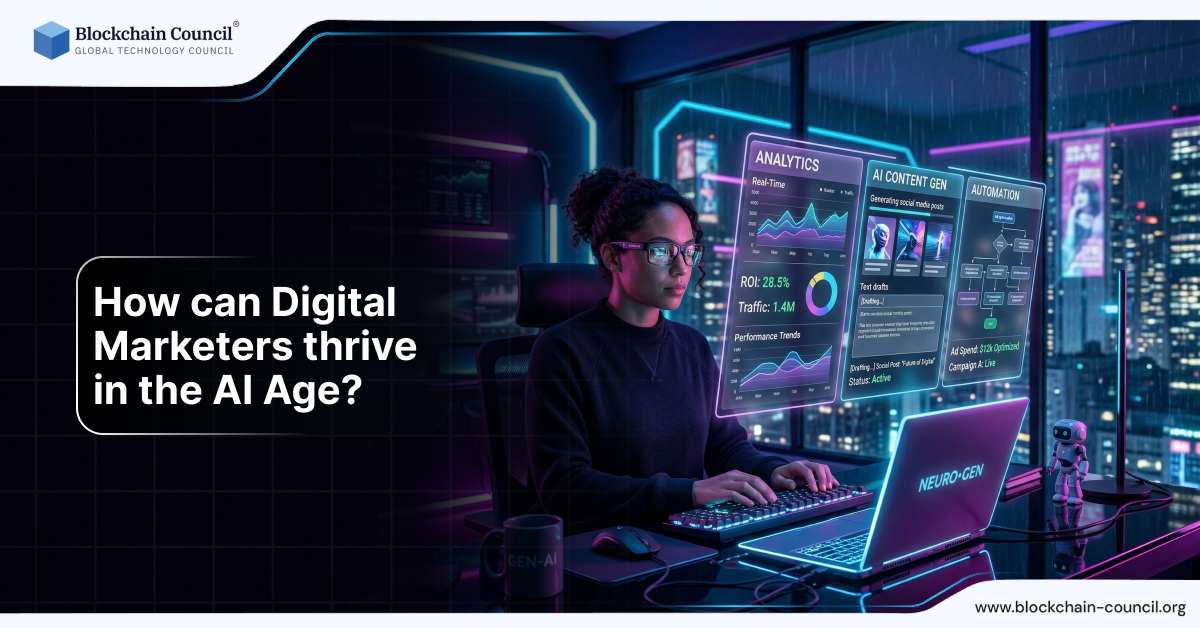
Digital marketing has always been a discipline defined by adaptation. From the shift to search engine optimization in the early 2000s, to the explosion of social media marketing in the 2010s, to the rise of data-driven performance marketing that followed, the marketers who thrived were consistently those who understood new technologies before their peers, adopted them strategically, and built the capabilities to use them with genuine depth. The AI revolution is the most significant of these transitions yet.
Artificial intelligence is not simply adding another channel or another tool to the digital marketer's toolkit. It is restructuring the entire discipline from the ground up. AI can generate content, manage advertising campaigns, personalize customer communications at individual scale, predict purchasing behavior, optimize conversion funnels in real time, and analyze competitive positioning across markets simultaneously. The question this raises for digital marketing professionals is not whether AI will change their field, which it already has, but how they can position themselves to thrive within that change rather than be displaced by it.

The most forward-thinking digital marketers are not treating AI as a threat to their roles. They are treating it as the most powerful amplifier their profession has ever had access to, and they are investing in the formal expertise needed to direct that amplifier toward genuine business outcomes. For marketers who want to operate at the frontier of AI-powered marketing, formal training in autonomous AI systems provides an indispensable foundation. An Agentic AI certification equips marketing professionals with structured knowledge of how AI agents plan, execute, and optimize multi-step marketing workflows autonomously, enabling them to design and govern these systems as strategic assets rather than adopting them passively as off-the-shelf products.
This article provides a comprehensive roadmap for digital marketers who want to understand how AI is transforming their field, which capabilities are most important to develop, how to position their expertise competitively, and which professional credentials will create the most durable career advantage in the AI age.
The AI Transformation of Digital Marketing: What Has Already Changed
The transformation of digital marketing by AI is not a future development. It is a present reality that is accelerating rapidly. Understanding what has already changed is the foundation for making strategic decisions about what to learn and where to specialize.
Content Creation at Scale
AI-generated content has moved from experimental to mainstream in the span of three years. Tools powered by large language models can produce blog articles, social media posts, email sequences, product descriptions, advertising copy, and video scripts with quality that is, in many applications, competitive with human-produced content. Marketing teams that previously required large content production departments are now running their content operations with a fraction of the headcount, using AI to generate first drafts that human editors refine and approve.
The implication for digital marketers is significant: content production as a primary career function is becoming automated at the execution level. The professionals who retain and grow their value in this space are those who provide the strategic direction, brand voice definition, editorial judgment, and quality oversight that transform AI-generated drafts into content that genuinely serves the audience and advances the brand. Production skill is giving way to direction skill as the defining capability.
Hyper-Personalization at Individual Scale
AI has made genuine personalization, communications and experiences tailored to the specific context, history, preferences, and behavioral patterns of individual users, operationally feasible for the first time. Previously, personalization was limited to broad segmentation: targeting an email to users who had abandoned a cart, or showing different landing pages to different demographic groups. AI-powered personalization engines now tailor every element of a customer experience, the message, the imagery, the offer, the timing, the channel, to the predicted preferences of each individual user in real time.
Real-world example: a major e-commerce platform implemented an AI personalization engine that analyzed behavioral data from each user's browsing, purchase, and engagement history to generate uniquely tailored home page layouts, product recommendations, and promotional offers. Conversion rates improved substantially, and average order values increased, because each customer was presented with the products and messages most likely to resonate with their specific context at that moment. The marketing team's role shifted from building campaigns to designing the personalization architecture and the AI systems that executed it.
Predictive Analytics and Data-Driven Decision-Making
AI predictive analytics has transformed how marketing investments are allocated and evaluated. Models trained on historical customer data can predict with meaningful accuracy which prospects are most likely to convert, which customers are at risk of churning, which channels will generate the highest return for a specific audience segment, and which messages will resonate most strongly with a given customer at a given stage of their journey. Marketing teams that have built AI analytics capabilities are making budget allocation decisions with a level of data-driven precision that their competitors relying on traditional analytics cannot match.
The Skills That Separate Thriving Marketers from Those Being Replaced
The digital marketers who are thriving in the AI age are not those who simply use AI tools more than their peers. They are those who bring a combination of strategic intelligence, technical literacy, creative judgment, and AI governance expertise that transforms AI capabilities into genuine marketing outcomes. Understanding this distinction is essential for directing your professional development effectively.
Strategic Direction and Brand Architecture
AI excels at executing against defined objectives within established parameters. It does not excel at determining what those objectives should be, what values and voice should define a brand, what emotional experience the brand should create for its audience, or how the brand should position itself relative to its competitive landscape. These strategic and creative architecture decisions are irreducibly human, and they are the foundation upon which all AI-driven marketing execution rests.
Digital marketers who have invested in developing deep strategic marketing capabilities, understanding audience psychology, competitive positioning theory, brand architecture, and customer journey design, are building the kind of expertise that AI amplifies rather than replaces. Their AI tools execute with greater precision and scale because the strategic foundation they provide is clear, coherent, and genuinely differentiated.
AI Literacy and Technical Fluency
Marketing professionals who understand how AI systems work, what they are optimizing for, and where their outputs can mislead as well as inform, are significantly more effective at using AI tools than those who treat them as black boxes. AI literacy for marketers does not require an engineering background. It does require an understanding of how machine learning models are trained, what data quality means for AI output quality, how to evaluate whether AI-generated content serves the intended strategic purpose, and how to recognize the specific ways in which AI tools tend to fail.
For marketers who want to develop genuine AI technical fluency, structured learning in AI principles through an AI expert certification provides the comprehensive foundation needed to engage with AI tools and AI teams as an informed professional. This is not about becoming a data scientist. It is about developing the working knowledge of AI systems that makes a marketing professional a credible partner for technical colleagues and a more effective user of AI capabilities.
Data Analysis and Interpretation
AI generates an enormous volume of performance data, but the insight that drives strategic decisions comes from human interpretation of that data in context. The ability to look at AI-generated analytics and ask the right questions, to identify patterns that are strategically meaningful rather than statistically interesting but practically irrelevant, and to translate data insights into actionable marketing decisions, remains a distinctly human capability that is growing in organizational value.
Python has become a foundational skill for data-oriented marketing professionals. It enables direct interaction with marketing APIs, custom analysis of campaign data, automation of reporting workflows, and integration of multiple data sources into unified analytics views. A formal python certification provides the rigorous programming knowledge that allows marketing professionals to work directly with data pipelines, build custom analysis tools, and engage more credibly with technical colleagues on data infrastructure decisions.
Agentic AI in Marketing: The Frontier That Separates Leaders
While most marketing professionals are still developing proficiency with AI content and analytics tools, the most forward-thinking practitioners are already working with agentic AI systems that can execute entire marketing workflows autonomously. This is the frontier that is creating the most significant differentiation in the marketing profession right now.
What Agentic AI Means for Marketing Operations
An agentic AI marketing system can be given a goal, such as generating and nurturing qualified leads for an enterprise software product, and it will research target accounts, identify relevant contacts, draft personalized outreach sequences, send and monitor communications, respond intelligently to prospect replies, escalate engaged prospects to the sales team, update the CRM with detailed activity logs, and report on performance across the entire workflow. A human marketing professional sets the strategy, the audience parameters, the brand voice guidelines, and the qualification criteria. The agentic system executes, monitors, and optimizes the campaign workflow continuously.
This is a fundamentally different marketing operating model from anything that preceded it, and it requires marketing professionals to develop a fundamentally different skill set. The ability to design agentic marketing workflows, to define the goals, boundaries, and evaluation criteria that make autonomous marketing systems effective and safe, and to supervise and refine their outputs, is becoming the defining capability that separates elite marketing professionals from those operating at the standard of the previous generation.
Governing AI Marketing Systems Responsibly
Agentic AI marketing systems operating at scale introduce governance responsibilities that did not exist when humans executed every marketing action manually. Brand voice consistency across thousands of AI-generated communications, compliance with advertising regulations in AI-powered campaign content, data privacy adherence in AI personalization systems, and ethical guardrails on AI targeting and message optimization are all areas that require explicit governance design and ongoing human oversight.
Marketing professionals who understand how to build these governance frameworks, how to audit AI marketing outputs for compliance and quality, and how to design the human review checkpoints that ensure brand integrity is maintained across AI-driven operations, are building a professional capability that will become a core organizational requirement as AI marketing adoption scales. Formal training in agentic AI systems through an Agentic AI certification provides the architectural understanding needed to build these governance systems knowledgeably rather than improvising them reactively.
Technical Capabilities That Amplify Marketing Effectiveness
The most effective digital marketers of the AI age are not purely strategic practitioners who delegate all technical work. They are professionals who have developed sufficient technical depth to engage credibly with the systems that power modern marketing operations, to evaluate technical proposals with genuine judgment, and to build custom solutions when off-the-shelf tools fall short.
Building Marketing Technology Integrations
Modern marketing technology stacks are composed of dozens of tools that must communicate with each other: CRM systems, marketing automation platforms, analytics tools, advertising platforms, content management systems, and AI-powered personalization engines. Building, maintaining, and optimizing the integrations between these systems requires technical knowledge that is increasingly valuable for marketing professionals who want to operate independently of engineering support.
Node.js has become a widely used technology for building the API integrations, webhook handlers, and real-time data flows that connect marketing technology systems. Marketing professionals who develop server-side JavaScript knowledge through a formal node.js certification gain the technical foundation needed to design and evaluate marketing technology architecture, to build lightweight custom integrations between platforms, and to engage with engineering teams as informed partners rather than dependent requesters.
Automating Marketing Analytics and Reporting
One of the most immediately productive applications of technical marketing skill is the automation of analytics and reporting workflows. Marketing professionals who can write Python scripts to pull data from platform APIs, transform and aggregate it according to custom business logic, and generate formatted reports delivered automatically to stakeholders, recapture hours of manual work each week and redirect that time toward higher-value strategic activities.
This capability also enables custom attribution modeling, cross-channel performance analysis, and competitive intelligence collection that off-the-shelf reporting tools cannot support. The marketing professional who can build these custom analytics workflows becomes an indispensable organizational resource, one who provides analytical depth and flexibility that the standard tools simply cannot match.
Building the AI-First Marketing Career: A Practical Roadmap
Understanding the strategic landscape of AI in marketing is valuable. Having a concrete plan for developing the capabilities and credentials that create lasting career advantage is essential. The following framework provides a practical roadmap for digital marketers who want to thrive in the AI age rather than simply survive it.
Stage 1: Develop Comprehensive AI-Powered Marketing Expertise
The starting point for any digital marketer building an AI-first career is comprehensive knowledge of how AI is transforming every dimension of marketing practice: content, personalization, analytics, advertising optimization, customer service, and campaign automation. This knowledge should combine strategic marketing principles with practical AI tool proficiency and the understanding of how AI systems work at a level sufficient to evaluate their outputs critically.
An AI Powered digital marketing certification provides exactly this integrated foundation: the combination of AI knowledge and digital marketing strategy expertise that equips practitioners to lead AI-powered marketing functions rather than merely operate within them. This is the credential that most directly addresses the intersection of marketing professional development and AI transformation, and it is increasingly recognized by marketing employers as a meaningful signal of genuine AI-era readiness.
Stage 2: Build Technical Marketing Skills
With a strong strategic and conceptual foundation established, the next developmental stage is building the technical skills that amplify marketing effectiveness and expand the scope of work a marketing professional can take on independently. Python proficiency, developed through a structured python certification program, is the highest-priority technical investment for data-oriented marketing professionals. It enables custom analytics, API integration, automation scripting, and direct engagement with AI libraries and data tools that are increasingly part of the marketing technology landscape. Node.js knowledge, developed through a node.js certification, provides the server-side architecture understanding needed to design and evaluate the real-time integrations and webhook-driven workflows that connect modern marketing technology ecosystems.
Stage 3: Develop Agentic AI and Advanced AI Expertise
For marketing professionals who want to lead at the organizational frontier of AI adoption, the third developmental stage is deep expertise in AI systems and agentic workflows. An AI expert certification provides comprehensive AI knowledge that enables marketing professionals to engage with AI strategy, AI system design, and AI governance at the depth that senior and leadership roles require. Complementing this with an Agentic AI certification builds the specialized expertise in autonomous marketing workflow design and governance that is currently rare and increasingly valued in organizations scaling their AI marketing capabilities.
Real-World Examples of Digital Marketers Thriving in the AI Age
Abstract strategies become more meaningful when grounded in the experiences of real marketing professionals who are navigating the AI transition successfully.
The Marketing Strategist Who Leads AI Content Operations
A content marketing director at a mid-sized B2B software company recognized early that AI would transform her team's content production capacity. Rather than resisting the change, she invested in building a structured AI content workflow: using AI tools to generate initial drafts based on detailed strategic briefs, establishing rigorous editorial standards for human review and refinement, and building a quality library of brand voice examples that trained the AI tools to produce outputs more aligned with the company's positioning. Her team's content output tripled while headcount remained flat. More importantly, the strategic quality of the content improved because her team's time shifted from production to editorial judgment, audience analysis, and strategic planning. Her role became more valuable, not less.
The Performance Marketer Who Automated Data Analysis
A performance marketing manager at an e-commerce company invested six months in developing Python proficiency. He then built a custom analytics system that pulled data from Google Ads, Meta Ads, and Shopify daily, applied custom attribution logic that reflected the company's specific multi-touch customer journey, and generated a formatted performance report delivered automatically to the leadership team every morning. The hours previously spent on manual data compilation were redirected to campaign strategy and optimization. His technical capability made him indispensable in a way that his peers who relied entirely on platform-native reporting tools were not, and it led directly to a promotion to head of growth marketing.
The Marketing Technology Manager Who Embraced Agentic Workflows
A marketing operations manager at a SaaS company began exploring agentic AI tools for her sales development function. She designed a workflow in which an AI agent researched target accounts, drafted personalized outreach emails based on company-specific research, monitored response rates, and escalated engaged prospects to the sales team with a detailed context summary. She built the governance framework herself: brand voice guidelines, content compliance checklist, escalation thresholds, and a weekly audit process for reviewing a sample of agent-generated communications. The pipeline from outbound outreach to qualified meetings improved significantly. Her expertise in both the strategic design and the governance of agentic marketing systems made her one of the most sought-after marketing operations professionals in her network.
The Mindset of the Thriving AI-Age Marketer
Technical skills and professional credentials are necessary for thriving in the AI age, but they are not sufficient. The marketers who sustain long-term career excellence through technological transitions are those who combine capability development with a specific professional mindset.
Curiosity as a Professional Practice
The AI marketing landscape is evolving faster than any structured curriculum can fully capture. New tools, new capabilities, and new best practices are emerging continuously. The marketers who stay ahead of this evolution are those who treat curiosity as a professional practice: allocating regular time to exploring new AI tools, reading research on AI marketing applications, participating in communities where practitioners share experiences, and experimenting with new approaches in low-risk contexts before deploying them at scale. This commitment to continuous learning is not optional in the AI age. It is the mechanism by which professional relevance is maintained in a rapidly changing field.
Outcome Orientation Over Tool Orientation
One of the most common traps for marketers navigating the AI tool landscape is becoming oriented around tools rather than outcomes. The question that should drive every AI adoption decision is not which AI tool is most impressive, but which AI capability will most meaningfully advance a specific marketing goal for a specific audience. Marketers who maintain rigorous outcome orientation in their AI adoption choices consistently outperform those who collect AI tools without a clear strategic purpose for each one.
Ethical Leadership in AI Marketing
As AI marketing capabilities expand, the ethical responsibilities of marketing professionals expand with them. AI personalization systems that feel invasive rather than helpful erode consumer trust. AI-generated content that is misleading, even unintentionally, damages brand credibility. AI targeting systems that discriminate along protected characteristics create legal and reputational exposure. The marketing professionals who will be most valued in the long term are those who exercise genuine ethical leadership in their AI adoption, not because it is required by regulation, but because they understand that sustainable marketing success is built on genuine consumer trust.
Conclusion
Digital marketing in the AI age is not a harder profession. It is a different one. The capabilities that create the most value have shifted from production and execution toward strategy, direction, governance, and the distinctly human judgment that gives AI-generated marketing outputs their meaning and their impact. The marketers who thrive will be those who embrace this shift with genuine intellectual engagement, who invest in developing the technical and strategic capabilities that the new landscape rewards, and who build the professional credentials that signal their readiness to lead in an AI-powered marketing world.
The competitive advantage in digital marketing has always accrued to those who understood new technologies faster and more deeply than their peers. In the AI age, that advantage belongs to the marketers who do not merely use AI tools but who direct them strategically, govern them responsibly, and build the organizational capabilities that turn AI's execution power into sustainable business outcomes. That is the standard that the most successful AI-age marketers are already setting, and the professional development investments described in this article are the pathway to joining them.
The AI age is not a threat to the digital marketing profession. It is the most significant expansion of marketing capability in the history of the discipline. The professionals who recognize this and invest accordingly will look back on this moment as the turning point in their careers, not because the technology changed everything, but because they had the foresight and the commitment to change with it.
Frequently Asked Questions
Q1. How is AI changing digital marketing in 2025?
AI is automating content, personalization, ad optimization, analytics, and even parts of full marketing workflows. Human value is shifting toward strategy, creativity, brand judgment, and AI oversight.
Q2. Will AI replace digital marketers?
Not entirely. AI will replace some tasks, but marketers who focus on strategy, audience insight, brand governance, and AI fluency will stay valuable.
Q3. What skills matter most for digital marketers in the AI age?
The strongest mix is marketing strategy plus AI literacy. Python and data analysis are also useful for marketers who want stronger technical and analytical capability.
Q4. What is an AI Powered digital marketing certification?
It is a credential that combines AI knowledge with digital marketing strategy. It helps marketers build structured skills and prove their expertise to employers.
Q5. How does agentic AI affect marketing operations?
Agentic AI can run multi-step marketing workflows with less human input. That means marketers increasingly need to design, guide, and monitor AI-driven systems.
Q6. Why should digital marketers learn Python?
Python helps marketers automate reporting, work with APIs, analyze data, and collaborate more effectively with technical teams.
Q7. What role does data analysis play in AI-powered marketing?
Data analysis helps marketers turn AI-generated outputs into useful decisions. It is what connects automation to real strategy and performance improvement.
Q8. How can marketers build technical skills without an engineering background?
They can start with structured, practical learning in areas like Python, automation, and API basics. No need to become an engineer, despite the internet’s ongoing obsession with that fantasy.
Q9. How important is ethical AI use in marketing?
It is essential. Ethical AI protects trust, brand reputation, compliance, and long-term customer relationships.
Q10. Which certifications give marketers the strongest career advantage?
The most useful certifications are those in AI-powered marketing, agentic AI, AI foundations, Python, and Node.js, depending on the marketer’s role and goals.
Related Articles
View All
AI & ML
BharatGen: India’s Indigenous Generative AI Revolution Transforming Language, Law, and Digital Sovereignty
Key Takeaways The provided text introduces BharatGen, a groundbreaking indigenous generative AI initiative designed to reflect India’s vast linguistic and cultural diversity. Professor Arnab Bhattacharya explains that this multimodal system aims to cover all 22 official Indian languages while…
AI & ML
AI Skills for Teachers and Professors: Integrating AI into Lesson Plans, Assessments, and Academic Integrity Policies
Learn essential AI skills for teachers and professors, with practical ways to use AI in lesson plans, redesign assessments, and update academic integrity policies.
AI & ML
AI Skills for Children: Fun and Safe Ways to Learn AI Concepts, Ethics, and Creativity
Teach AI skills for children with games, storytelling, and guided projects that build core concepts, ethics, creativity, and safe habits at home and school.
Trending Articles

The Role of Blockchain in Ethical AI Development
How blockchain technology is being used to promote transparency and accountability in artificial intelligence systems.

AWS Career Roadmap
A step-by-step guide to building a successful career in Amazon Web Services cloud computing.

Top 5 DeFi Platforms
Explore the leading decentralized finance platforms and what makes each one unique in the evolving DeFi landscape.