Growing Demand for AI in UX and UI Design
 Michael Willson
The demand for AI in UX and UI design is growing rapidly as businesses realize that user experience is central to success. AI tools are transforming how designers create, test, and deliver products, making processes faster and more personalized. At the same time, empathy, creativity, and cultural understanding remain core strengths that only humans bring to the table. For professionals looking to stay ahead in this space, gaining an AI certification provides the skills and credibility needed to combine design expertise with advanced AI knowledge.
Why AI Matters for UX and UI Design
AI is no longer an optional add-on for designers. It is now built into nearly every stage of the workflow. From user research and data analysis to layout generation and accessibility, AI supports teams in building smarter, more user-focused designs. This allows designers to spend less time on repetitive tasks and more time on strategy and creativity.

AI certs are becoming a valuable way for designers and developers to prove they understand not just the design tools but also how AI algorithms influence user behavior and outcomes. This is key as companies look for professionals who can bridge design and AI together.
How AI Enhances the Creative Process
One of the biggest benefits of AI in UX design is its role as a creative partner. AI helps generate ideas, produce multiple design variations, and accelerate prototyping. Designers can test more concepts in less time, which speeds up innovation without sacrificing quality.
AI also plays a major role in personalization. Interfaces are increasingly adapting in real time to individual user preferences. Layouts, content, and navigation can shift automatically based on how a person interacts with a platform. This level of personalization is becoming the standard for competitive digital experiences.
Info: AI’s Superpowers in UX Design
Creative Partner
- Acts as a digital brainstorming ally.
- Suggests new design directions and alternative layouts.
- Accelerates prototyping with rapid mock-ups and iterations.
Personalisation Engine
- Learns user preferences in real time.
- Adapts interfaces, content, and recommendations to each individual.
- Creates experiences that feel tailored and personal.
Productivity Booster
- Automates repetitive tasks such as testing and layout adjustments.
- Analyses user feedback to surface key pain points.
- Frees designers to focus on creativity and strategy.
Accessibility Champion
- Enhances readability with adaptive language and design support.
- Provides features like voice guidance, captioning, and translation.
- Expands inclusivity so a wider range of users can engage smoothly.
The Rise of AI in UI Development
The role of AI in UI design is growing quickly. At Google I/O 2025, the company introduced Stitch, an AI-powered tool that can turn text or image prompts into UI designs with front-end code. This means designers can go from concept to prototype in minutes, experimenting with styles, themes, and formats before exporting directly into platforms like Figma or HTML/CSS.
This ability to move from idea to working code so quickly is revolutionizing front-end design. It gives designers more flexibility to focus on creating meaningful user journeys instead of spending too much time on mechanical tasks.
Emerging Trends in UX and UI Design with AI
AI is also driving new design trends. Businesses are now investing in immersive experiences, combining AI with AR and VR. By 2025, more than 70 percent of companies are planning to integrate immersive technologies into their user experiences. This means UX and UI professionals need to prepare for a future where traditional screen design is only part of the equation.
AI-augmented workflows are another trend. By embedding AI across the entire process—from research and ideation to testing and delivery—teams work faster and make decisions that are more aligned with user needs.
Emerging AI-Powered UX/UI Trends
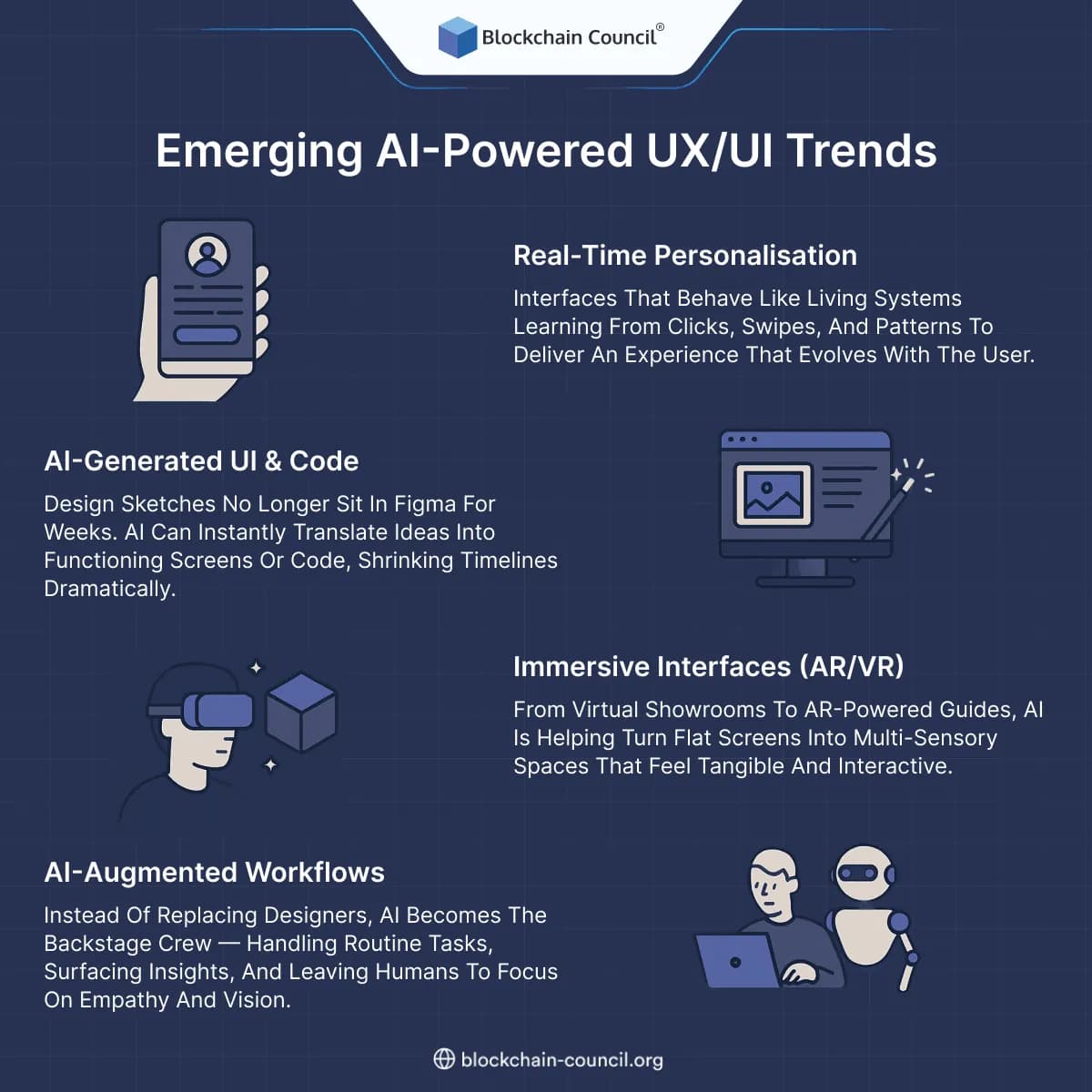
- Real-Time Personalisation
Interfaces that behave like living systems – learning from clicks, swipes, and patterns to deliver an experience that evolves with the user. - AI-Generated UI & Code
Design sketches no longer sit in Figma for weeks. AI can instantly translate ideas into functioning screens or code, shrinking timelines dramatically. - Immersive Interfaces (AR/VR)
From virtual showrooms to AR-powered guides, AI is helping turn flat screens into multi-sensory spaces that feel tangible and interactive. - AI-Augmented Workflows
Instead of replacing designers, AI becomes the backstage crew — handling routine tasks, surfacing insights, and leaving humans to focus on empathy and vision.
Skills in Demand for AI-Driven Design
As the demand for AI in UX and UI design grows, so does the need for professionals who can apply these tools effectively. Skills in AI-powered prototyping, personalization, and accessibility are especially valued. Designers who can balance technical AI knowledge with user-centered empathy are in high demand.
To meet this demand, many professionals are pursuing structured certifications. A Data Science Certification is helpful for those who want to understand the data side of design, including analytics and personalization algorithms. Meanwhile, leaders aiming to connect design strategy with business growth benefit from the Marketing and Business Certification, which aligns AI adoption with customer engagement and revenue.
The Future of UX and UI Design with AI
The future of UX and UI design is about blending human creativity with AI-driven efficiency. Designers will not be replaced but empowered to do more, faster, and at higher quality. Those who learn how to integrate AI tools effectively will be recognized as leaders in shaping digital experiences.
For professionals, building AI expertise is no longer optional. With AI certs and professional certifications, designers can position themselves as innovators at the intersection of technology and design.
Conclusion
AI is reshaping UX and UI design by streamlining creativity, enabling real-time personalization, and supporting immersive experiences. It is also opening new career opportunities for designers who are ready to adapt. The demand for skilled professionals is rising, and companies are actively seeking those who can combine empathy, creativity, and technical AI knowledge.