
AI in Preserving Indigenous Knowledge
 Michael Willson
How Can AI Help Protect Indigenous Knowledge?
Artificial intelligence is now being used to preserve Indigenous knowledge in many parts of the world. From endangered languages and oral traditions to cultural practices and heritage archives, AI is helping communities safeguard what could otherwise be lost. This is not only about recording history but also about keeping cultural identity alive for future generations. Anyone wanting to build skills in this area can consider an AI certification to better understand how these technologies work and how they can be applied responsibly.
The urgency is clear. Many languages and traditions that were once passed down in person are now disappearing due to urban migration, fewer fluent speakers, and changes in lifestyle. With AI, new opportunities are emerging to record, translate, and share this knowledge, while ensuring Indigenous communities remain in charge of their cultural data.
AI in Preserving Indigenous Knowledge
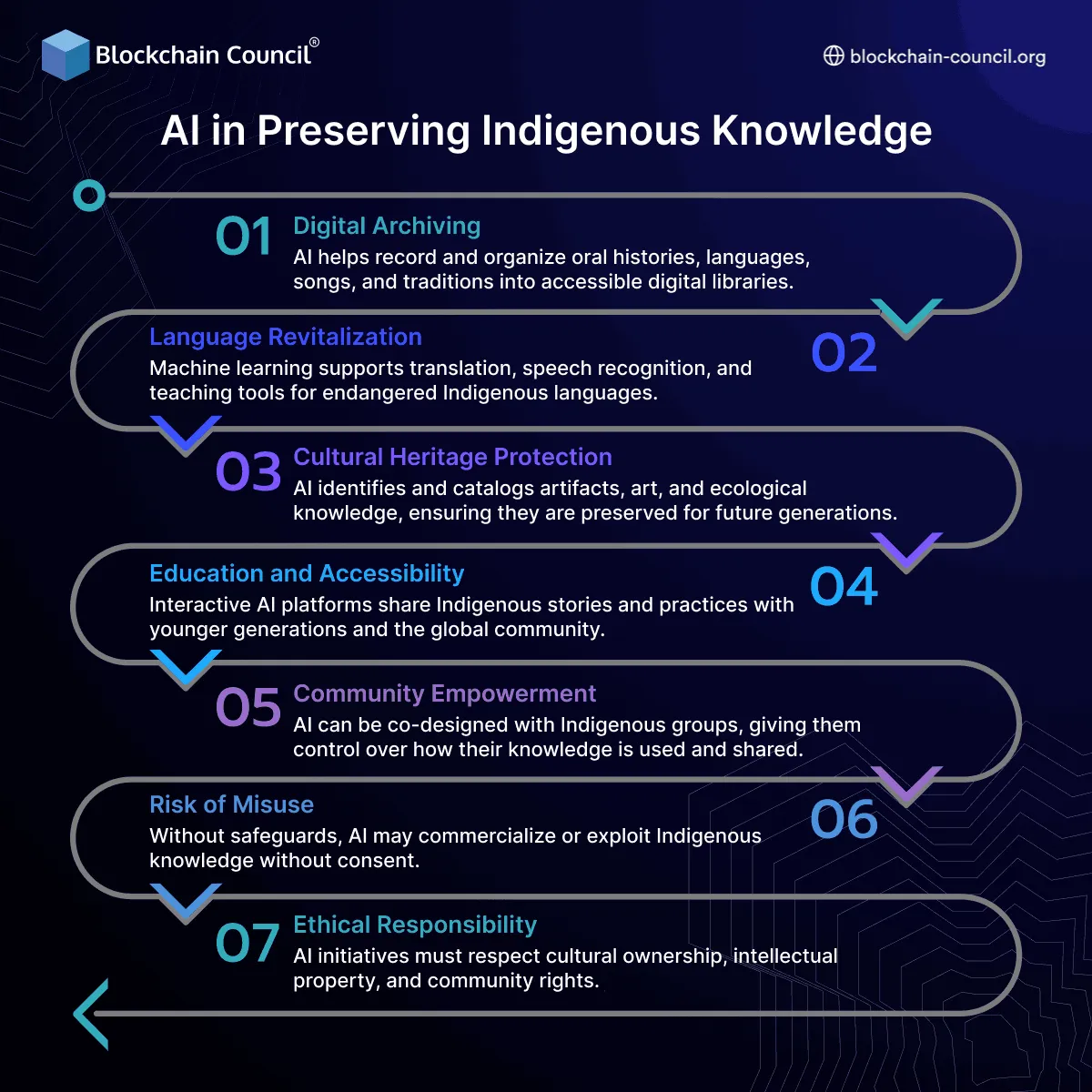
Digital Archiving
AI helps record and organize oral histories, languages, songs, and traditions into accessible digital libraries.
Language Revitalization
Machine learning supports translation, speech recognition, and teaching tools for endangered Indigenous languages.
Cultural Heritage Protection
AI identifies and catalogs artifacts, art, and ecological knowledge, ensuring they are preserved for future generations.
Education and Accessibility
Interactive AI platforms share Indigenous stories and practices with younger generations and the global community.
Community Empowerment
AI can be co-designed with Indigenous groups, giving them control over how their knowledge is used and shared.
Risk of Misuse
Without safeguards, AI may commercialize or exploit Indigenous knowledge without consent.
Ethical Responsibility
AI initiatives must respect cultural ownership, intellectual property, and community rights.
What Role Does AI Play in Language Revitalization?
Language is one of the strongest markers of cultural identity. Unfortunately, many Indigenous languages are classified as endangered. AI is proving to be a powerful partner in the effort to revive them. Machine learning models can now be trained to recognize speech, generate text, and even create learning tools from small sets of recordings and documents.
In New Zealand, Te Hiku Media developed an automatic speech recognition system for Māori, known locally as Te Reo. By using both historical recordings and contributions from native speakers, the system achieved high levels of accuracy. It has become a tool not only for language preservation but also for teaching. Children and young adults can now access digital resources that make it easier to engage with their heritage.
A different but equally striking example comes from China, where researchers built the NushuRescue framework. Nushu is a rare script once used by women, and it had nearly disappeared. By applying large language models, researchers managed to create tools for both understanding and teaching Nushu with very limited data. This project shows that even knowledge at the edge of extinction can be supported with the right technology.
North America is also seeing inspiring leadership. Michael Running Wolf, a Northern Cheyenne technologist, has been working on AI projects that record and protect Native American languages. His message is consistent: preservation efforts must be designed and owned by the communities themselves, otherwise they risk exploitation or cultural distortion.
How Is AI Digitizing Cultural Heritage?
Indigenous knowledge is not limited to language. It also includes intangible cultural heritage such as music, dance, rituals, and traditional crafts. AI is being used to digitize these practices so that they can be studied, taught, and celebrated in new ways.
China has introduced ICH-Qwen, a large language model dedicated to intangible cultural heritage. It is designed to assist in preservation, reasoning, and distribution of cultural materials. This type of system makes it easier for museums, researchers, and communities to access and analyze data related to cultural practices.
Brazil offers another perspective. Researchers there are using semantic pipelines that combine visual and text embeddings to connect Indigenous heritage collections in digital museums. For example, artifacts, drawings, and oral descriptions can now be linked to reveal deeper cultural relationships. This allows heritage to be understood not as isolated pieces but as part of a connected whole.
These innovations highlight a new chapter in cultural preservation. Instead of being locked away in archives, Indigenous heritage can be transformed into living, searchable, and interactive resources. This helps both researchers and community members reconnect with traditions in meaningful ways. Scholars highlight how a Prompt Engineering Course can guide responsible AI use in safeguarding cultural heritage.
Can AI Support Traditional Medicine and Biodiversity Knowledge?
AI is also being applied to traditional medicine systems, which often include detailed knowledge about plants, healing methods, and biodiversity. This knowledge has been shared through generations but is increasingly vulnerable to loss.
In India, the government has launched an AI-based initiative to digitize traditional medicine under the Traditional Knowledge Digital Library. By compiling knowledge from Ayurveda, Unani, and other systems, this platform protects against biopiracy while also creating resources for modern healthcare research.
The World Health Organization and other agencies have also explored how AI can be used to analyze medicinal plants. By combining traditional Indigenous knowledge with modern biomedical data, AI models can identify compounds with potential medical benefits. This shows how ancient knowledge and modern science can work together.
These examples highlight not only preservation but also innovation. By protecting Indigenous medicinal knowledge, AI is creating bridges between cultures and opening up new opportunities for global health.
Why Is Data Sovereignty Important for Indigenous Communities?
When it comes to preserving Indigenous knowledge with AI, the question of who owns the data is critical. Data sovereignty means that Indigenous communities have control over their own information. Without this principle, there is a risk that cultural knowledge could be taken, misused, or commercialized without proper consent.
Indigenous leaders and organizations have repeatedly emphasized that AI tools must respect cultural ownership. If a dataset contains recordings of songs, stories, or rituals, then the community should decide how that data is stored, who has access, and how it is used. This is why digital sovereignty frameworks are being created to give communities more power over the use of their heritage in technology systems.
There are already cases where Indigenous groups have set up their own data trusts to manage information in a way that aligns with cultural values. This model helps prevent data colonialism, where outside organizations benefit from Indigenous knowledge without giving anything back. As AI spreads globally, these safeguards are essential.
What Ethical Challenges Does AI Bring to Indigenous Preservation?
AI offers solutions, but it also introduces risks. One challenge is bias. If a system has not been trained on diverse cultural material, it may misinterpret Indigenous traditions or present them in misleading ways. Another risk is deepfakes, which could distort cultural stories or rituals by creating inaccurate digital versions.
There are also legal and moral questions around intellectual property. Indigenous communities often hold collective knowledge that does not fit neatly into Western intellectual property laws. If AI systems extract value from this knowledge, who benefits? Communities are calling for benefit-sharing frameworks that ensure they receive recognition and compensation.
International groups like UNESCO and the United Nations are already highlighting these issues. They stress that AI must be inclusive, ethical, and guided by human rights principles. This means involving Indigenous voices at every stage of AI development, from data collection to system design.
How Can Traditional and Modern Knowledge Work Together?
A promising approach for using AI in Indigenous contexts is called Two-Eyed Seeing. This idea comes from Mi’kmaq elders in Canada and suggests that we should look at the world through both Indigenous and Western knowledge systems. When applied to AI, it means designing systems that respect Indigenous ways of knowing while also using modern technology to enhance preservation.
For example, an AI tool could analyze biodiversity data while also incorporating oral traditions about local ecosystems. This provides a richer and more accurate understanding of the environment. In health research, combining Indigenous medicinal knowledge with modern data science can lead to discoveries that neither system could achieve alone.
This balanced perspective prevents one system from dominating the other. Instead, it creates a partnership where both forms of knowledge are valued equally. For learners, studying approaches like this is becoming part of modern Data Science Certification programs, as they show how analytics can support culture-sensitive projects.
Who Are the Leaders Driving AI for Indigenous Knowledge?
Benefits of Using AI for Indigenous Knowledge
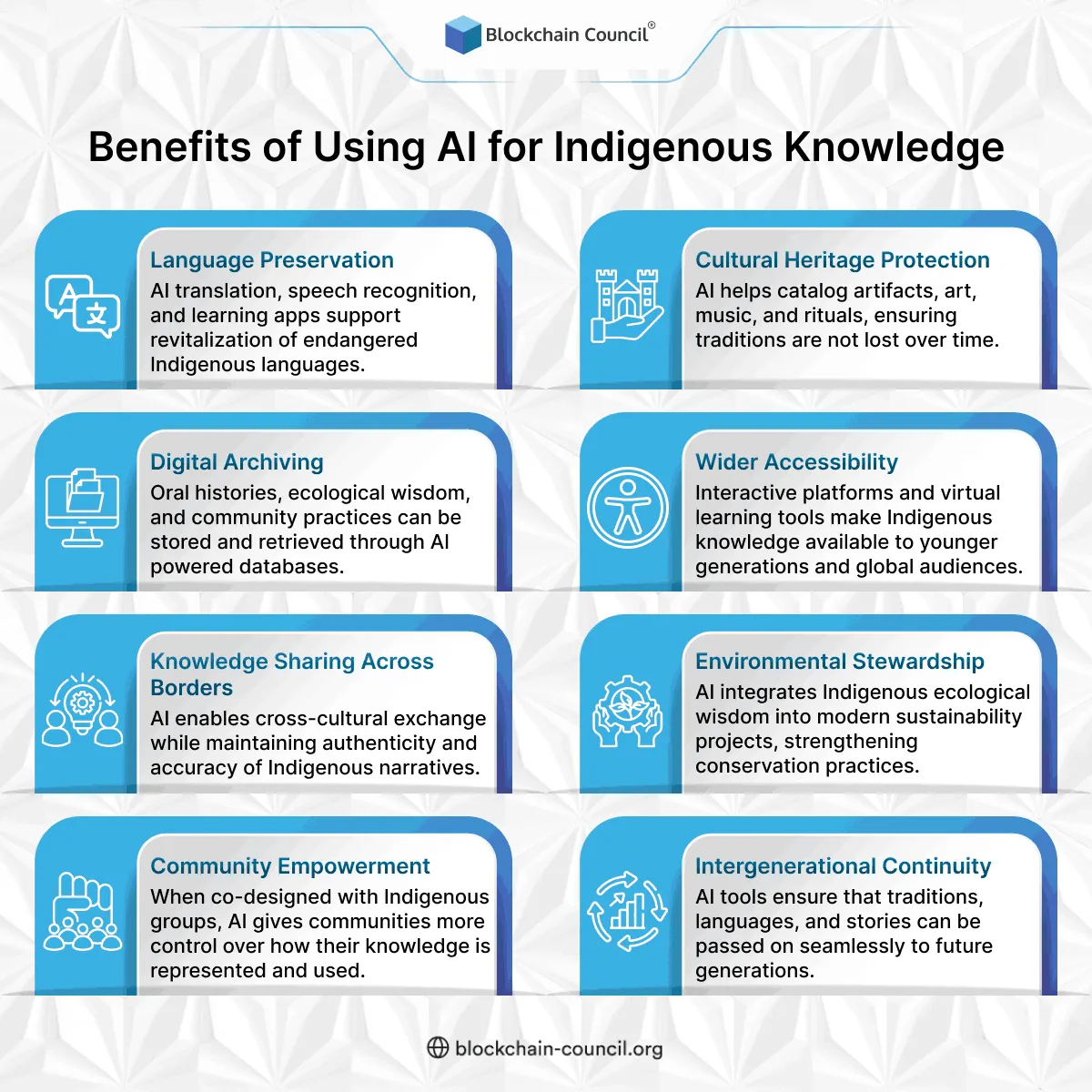
- Language Preservation
AI translation, speech recognition, and learning apps support revitalization of endangered Indigenous languages. - Cultural Heritage Protection
AI helps catalog artifacts, art, music, and rituals, ensuring traditions are not lost over time. - Digital Archiving
Oral histories, ecological wisdom, and community practices can be stored and retrieved through AI-powered databases. - Wider Accessibility
Interactive platforms and virtual learning tools make Indigenous knowledge available to younger generations and global audiences. - Knowledge Sharing Across Borders
AI enables cross-cultural exchange while maintaining authenticity and accuracy of Indigenous narratives. - Environmental Stewardship
AI integrates Indigenous ecological wisdom into modern sustainability projects, strengthening conservation practices. - Community Empowerment
When co-designed with Indigenous groups, AI gives communities more control over how their knowledge is represented and used. - Intergenerational Continuity
AI tools ensure that traditions, languages, and stories can be passed on seamlessly to future generations.
Several Indigenous technologists and researchers are leading projects that bring AI and cultural preservation together. Michael Running Wolf, a Northern Cheyenne expert, is creating AI systems that record endangered Native American languages. He argues that only community-led projects can ensure that preservation efforts are culturally accurate and beneficial.
Another example is Keolu Fox, a Native Hawaiian genomics researcher. He promotes the use of data trusts, federated learning, and blockchain systems to protect Indigenous genetic and cultural data. By applying blockchain technology courses, communities can secure control over their information while still using AI to analyze it.
In New Zealand, Peter Lucas Jones has been at the forefront of Māori language revival projects using AI. His team at Te Hiku Media has built speech recognition tools that have become a benchmark for how culturally grounded AI projects can succeed.
These leaders show that Indigenous knowledge and modern AI can meet in respectful and innovative ways. Their work provides a roadmap for how future systems might balance tradition and innovation.
How Do Certifications and Training Support This Field?
As more people explore AI’s role in cultural preservation, formal training is becoming important. Not only for researchers but also for community members who want to participate directly in these projects. Courses like Agentic AI Certification are helping professionals learn how to design AI systems that can act autonomously while still respecting human guidance.
For those looking at career opportunities, there is a wide range of tech certifications that can build relevant skills. These programs teach data handling, machine learning, and ethical frameworks that apply directly to Indigenous preservation. Anyone wanting a broader perspective on applying digital tools to global industries can also explore Marketing and Business Certification, which connects technical knowledge with leadership skills.
The concept of technology is no longer only about machines and code. It now includes cultural awareness, ethics, and social responsibility. That is why training paths are expanding to prepare people not just as engineers, but as caretakers of culture in the digital age.
What Does the Future Hold for AI and Indigenous Knowledge?
The field is moving fast. AI tools are expected to become more accessible, with community-friendly platforms that allow Indigenous groups to build their own models. These systems could be used for everything from language apps to virtual museums.
At the same time, regulations and ethical guidelines are likely to grow stronger. Governments and international organizations are recognizing the risks of cultural misappropriation. They are also pushing for standards that include transparency, consent, and benefit sharing.
If these steps succeed, AI will not be a threat to Indigenous knowledge but a partner in preserving it. Communities will be able to use AI on their own terms, ensuring that cultural survival is matched with cultural sovereignty.
How Are Global Organizations Supporting This Movement?
International organizations are beginning to recognize that Indigenous knowledge is essential for solving global problems such as climate change, biodiversity loss, and sustainable development. AI is being positioned as a tool that can amplify Indigenous voices in these discussions rather than replace them.
The United Nations has released several guidelines encouraging responsible use of AI that respects Indigenous rights. UNESCO has also stressed the importance of including cultural diversity when designing new AI systems. Their reports highlight that Indigenous peoples must not only be subjects of preservation but active partners in shaping AI tools.
Regional collaborations are also growing. In Latin America, initiatives are focused on using AI to protect traditional ecological knowledge tied to forests and rivers. In Africa, local projects are exploring how AI can map Indigenous agricultural practices that improve soil and water conservation. These initiatives show that Indigenous knowledge is not just heritage but practical expertise that benefits the entire world.
What Case Studies Show AI in Action for Culture?
Several recent projects illustrate how AI can be applied in very practical ways. In Vietnam, researchers have studied how to prevent generative AI from misusing Indigenous knowledge. Their findings recommend legal protections and community monitoring systems. This case shows that countries are beginning to anticipate risks before they become widespread.
In Brazil, the use of semantic pipelines for Indigenous heritage collections has opened new pathways for museums. Instead of simply displaying artifacts, AI tools allow connections to be drawn between different pieces, creating a network of meaning that mirrors Indigenous ways of understanding.
China’s introduction of ICH-Qwen is another case study worth noting. By focusing specifically on intangible cultural heritage, this model allows for reasoning over cultural practices, stories, and crafts. Unlike general-purpose models, it has been fine-tuned to respect context, making it more accurate and useful for preservation efforts.
Each of these projects highlights a simple truth: when AI is designed with a clear cultural purpose, it can become an ally rather than a threat.
What Risks Need More Attention?
Despite progress, risks remain. One of the biggest dangers is cultural misrepresentation. If an AI system generates inaccurate versions of songs, rituals, or stories, it could spread misinformation that damages cultural identity. Deepfakes and synthetic media add to this concern.
Another risk is exploitation. Companies or researchers could use Indigenous knowledge to develop profitable products without proper consent or benefit sharing. This type of misuse has already occurred in areas like traditional medicine, and AI could make it even easier to extract knowledge at scale.
There is also the danger of cultural homogenization. If AI tools are not carefully designed, they may prioritize mainstream languages and traditions while treating Indigenous knowledge as secondary. This could unintentionally reinforce existing inequalities.
The solution lies in strong governance, legal safeguards, and above all, community leadership. Without these, the risks could outweigh the benefits.
How Can AI Help in Education and Youth Engagement?
One of the most promising areas for AI in Indigenous preservation is education. By creating digital resources such as interactive dictionaries, story archives, and learning apps, AI makes cultural knowledge accessible to younger generations.
For example, students can now use language learning apps powered by AI to practice pronunciation in endangered languages. Teachers can integrate digital archives into their classrooms, making history lessons more engaging. Communities can even design their own AI-powered platforms to ensure cultural accuracy.
Youth engagement is especially important because many young people are growing up in urban areas with limited exposure to traditional practices. By bringing culture into digital spaces, AI ensures that traditions remain relevant and accessible. This type of integration also builds digital literacy, empowering Indigenous youth to become both cultural guardians and future innovators.
What Is the Role of Communities in Building AI for Heritage?
Community involvement is not optional, it is essential. Successful projects in New Zealand, North America, and Brazil all share one thing in common: they were guided by Indigenous communities from start to finish.
This means more than just collecting data. It includes setting priorities, deciding how the data will be stored, and controlling how the results are used. In many cases, communities also contribute technical expertise. Indigenous coders, researchers, and students are playing active roles in shaping the tools.
By embedding cultural protocols into AI design, these projects show that preservation is not about freezing culture in the past but allowing it to grow in ways that remain authentic.
How Does AI Connect Indigenous Knowledge to Global Challenges?
AI can help translate Indigenous knowledge into solutions for global issues. Traditional ecological knowledge, for example, includes sustainable farming, water conservation, and biodiversity protection. By analyzing this knowledge with AI, scientists can uncover methods that support climate resilience.
In healthcare, AI can combine traditional medicinal knowledge with modern medical research. This does not replace one system with another but creates a dialogue that benefits both. In conservation, AI can map traditional hunting or fishing practices that protect ecosystems better than industrial approaches.
These applications show that Indigenous knowledge is not just cultural heritage. It is also a living source of innovation that can guide global sustainability.
Conclusion
AI is proving to be a powerful tool for preserving Indigenous knowledge, but only when it is used responsibly. The technology can record endangered languages, digitize heritage, support traditional medicine, and connect cultural wisdom to modern challenges. At the same time, it must be guided by principles of sovereignty, ethics, and community leadership.
The future of AI in this field will depend on respect. Respect for the voices of Indigenous peoples, respect for the cultural contexts that shape knowledge, and respect for the need to balance innovation with tradition. With the right frameworks, AI will not just preserve Indigenous heritage but empower it to thrive in the digital era.