AI and the Future of Work
 Michael Willson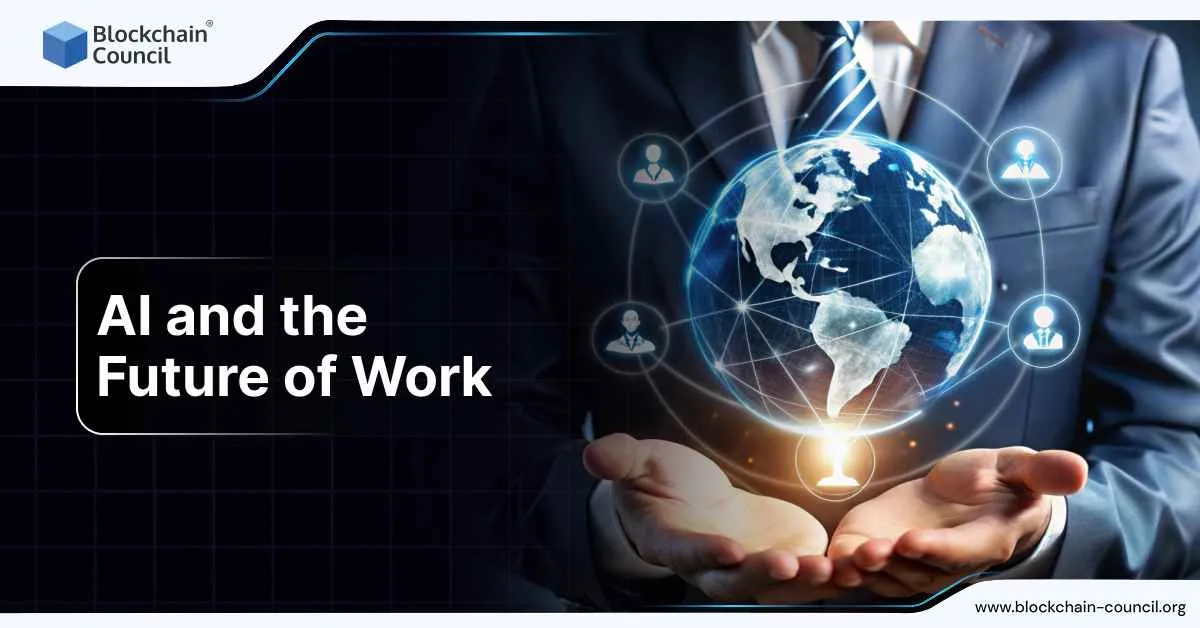
What Is AI’s Real Impact on Jobs Right Now?
Artificial intelligence isn’t some distant idea about robots replacing people. It’s already changing how we work today. Across offices, factories, and classrooms, AI tools are helping humans do tasks faster, make better decisions, and focus on creative work that machines can’t handle yet. From writing emails to analyzing data, AI is quietly becoming part of daily routines. In short, the future of work is already here—it’s just unevenly distributed.
If you’re wondering how to keep up, this is where earning an AI certification can help. It builds practical understanding of how AI fits into your job, your industry, and your long-term career path.

Recent global studies agree on one thing: almost every role will be touched by AI in some way. The International Monetary Fund estimates that around 40% of jobs worldwide are at risk of being changed by AI, while in advanced economies that number jumps closer to 60%. But “risk” doesn’t always mean “loss.” Many of these jobs are evolving, not disappearing. AI often automates the boring parts—like scheduling or report formatting—while freeing workers for higher-value tasks such as problem-solving or design.
Big tech firms, research institutes, and consultancies all reach a similar conclusion. AI is transforming work faster than most organizations expected, yet the biggest gains are going to those that move early and train their people well.
What Do the Latest Reports Reveal About AI and Work?
The 2025 Microsoft Work Trend Index shows that AI adoption jumped sharply after generative models became mainstream. It found that companies using AI for content creation, customer service, and analytics are seeing strong productivity boosts, often within months. But these same reports also warn of an emerging divide between “Frontier Firms” that have restructured their workflows around AI, and everyone else still experimenting.
The IMF and the Organisation for Economic Co-operation and Development (OECD) echo this. Their research highlights that advanced economies are more exposed to AI because they have more white-collar, data-heavy jobs that AI can easily augment. However, this exposure also means bigger opportunities. If handled correctly, AI could help workers in these regions become more productive and raise wages over time.
Stanford University’s 2025 AI Index found measurable proof that AI increases output quality and reduces task time in professional roles. For example, programmers using AI assistants like GitHub Copilot completed projects 55% faster. Similarly, call-center agents using AI guidance were more accurate and efficient. These results show that AI isn’t replacing humans outright—it’s amplifying them.
But it’s not all smooth sailing. McKinsey’s latest research warns that many companies are stuck in what they call “pilot purgatory.” They’ve tested AI tools but haven’t fully changed how their people work. Without new structures for accountability, data sharing, and performance measurement, AI’s potential remains untapped.
Who’s Most Exposed to AI Disruption?
AI exposure doesn’t look the same across industries. White-collar fields—law, finance, design, and marketing—see the biggest effects because AI deals with language, images, and code. Manufacturing and logistics feel the impact through robotics and predictive maintenance. Healthcare, surprisingly, is both safe and at risk: AI helps read scans and manage patient data, but nurses and doctors still rely heavily on empathy and judgment.
The IMF categorizes workers into three groups. The first includes those whose jobs are highly automatable, such as clerical and data-entry positions. The second group is AI-complementary, where AI helps workers do more, like analysts, teachers, and developers. The third group is AI-resistant, mainly manual or human-centric jobs such as construction, caregiving, and hospitality.
That doesn’t mean the first group is doomed. Many of these workers can transition with upskilling. This is why structured training and recognized credentials—like a Data Science Certification—are becoming career lifelines. Data literacy, AI tool fluency, and analytical thinking are the new power skills for every professional, regardless of industry.
What Skills Matter Most in the First Wave of AI Adoption?
According to the OECD and Stanford HAI reports, the most valuable abilities are not just coding or model tuning. They are hybrid skills: communication, data interpretation, and digital judgment. Workers who can translate AI outputs into business actions stand out.
Think of AI as a super-smart intern. It can suggest solutions, but it needs a capable manager to guide it. That’s you. Understanding prompt engineering, ethics, and data quality gives professionals an edge. Certifications such as an agentic ai certification go one step further by teaching how to coordinate multiple AI agents that can automate sequences of work—like preparing reports, analyzing metrics, and updating dashboards.
This shift toward “agentic systems” marks a new chapter in workplace automation. Unlike simple bots, agentic AIs can reason, decide, and act across connected tools. They don’t just follow instructions; they manage processes. Companies adopting this model are already seeing massive productivity gains.
At the same time, understanding the fundamentals of modern technology is essential. Even non-technical roles need some digital fluency to supervise AI effectively. Whether it’s grasping how data flows through a system or how privacy policies affect model performance, a base level of technical awareness is no longer optional.
How Are Workers Preparing Themselves for the AI Future?
In surveys across 31 countries, Microsoft and LinkedIn found that most professionals want to use AI but feel underprepared. Only about one in three employees has received formal AI training. This gap is the new digital divide—not access to devices, but access to learning.
Forward-thinking organizations are addressing this with structured development programs. Many now encourage staff to complete online tech certifications such as those from globaltechcouncil.org. These programs combine practical lessons on AI tools with strategic thinking about automation, privacy, and data use.
Marketing teams are another group leaning heavily into AI. With tools that generate ads, analyze customer sentiment, and personalize campaigns, marketing is becoming an AI-augmented profession. Learners exploring the Marketing and Business Certification gain insight into how AI changes customer journeys, digital funnels, and creative work.
In the same way, AI is reshaping blockchain ecosystems. Developers and analysts pursuing blockchain technology courses are learning how AI supports fraud detection, smart contract auditing, and tokenomics. These cross-disciplinary paths are what make modern careers resilient.
How Does AI Actually Change Daily Workflows?
Imagine a typical office day five years ago—hundreds of emails, long reports, and repetitive administrative work. Now picture today’s reality. AI assistants summarize inboxes, extract insights from data sheets, and even draft entire presentations.
This doesn’t mean humans do less. Instead, they shift to higher-order thinking: strategy, decision-making, and relationship-building. The same trend appears in design (AI drafts concepts), in law (AI reviews documents), and in finance (AI detects anomalies).
Agentic AI is a major leap in this evolution. These are systems of connected AI “agents” that work together to complete multi-step processes. For instance, a content team could set up an agent to research a topic, another to outline the piece, a third to generate visuals, and a final one to schedule publication. Humans stay in control, but the heavy lifting happens behind the scenes.
Workers who can design or supervise such systems will be in demand. This is where combining technical awareness with strategic thinking pays off.
How Can Workers Measure Productivity Gains from AI?
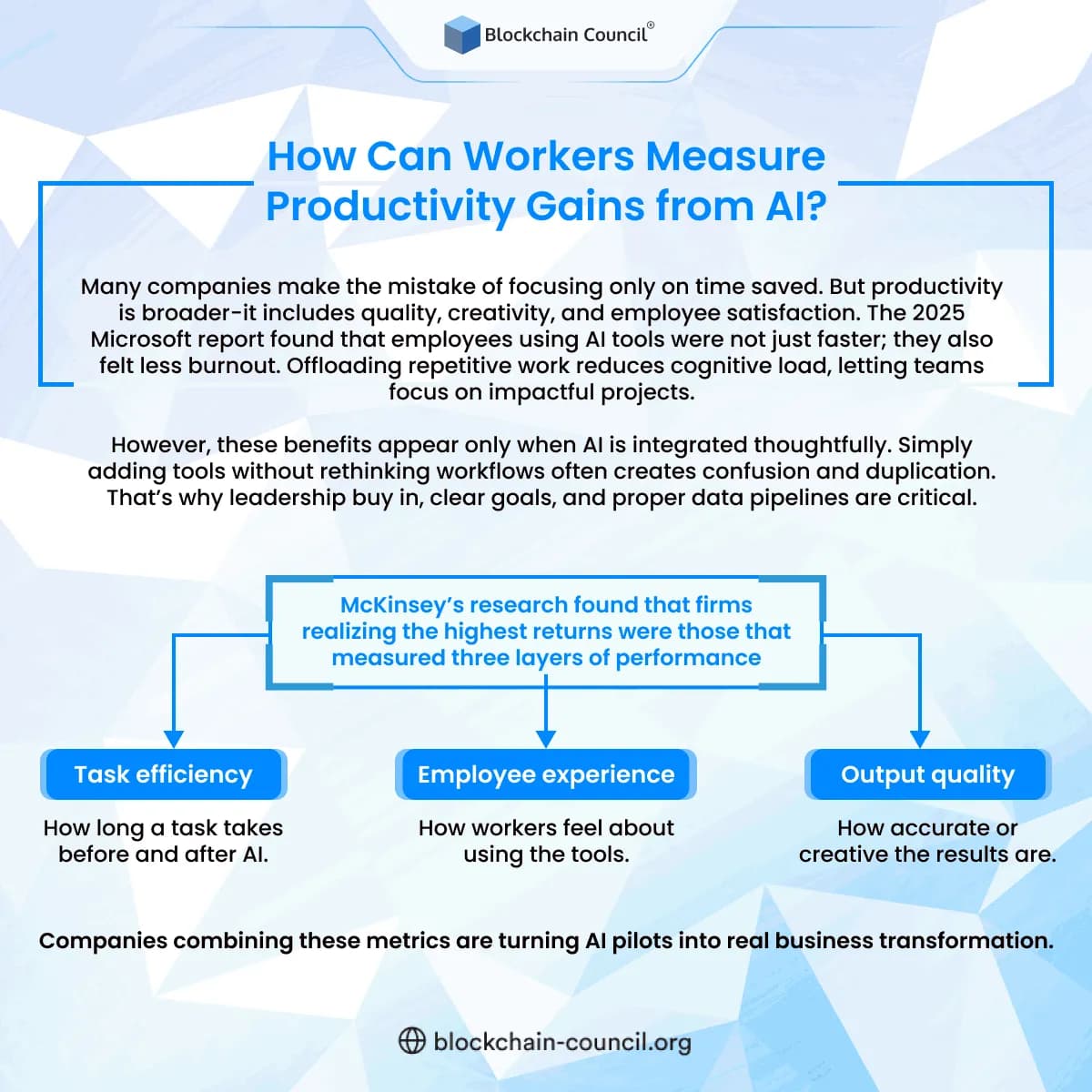
Many companies make the mistake of focusing only on time saved. But productivity is broader—it includes quality, creativity, and employee satisfaction. The 2025 Microsoft report found that employees using AI tools were not just faster; they also felt less burnout. Offloading repetitive work reduces cognitive load, letting teams focus on impactful projects.
However, these benefits appear only when AI is integrated thoughtfully. Simply adding tools without rethinking workflows often creates confusion and duplication. That’s why leadership buy-in, clear goals, and proper data pipelines are critical.
McKinsey’s research found that firms realizing the highest returns were those that measured three layers of performance:
- Task efficiency (how long a task takes before and after AI).
- Output quality (how accurate or creative the results are).
- Employee experience (how workers feel about using the tools).
Companies combining these metrics are turning AI pilots into real business transformation.
What Is the Role of Policy and Training in Shaping AI Workplaces?
Governments and institutions are starting to design policies for a fair AI transition. The OECD urges nations to focus on inclusive upskilling, digital safety nets, and support for small and medium enterprises. The IMF warns that countries failing to invest in human capital will see inequality rise as automation spreads.
At the same time, privacy and ethical AI frameworks are evolving. Employers must handle data responsibly when using AI for monitoring or evaluation. Transparency, explainability, and bias checks are not just legal needs but trust builders among staff.
Workers, too, play a part. Continuous learning is becoming part of every job description. Taking structured programs like AI certs and other skill-based learning ensures that employees remain adaptable, no matter how fast AI develops.
Why Are Frontier Firms Pulling Ahead?
Frontier Firms, as Microsoft calls them, are organizations that didn’t treat AI as an experiment but as a new operating model. They redefined decision-making, created AI governance boards, and redesigned job descriptions. These firms are outperforming peers because they align technology, talent, and culture from the start.
For example, in retail, early AI adopters use predictive analytics to manage stock, dynamic pricing to adjust offers, and natural-language bots for customer service. In healthcare, AI speeds up diagnosis and optimizes schedules. In finance, it supports fraud detection and risk analysis. The result is a competitive edge that compounds over time.
The common thread is human-machine collaboration. Every successful case shows that humans plus AI beat either one alone.
What Challenges Still Remain?
Despite rapid progress, the road to AI-enabled work has obstacles. Data quality is inconsistent, and many companies lack clean, labeled data to train or fine-tune models. Employees worry about privacy when AI monitors performance. Regulation is also catching up slowly, leaving uncertainty about what’s allowed.
Cultural resistance can be just as big a problem as technical issues. Some managers fear losing control, while others underestimate training needs. Effective change management—clear communication, shared goals, and visible leadership support—makes the difference between hype and impact.
Another emerging challenge is algorithmic transparency. Workers need to understand how AI decisions are made, especially in performance reviews or hiring. Building this understanding through training and documentation helps build confidence in the system.
How Should Individuals Navigate the Transition?
The best advice is simple: stay curious and keep learning. Start with small, practical experiments—use AI for summaries, drafts, or research. Notice what works and where the tool struggles. That insight makes you valuable.
Next, build digital literacy systematically. Programs like those on globaltechcouncil.org cover not just AI but related tech certifications in data science, cloud computing, and cybersecurity. These complement AI fluency and make you adaptable to any digital transformation.
Networking also matters. Professionals who share experiences about AI adoption learn faster. Join webinars, online communities, and forums where industry peers discuss new workflows. The ability to talk confidently about AI tools in real terms—not buzzwords—sets you apart.
Companies value employees who can link technology to outcomes. That’s the skill of the decade.
How Does AI Change Daily Workflows in Practice?
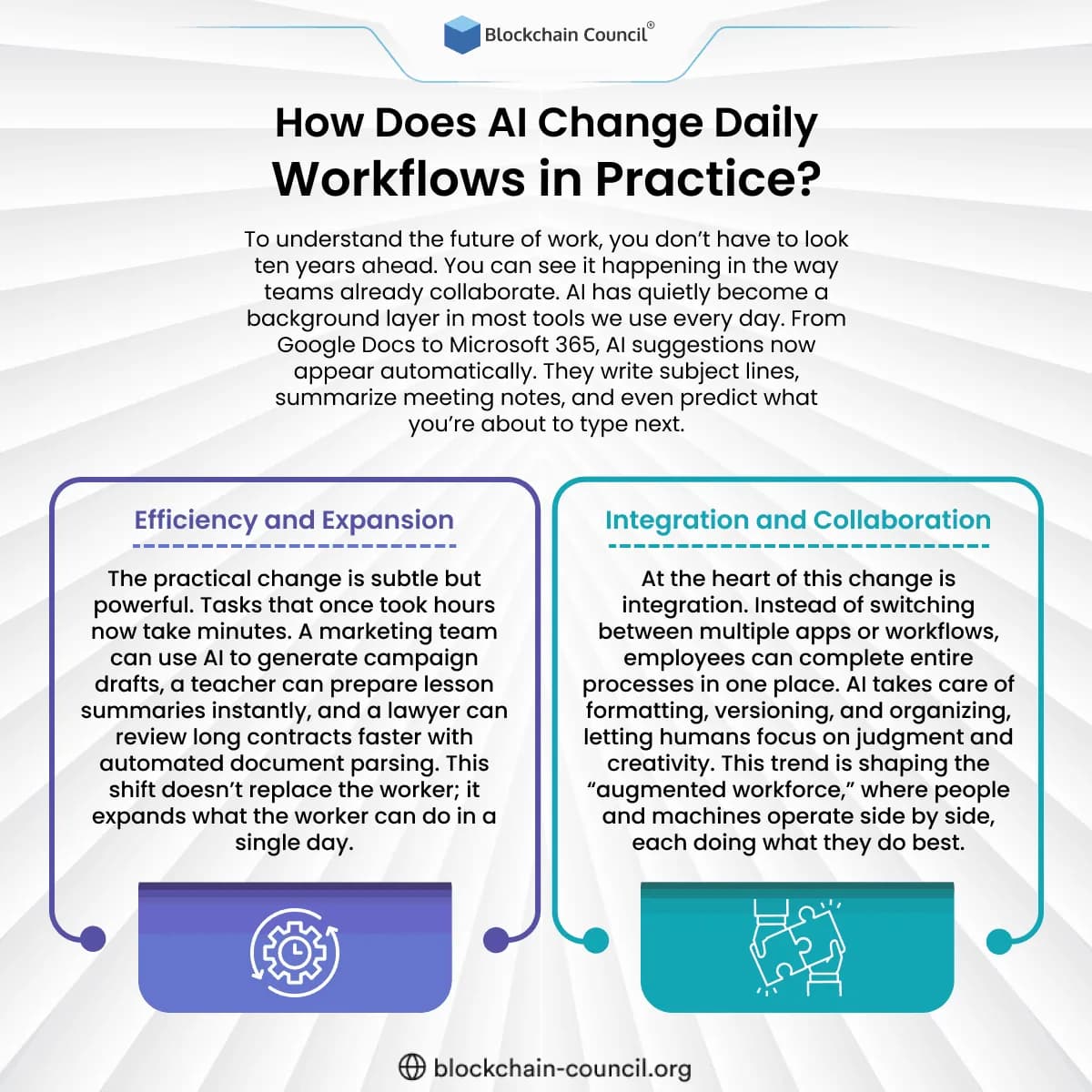
To understand the future of work, you don’t have to look ten years ahead. You can see it happening in the way teams already collaborate. AI has quietly become a background layer in most tools we use every day. From Google Docs to Microsoft 365, AI suggestions now appear automatically. They write subject lines, summarize meeting notes, and even predict what you’re about to type next.
The practical change is subtle but powerful. Tasks that once took hours now take minutes. A marketing team can use AI to generate campaign drafts, a teacher can prepare lesson summaries instantly, and a lawyer can review long contracts faster with automated document parsing. This shift doesn’t replace the worker; it expands what the worker can do in a single day.
At the heart of this change is integration. Instead of switching between multiple apps or workflows, employees can complete entire processes in one place. AI takes care of formatting, versioning, and organizing, letting humans focus on judgment and creativity. This trend is shaping the “augmented workforce,” where people and machines operate side by side, each doing what they do best.
How Do Agentic AI Systems Transform the Workplace?
The next step in this evolution is agentic AI—systems that can plan, act, and verify results across multiple tools. Unlike simple assistants that wait for a command, agentic AI can manage tasks from start to finish. For instance, a company’s HR agent could automatically collect survey responses, analyze trends, and draft an executive summary.
When used correctly, these systems become digital coworkers. You give them goals, not step-by-step instructions. The agentic ai certification explains how such systems coordinate across departments to reduce bottlenecks and errors. In operations, one agent could monitor inventory while another predicts restocking needs. In finance, an agent could track transactions and alert teams when anomalies appear.
This model is different from automation of the past. It’s not about rigid scripts; it’s about flexible decision-making. Each agent interacts with others, learning from feedback and refining results. As more organizations adopt these tools, “agent orchestration” could become a standard business skill, much like using spreadsheets or managing projects today.
How Should Teams Rethink Productivity with AI?
Many organizations still measure success using outdated metrics—hours worked, calls made, or reports submitted. But AI changes the equation. It handles repetitive tasks efficiently, so the real measure becomes impact. Did the work improve outcomes? Did it create new opportunities?
Companies that embrace this shift report higher employee satisfaction. People no longer waste time on routine paperwork. They spend more effort solving meaningful problems. Research from Microsoft shows that workers using AI felt a 35% improvement in job satisfaction due to reduced stress and workload.
Still, measuring AI productivity requires structure. Businesses need baseline data—how long tasks used to take—and a clear method to compare performance after AI adoption. The most effective teams use hybrid metrics that track efficiency, accuracy, and creativity. For example, they combine time saved with customer satisfaction scores.
The organizations getting this right also invest in transparency. They explain how AI decisions are made, how data is used, and what the limits are. Trust and clarity turn fear of automation into collaboration with technology.
How Can Businesses Avoid the “Pilot Trap”?
McKinsey calls it “pilot purgatory”—companies test AI tools but never roll them out across the business. It happens because leadership underestimates the change management required. Buying an AI platform is easy. Changing processes, retraining staff, and building trust take real effort.
To avoid this trap, executives should start with one workflow that’s easy to measure, such as expense reporting or content creation. Once they prove the impact, they can scale the system. Microsoft’s “Frontier Firms” did this by creating dedicated AI task forces that tracked usage and outcomes across departments.
Equally important is setting a data foundation. AI runs on clean, consistent, and accessible data. Companies must invest in quality control before deploying models. Without reliable data, even the best AI system produces unreliable results.
Upskilling plays a big role here. A team with digital fluency adapts quickly to new workflows. Encouraging staff to pursue tech certifications ensures they can manage AI-driven tasks with confidence. It also builds a culture where learning is part of everyday work, not a separate activity.
How Is AI Reshaping Skills and Training?
The skill landscape is shifting fast. AI doesn’t just automate—it redefines what’s valuable. Instead of memorizing information, workers need to know how to find, interpret, and apply it. Critical thinking, ethical reasoning, and data storytelling are now core professional skills.
Employers are responding with targeted training programs. Platforms like globaltechcouncil.org and the Marketing and Business Certification help professionals stay current in a world where marketing, analytics, and decision-making are all AI-powered.
For data-heavy roles, the Data Science Certification prepares workers to interpret model results, understand metrics, and communicate findings clearly. In marketing, professionals learn to balance automation with creativity—knowing when to rely on AI and when to add a human touch.
The goal isn’t just to keep your job; it’s to elevate your role. As AI handles lower-level work, humans move to strategy, design, and oversight. This is why continuous learning is more important than ever.
How Are Startups and Small Businesses Using AI Differently?
Startups tend to adopt AI faster because they don’t have legacy systems to replace. They build AI-first workflows from the beginning. Many small firms use generative AI to handle marketing, customer service, and data entry. It’s a cost-effective way to compete with larger organizations.
However, small companies must still approach AI responsibly. They need clear policies for data privacy, accuracy, and human review. The OECD emphasizes that trust is key—clients and customers must feel confident that AI outputs are ethical and secure.
AI also helps startups scale globally. A small design firm can now create multilingual content, generate promotional videos, and analyze user behavior across markets without hiring large teams. These changes make entrepreneurship more accessible and efficient.
Courses in blockchain technology courses and AI-driven systems are helping entrepreneurs integrate automation into secure, transparent processes. For example, combining blockchain with AI enables safer contracts and better audit trails, solving problems of trust and verification that once required manual checks.
How Does AI Affect Decision-Making at Work?
In the past, managers relied on reports, gut instinct, or experience. AI introduces data-driven insight to almost every decision. Dashboards powered by machine learning identify trends, predict risks, and even suggest actions. But the final judgment still rests with humans.
The danger lies in overtrusting AI. Even well-trained models can make biased or incomplete predictions. This is why human oversight is essential. People need to interpret AI recommendations critically, not blindly accept them. That’s where AI literacy becomes vital.
Workers who understand how AI makes decisions can question results intelligently. This blend of skepticism and understanding makes organizations stronger. Training through recognized programs, such as the AI certification, helps professionals grasp both the power and the limits of machine reasoning.
When AI and human logic complement each other, companies make faster and better decisions.
How Does AI Influence Workplace Culture?
AI doesn’t just change what people do—it changes how they feel about work. Early studies show that automation reduces burnout by handling repetitive tasks, but it can also increase stress if employees feel monitored or replaced.
The best companies are transparent. They explain why AI is used, how data is stored, and what privacy controls are in place. When workers trust the system, they collaborate with it instead of resisting it.
AI can also make work more inclusive. Automated translation, captioning, and accessibility tools help people with different backgrounds or abilities participate fully. Remote collaboration becomes smoother, and team diversity grows.
Still, leadership must keep communication open. Employees should be encouraged to share feedback about AI tools, both good and bad. This culture of experimentation and honesty makes AI adoption smoother and more sustainable.
How Can Governments Support Workers During the AI Shift?
The IMF and OECD both stress that government action is essential to ensure fairness during the AI transition. Policies that support retraining, digital education, and income protection can prevent inequality from widening.
Public-private partnerships are a strong model. Governments can fund training programs, while companies provide practical tools and mentorship. When workers see a clear path to new opportunities, they embrace technology instead of fearing it.
Several countries are already experimenting with AI readiness initiatives. They provide vouchers for online courses, incentives for companies to train employees, and guidelines for ethical AI use. These efforts help balance innovation with job security.
Education systems also play a key role. Schools that teach data literacy, problem-solving, and digital communication prepare students for the AI economy. Lifelong learning should be seen not as a luxury but as a necessity.
How Can Workers Future-Proof Their Careers?
The most future-proof workers are those who treat learning as part of life, not as a temporary fix. The fastest-growing roles combine human strengths—creativity, empathy, adaptability—with digital understanding.
Start by identifying how AI affects your field. Then look for ways to work with it. For example, if you’re in marketing, learn prompt writing or data interpretation. If you’re in finance, study predictive analytics. If you’re in operations, explore workflow automation and optimization.
A clear development plan helps. Courses and communities on globaltechcouncil.org and Marketing and Business Certification offer structured paths that combine technical skill with business strategy. These are the skills companies look for when hiring or promoting.
AI isn’t about replacing you—it’s about enhancing what you can do. Workers who embrace it early will lead the change rather than react to it.
What Does the AI-Powered Office of the Future Look Like?
Picture a typical morning in 2026. You arrive at work, and your digital assistant has already reviewed your inbox, prioritized your meetings, and summarized yesterday’s key decisions. You open your dashboard, which updates automatically with project metrics. Your AI agent highlights anomalies and even drafts quick follow-up messages.
Meetings are shorter because everyone has context beforehand. Reports write themselves in the background, and AI chatbots handle routine customer queries. Employees focus on creative problem-solving, negotiations, and innovation.
This isn’t a distant dream. Many leading companies are already close to this setup. The challenge now is scaling it responsibly, ensuring data protection, and giving humans the right level of control.
AI will not eliminate human work—it will redefine what it means to work well. Those who adapt early will find themselves leading more meaningful, efficient, and creative careers.
What Policies Keep AI Adoption Fair and Safe?
AI has grown faster than the rules built to guide it. This mismatch creates tension. Businesses want to use AI to stay competitive, but workers want protection from unfair monitoring, bias, or job insecurity. Governments and regulators are now working to close this gap.
The OECD recommends clear policies around three pillars: transparency, accountability, and human oversight. Transparency means workers should know when and how AI is used. Accountability means companies must take responsibility for AI’s mistakes. Human oversight ensures that final decisions affecting people—like hiring or evaluation—are not made by a machine alone.
Some regions already lead the way. The European Union’s AI Act focuses on risk-based regulation, setting strict rules for high-risk systems. The United States and Canada are following with voluntary frameworks that encourage responsible AI use. Many Asian economies, including Japan and Singapore, are developing their own guidelines to protect workers while staying innovation-friendly.
For companies, the best strategy is to blend compliance with culture. This means not just meeting the legal minimum, but actively promoting responsible use. Regular audits, bias detection tools, and open communication help build trust. When employees see fairness in how AI operates, adoption becomes smoother and productivity higher.
How Will AI Reshape Pay, Careers, and Mobility?
AI is likely to widen the pay gap between workers who can use it and those who cannot. People who understand AI tools, data workflows, and automation systems earn more because they make businesses more efficient. In contrast, those who rely on manual, repetitive work risk stagnation.
But the story isn’t entirely negative. The IMF points out that AI can increase job mobility. As new kinds of work appear—AI trainers, data ethicists, automation supervisors—many workers will move to roles that didn’t exist before. AI also allows for remote collaboration across countries, giving skilled workers access to global opportunities.
One major trend is task-based pay. Instead of fixed job titles, companies are breaking work into AI-supported tasks. A project manager, for instance, may also become a prompt engineer or workflow designer. Flexible work portfolios replace static roles.
The key to success is adaptability. Professionals who embrace AI tools, even at a basic level, can double their output and career growth. Learning platforms such as globaltechcouncil.org offer structured pathways through recognized tech certifications. These programs combine skill-based training with applied knowledge, preparing people for fluid and AI-integrated job markets.
What Does a 24-Month AI Adoption Plan Look Like?
Adopting AI isn’t about buying software—it’s about redesigning how work happens. A practical 24-month roadmap starts small and scales responsibly.
Phase 1 (0–6 months): Assess and Educate.
Companies begin by mapping workflows to identify which tasks are suitable for AI. They also conduct staff training to reduce fear and build understanding. Introducing courses like the AI certification helps employees understand both potential and limits of AI.
Phase 2 (6–12 months): Pilot and Measure.
Next comes focused experimentation. Teams choose one process—like customer support automation—and track outcomes carefully. They measure time saved, error reduction, and customer response. This phase is about proving value.
Phase 3 (12–18 months): Integrate and Scale.
Successful pilots expand. Data pipelines are cleaned and standardized. Policies for data privacy, access control, and audit logging are implemented. Managers redefine performance metrics, emphasizing results rather than effort.
Phase 4 (18–24 months): Optimize and Govern.
AI becomes a daily tool. Companies set up internal AI councils to guide ethical use, handle risk, and explore new opportunities. External partnerships with training organizations, such as those offering agentic ai certification, ensure continuous learning.
This approach balances experimentation with accountability. It also builds resilience, ensuring that when new AI models appear, teams can adapt without starting from zero.
What Does AI Mean for the Global Workforce?
Globally, AI affects workers differently depending on their country’s economic structure. In advanced economies, automation often targets office-based jobs. In emerging economies, it reshapes agriculture, logistics, and manufacturing.
The IMF estimates that while 40% of jobs may change, very few will vanish entirely. Instead, the nature of work will evolve. The challenge for developing nations is not losing jobs but keeping up with skills demand. Investments in education, digital infrastructure, and business incubation will define their success.
Meanwhile, remote work powered by AI collaboration tools is breaking geographic barriers. A designer in Kenya can work for a firm in London, and an analyst in Brazil can support a U.S. fintech company. This global mobility of talent may reduce inequality if digital access becomes universal.
However, the opposite could also happen if access remains uneven. Policymakers must ensure affordable internet, open-source AI models, and cross-border training. International cooperation will be essential to prevent a global “AI divide.”
How Will AI Influence Leadership and Management Styles?
Leadership in the AI era looks different. Managers no longer supervise only people—they oversee hybrid teams of humans and digital agents. The best leaders act as orchestrators, guiding collaboration between the two.
Decision-making becomes more data-driven. Managers use AI dashboards for real-time insights, forecasting, and performance tracking. But empathy, communication, and adaptability remain critical. Employees trust leaders who can explain technology in simple terms and align it with purpose.
Training for executives is changing too. Many pursue the Marketing and Business Certification to learn how to combine AI insights with strategy. This ensures leaders don’t just follow trends but shape them.
Organizations that encourage cross-functional thinking—where technologists understand business and managers understand data—see stronger results. AI doesn’t remove the need for leadership; it makes leadership smarter and more intentional.
What Challenges Could Slow AI’s Growth at Work?
Despite its promise, AI faces real barriers. Data privacy laws vary across regions, making global rollouts complex. Smaller companies lack the budgets or expertise to integrate AI safely. Many workers also distrust automated monitoring tools, fearing surveillance.
Technical issues add more friction. Models can hallucinate, produce biased outputs, or misinterpret inputs. Companies must invest in validation systems and human review. Ethical design becomes as important as technical performance.
Another concern is resource use. Training large AI models consumes significant energy. Firms will have to balance innovation with sustainability goals. Cloud providers are already moving toward carbon-neutral infrastructure, but widespread adoption needs industry-wide standards.
The good news is that solutions are emerging. Open-source models, better datasets, and transparent auditing tools are improving reliability. Collaboration among governments, researchers, and private firms will determine how fast and safely AI can expand.
What Will Work Look Like by 2026?
If current trends continue, by 2026 AI will be as normal as email or video calls. Offices will operate around intelligent systems that anticipate needs rather than react to them. Workers will manage personalized AI dashboards that organize their entire day.
Performance reviews will measure creativity, collaboration, and adaptability instead of attendance or raw output. Continuous learning platforms will be part of every job, updating skills in real time. Companies will compete not just on products but on how well they use AI to empower employees.
Job descriptions will blend disciplines. A marketing strategist will use predictive models, a teacher will work with adaptive learning software, and an engineer will rely on generative design. The workplace will feel less like a factory and more like an ecosystem of intelligent collaboration.
Workers who engage early through structured learning—whether in AI, blockchain, or advanced technology—will shape this future. Those who wait may find themselves catching up in a world that never slows down.
What Are the Open Questions About AI and Work?
Even with all the progress, several big questions remain. Can AI really boost productivity across every sector, or will benefits cluster in a few industries? How can we measure long-term well-being instead of short-term gains? And who is responsible when AI systems make mistakes that affect careers?
Another unknown is the psychological impact of AI-heavy work. Will humans feel more fulfilled doing creative tasks, or disconnected as machines handle the routine? Studies so far are mixed. Some workers report excitement and relief, while others feel anxiety about job security.
Finally, the question of education looms large. Can schools and universities keep pace with technology? Are we teaching students how to think critically about algorithms and data ethics? These challenges will define the next decade of employment policy.
What Should You Do Now to Stay Ahead?
Start small but stay consistent. Pick one AI tool relevant to your field and use it daily. Build confidence before exploring advanced systems. Track what tasks you automate and how much time it saves. This creates a personal data story you can share in interviews or performance reviews.
Finally, stay connected. Join online forums, attend webinars, and follow credible research sources like the IMF, OECD, or Stanford HAI. The more you engage with evolving trends, the better you’ll recognize new opportunities.
AI isn’t the end of human work—it’s a turning point. It’s a chance to redesign how we use our time, talent, and creativity. Workers who embrace learning will thrive; those who resist will struggle to keep up. The future of work isn’t about man versus machine—it’s about partnership.