AI and the Democratization of Investment
 Michael Willson
What Is AI and the Democratization of Investment?
AI and the democratization of investment describe how artificial intelligence is opening up financial markets to everyone. It means that powerful analytical tools once limited to hedge funds and major institutions are now available to everyday users through apps and platforms. Anyone with a smartphone can learn, invest, and grow their wealth with guidance powered by intelligent algorithms.
These systems analyze huge volumes of data, interpret market movements, and present insights in plain language. For beginners, that’s the bridge between confusion and confidence. It’s how AI transforms complicated financial concepts into accessible opportunities.

If you want to understand how these systems work in practice, the best place to start is the AI certification offered by Blockchain Council. It teaches the fundamentals of machine learning and neural networks that drive modern financial innovation.
How Does AI Make Investing More Accessible?
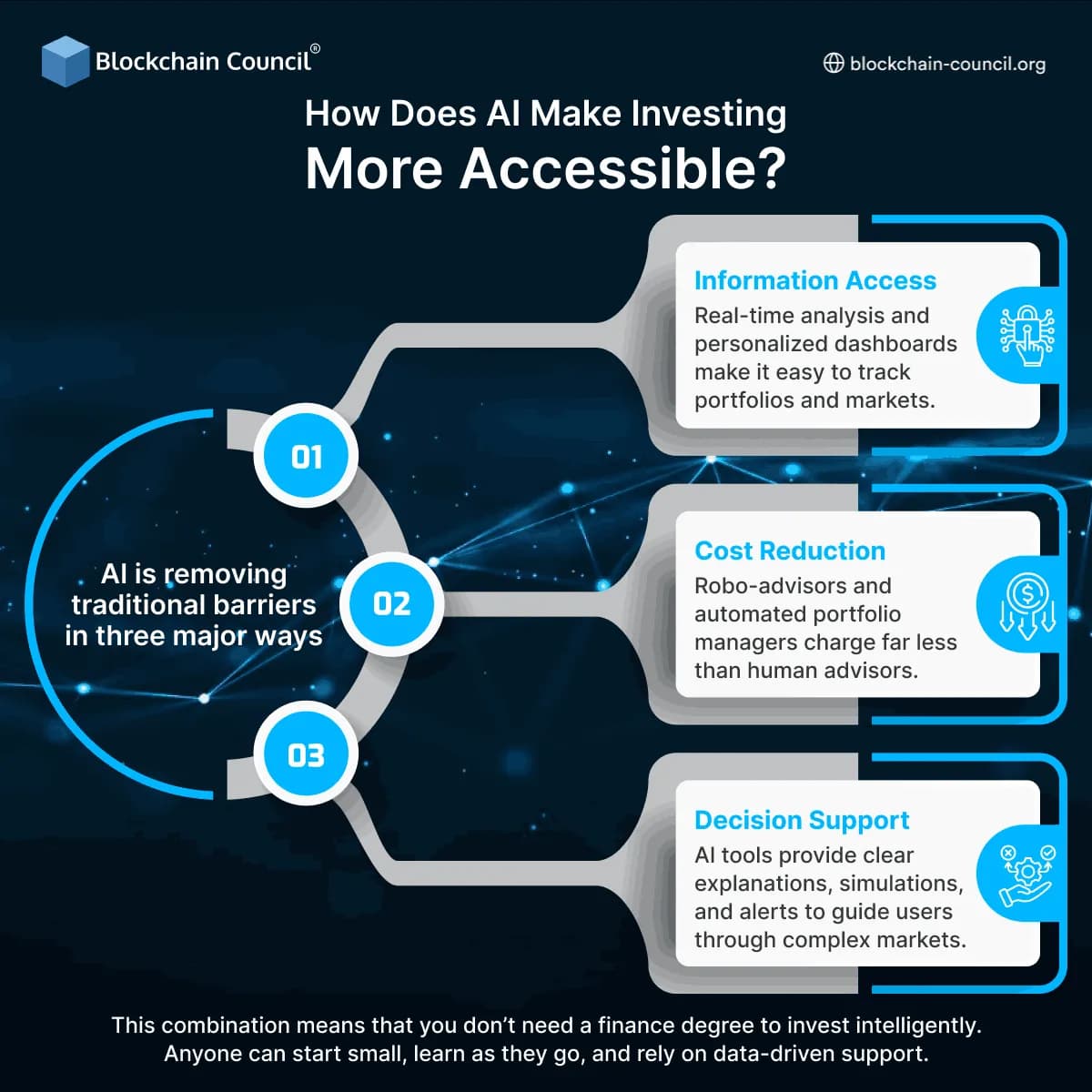
AI is removing traditional barriers in three major ways:
- Information Access: Real-time analysis and personalized dashboards make it easy to track portfolios and markets.
- Cost Reduction: Robo-advisors and automated portfolio managers charge far less than human advisors.
- Decision Support: AI tools provide clear explanations, simulations, and alerts to guide users through complex markets.
This combination means that you don’t need a finance degree to invest intelligently. Anyone can start small, learn as they go, and rely on data-driven support.
What Does Democratization Mean for Retail Investors?
In simple terms, democratization means fairness and access. It’s about removing privilege from investing. AI systems bring equal opportunities to individuals regardless of income or location.
For example:
- A student can buy fractional shares of tech companies.
- A retiree can automate rebalancing without hiring an advisor.
- A freelancer can receive risk assessments tailored to inconsistent income.
Each case shows how technology empowers real people.
How Are Robo-Advisors Transforming Financial Access?
Robo-advisors were the first large-scale use of AI in retail investing. They manage money automatically based on your goals and tolerance for risk.
Here’s how they work:
- You fill out a short questionnaire about your objectives.
- The AI builds a portfolio using exchange-traded funds (ETFs).
- The system monitors performance and rebalances regularly.
This automation eliminates emotional decision-making and cuts advisory costs drastically. Millions of users now rely on these systems for long-term growth.
How Does AI Improve Investment Decisions?
AI helps investors make better choices by analyzing more data than any human could process. These algorithms look at price trends, company earnings, global events, and even social sentiment. Then they generate insights and present clear reasoning.
An AI platform might say:
- “Your portfolio is too concentrated in one sector.”
- “Energy stocks are outperforming your current allocation.”
- “A similar market pattern occurred in 2018; risk is increasing.”
This type of contextual feedback used to cost thousands of dollars in research subscriptions. Now, it’s part of most retail investing apps.
How Does AI Personalize the Investment Journey?
Personalization is what makes AI truly revolutionary. It adapts strategies to fit each person’s goals, lifestyle, and budget.
Some examples include:
- Recommending conservative plans for users close to retirement.
- Suggesting diversified ETFs for beginners.
- Adjusting allocations for users with fluctuating income.
AI learns continuously from your behavior. The longer you use it, the smarter and more relevant its suggestions become.
Why Is Financial Education Part of the Democratization Process?
Access without understanding can still lead to mistakes. AI fills this gap by teaching while managing.
When you purchase your first stock, the system might explain price-to-earnings ratios or dividends. If you rebalance, it can illustrate why that reduces risk. Over time, these mini-lessons create confident investors.
If you want to strengthen your analytical abilities, the Data Science Certification from Global Tech Council is an excellent choice. It teaches how algorithms process and interpret financial data.
How Does AI Build Trust and Transparency?
Trust is essential in finance, and AI builds it through clarity and verification. The best platforms show exactly why they recommend a trade or strategy. They display the metrics and logic behind every suggestion.
AI also improves security. Fraud-detection models monitor unusual patterns in transactions, logins, and communication. If something looks suspicious, users get instant alerts.
Transparency plus security equals confidence. That’s how AI wins user trust and drives adoption.
How Does Human Oversight Complement AI?
Even with automation, human expertise remains valuable. AI systems handle data, but humans provide context, ethics, and empathy.
Many firms now use hybrid models combining both. The AI handles repetitive tasks such as rebalancing, while advisors focus on life goals and risk discussions. This balance ensures that investors benefit from both precision and personal understanding.
Professionals who want to learn how autonomous systems collaborate with humans should consider the agentic ai certification to explore how decision-making models align with real-world responsibility.
What Risks Come with AI Investing?
AI is powerful, but it’s not perfect. Investors must be aware of:
- Automation bias: Following algorithmic advice blindly.
- Data privacy issues: Sharing financial information with third-party platforms.
- Algorithmic bias: Models trained on limited data can produce skewed results.
Understanding these limitations helps users stay cautious and informed. Responsible platforms publish audits and explanations to reduce these risks.
How Do Regulations Protect AI Investors?
Regulators worldwide are defining standards for AI in finance. They emphasize transparency, explainability, and accountability.
In the United States, financial authorities require firms to show how algorithms make decisions. In Europe, the AI Act sets strict requirements for systems used in investments. These measures protect consumers while encouraging innovation.
The outcome is a balanced environment where AI can thrive without compromising fairness.
How Is AI Expanding Access Globally?
AI is making financial inclusion a global reality.
- In developing regions, mobile-first AI platforms allow small investments in local currencies.
- In mature markets, AI focuses on optimizing tax efficiency and ESG (environmental, social, governance) portfolios.
- In Asia, investors use AI tools for sentiment analysis and predictive trading.
By adapting to regional contexts, AI ensures that financial growth is no longer limited to a few markets.
How Does AI Reduce Emotional Bias in Trading?
Human emotions can destroy disciplined investing. Fear causes panic selling, and greed leads to overconfidence. AI eliminates these extremes by executing strategies based on data, not emotion.
For example, if markets dip 5 percent, AI evaluates whether it’s a correction or a long-term trend before acting. This logic-driven behavior leads to more consistent results.
Anyone who wants to understand algorithmic trading in depth should explore the AI trading course to learn how automated systems manage trades objectively.
How Does AI Enhance Transparency and Accountability?
Every action made by AI can be logged, analyzed, and reviewed. This recordkeeping builds accountability across platforms.
For instance, users can see which indicators triggered a buy or sell order. That level of visibility was unthinkable in traditional financial management.
Accountability also extends to firms, which must demonstrate compliance and fairness in their algorithms. The result is a system where investors can verify performance independently.
How Is AI Changing Financial Learning?
AI tutors and adaptive learning platforms personalize education just like investment apps personalize portfolios.
They track your progress, adjust lessons, and provide instant feedback. This helps learners master complex topics faster.
For those building long-term careers, tech certifications from Global Tech Council offer structured pathways into AI, analytics, and digital transformation across industries.
How Does AI Encourage Responsible and Ethical Investment?
AI promotes ethical investing by evaluating ESG metrics such as carbon emissions, labor practices, and corporate governance.
Investors can filter out companies that fail to meet sustainability goals. The AI then recommends options that align with both performance and principles.
By merging profitability with responsibility, AI ensures that democratization also supports positive global impact.
How Is AI Creating New Career Paths?
As finance becomes more technology-driven, demand for skilled professionals is exploding.
Here are growing roles shaped by AI:
- Data analysts who interpret model outputs.
- AI trainers who fine-tune algorithms for accuracy.
- Compliance experts who audit AI systems.
- Financial educators who translate insights for users.
Earning AI certs proves that professionals have the knowledge to work effectively with these technologies. Certifications signal credibility in competitive markets.
How Does Blockchain Strengthen AI-Driven Finance?
Blockchain and AI form a strong partnership in modern investing. Blockchain secures transactions, while AI interprets the data stored on those ledgers.
Together they provide:
- Transparency: Every trade recorded immutably.
- Speed: Real-time settlement and reconciliation.
- Trust: Reduced chances of tampering or error.
Learners who want to understand this intersection can take blockchain technology courses to explore how decentralization complements intelligent automation.
How Does AI Help Build Smarter Portfolios?
AI creates data-driven portfolio recommendations that adapt to your objectives and risk profile.
It can:
- Analyze years of market data in seconds.
- Simulate possible outcomes under different conditions.
- Suggest optimal asset allocations.
- Monitor and adjust automatically.
These capabilities remove guesswork and keep strategies aligned with personal goals.
For a deeper understanding of this process, the AI powered investment course offers hands-on insight into how algorithms design and manage portfolios.
How Are Businesses and Educators Using AI in Finance?
AI is reshaping both marketing and financial education.
- Marketers use AI to analyze customer behavior, personalize campaigns, and predict market demand.
- Educators use AI to tailor learning content and measure comprehension in real time.
Professionals interested in these applications should look into the Marketing and Business Certification to understand how data analytics and automation drive customer engagement.
How Does AI Empower Small Investors?
Small investors often feel outmatched by institutions with access to advanced research. AI evens the field by offering the same analytical power at a fraction of the cost.
Features like fractional trading, portfolio simulation, and instant alerts ensure that anyone can participate confidently.
AI doesn’t care whether an account holds one hundred dollars or one hundred thousand. It provides consistent quality of insight to everyone.
What Global Trends Support AI-Driven Investing?
Several trends are pushing AI investment tools into mainstream use:
- Cheaper computing power that makes advanced models affordable.
- Wider smartphone adoption connecting billions to digital finance.
- Regulatory clarity that encourages innovation while protecting consumers.
- Cultural acceptance of automation in daily decision-making.
These forces combine to create a perfect environment for inclusive financial systems.
How Should Professionals Prepare for the Future of AI Investing?
Staying competitive requires continuous learning and cross-disciplinary knowledge. Professionals should focus on:
- Understanding how algorithms interpret financial signals.
- Building ethical frameworks for AI use.
- Learning compliance and auditing standards.
- Developing soft skills like communication and strategic thinking.
Comprehensive programs in modern technology education teach professionals how to balance technical expertise with business application.
What Does the Future of Democratized Investing Look Like?
The next phase of democratization will emphasize fairness, transparency, and lifelong learning.
Expect to see:
- AI assistants that converse naturally about investments.
- Platforms that translate market news into personal impact.
- Fraud detection that protects small investors in real time.
- Global communities that share insights and mentorship through AI-powered networks.
These developments will redefine financial literacy and inclusion.
How Will AI Shape Financial Behavior?
AI is already shaping how people save, spend, and invest. Apps can predict spending trends, recommend budgets, and highlight investment opportunities automatically.
By aligning daily behavior with long-term goals, AI turns financial planning into a continuous, adaptive process. Investors learn through doing, supported by personalized feedback loops.
The result is greater confidence and accountability across generations of new investors.
Why Is Continuous Learning Essential in This Era?
Financial markets and technology evolve quickly. What works today might not work tomorrow. Continuous learning ensures investors and professionals stay updated.
Structured programs and certifications provide an organized way to grow expertise while remaining employable. Learning about AI, blockchain, and analytics keeps skills relevant in a rapidly changing economy.
That mindset aligns with the spirit of democratization: access, adaptability, and awareness for everyone.
How Will AI and Human Expertise Coexist in the Future?
Rather than competing, AI and humans will collaborate. Machines will process data faster, while humans provide interpretation and moral guidance.
Future advisory models will feature:
- Automated data crunching handled by AI.
- Human experts validating and contextualizing outputs.
- Clients receiving hybrid insights that combine accuracy and empathy.
This partnership ensures efficiency without losing personal connection.
Why Is AI the Cornerstone of Modern Financial Inclusion?
AI bridges three major gaps: information, affordability, and confidence. It gives ordinary people access to tools once reserved for experts. It cuts costs through automation and improves decision-making through education.
As global connectivity expands, billions of new investors can join financial markets safely and intelligently.
The democratization of investment isn’t just about making money. It’s about creating a world where knowledge, opportunity, and technology align to build shared prosperity.
Conclusion: The Real Power of AI in Investing
Artificial intelligence has already redefined what it means to invest. It simplifies research, educates users, and automates complex processes. More importantly, it ensures that financial growth is no longer limited to those with wealth or specialized education.
By combining intelligent automation with transparency, AI brings equality to finance. It allows anyone to participate, learn, and build wealth responsibly.
As regulations mature and systems evolve, this transformation will only accelerate. Investing will become not only more profitable but also more inclusive and sustainable.
The democratization of investment powered by AI is the clearest signal that the future of finance belongs to everyone.