AI Data Management in the Cloud
 Michael Willson
AI data management in the cloud is about using cloud platforms to store, process, and secure data so it can be used effectively for artificial intelligence. This approach helps businesses manage large volumes of structured and unstructured data, maintain governance, and prepare information for AI models. With AI workloads expanding across industries, managing data in the cloud has become one of the most critical parts of digital transformation.
If you want to understand these technologies in practice, the AI Certification is a good way to start. It shows how AI connects with data pipelines, governance, and cloud systems.

This article explores how AI and cloud data management work together, the platforms leading the market, the trends shaping the future, and the challenges organizations must address.
What Is AI Data Management in the Cloud
AI data management in the cloud means combining cloud-based storage, compute, and automation with AI-driven tools for organizing and preparing data. Unlike traditional systems, cloud data management is built for scale and flexibility. It allows teams to work with massive datasets and ensure quality, governance, and security.
AI improves this process by automating preparation, validation, and feature engineering. It makes data pipelines more efficient and less dependent on manual work. As a result, enterprises can move from raw data to actionable insights much faster.
Market Growth and Platform Leaders
The demand for AI-ready data platforms is growing rapidly. Cloud-native companies like Snowflake and Databricks are leading this change.
- Snowflake: Its Q2 2025 revenue reached 1.1 billion dollars, driven by strong demand for AI-ready cloud platforms. It expects to cross 4.4 billion dollars in product revenue for the year.
- Databricks: Growing at nearly 60 percent year over year, it targets a 3 billion dollar annualized run rate by the end of 2025. It focuses heavily on unstructured data and AI-native intelligence.
These platforms are competing with others like Palantir, but the market shows that cloud-based data management for AI is one of the fastest-growing technology areas.
Trends Shaping AI Data Management
Several key trends are defining how AI data management is evolving:
- Unified data fabrics: Companies are moving toward integrated ecosystems where all tools and data sources connect.
- Generative AI integration: AI is being applied to metadata management, catalogs, and lineage tracking.
- Data mesh strategies: Domains within organizations manage their own data as products, improving ownership and usability.
- Automation: AI-based automation handles preparation, cleaning, and pipeline monitoring.
- Semantic layers: These make data more understandable across teams, helping bridge the gap between business and technical users.
By 2028, many fragmented tools are expected to consolidate into unified platforms.
Governance and Security Challenges
Managing AI data in the cloud comes with challenges. Governance and compliance remain major concerns.
- Data sovereignty: With growing geopolitical pressures, organizations need location-aware policies for where data is stored and processed.
- AI governance: Policies must cover access, usage, and bias detection. Embedding governance into workflows is more effective than adding it later.
- Confidential computing: This ensures sensitive data is secured even from cloud providers themselves.
- Data clean rooms: These allow secure collaboration on sensitive data without exposing raw information.
These elements are essential for building trust in AI-driven cloud systems.
Resource Optimization
Cloud resources are expensive when not managed well. AI is now used to optimize resource allocation through dynamic scaling and reinforcement learning. Research shows that automated approaches can cut costs by up to 40 percent while improving utilization by 20 to 30 percent.
For organizations running large AI workloads, resource optimization is as important as governance. It helps balance performance with financial efficiency.
AI Data Management in the Cloud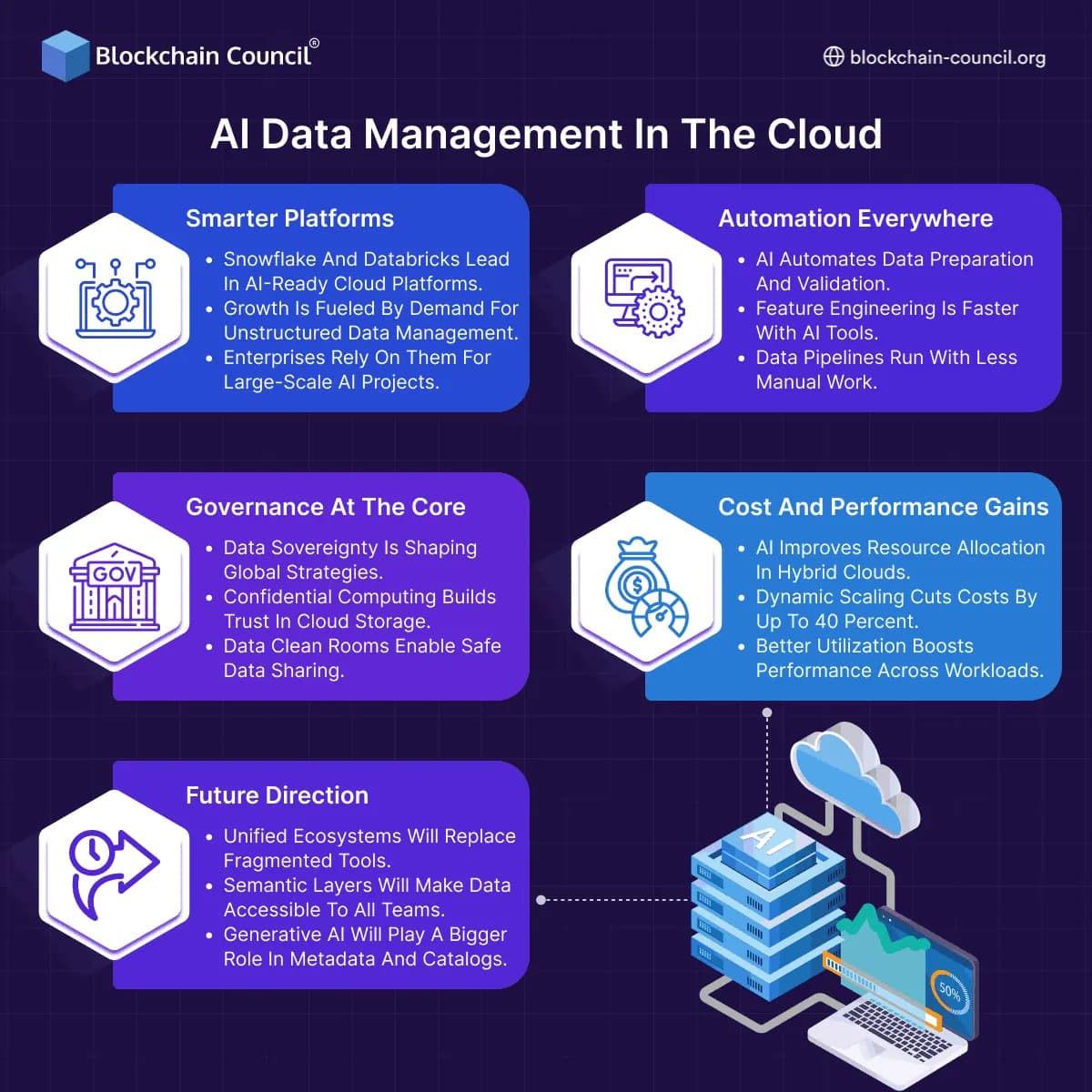
Smarter Platforms
Snowflake and Databricks lead in AI-ready cloud platforms.
Growth is fueled by demand for unstructured data management.
Enterprises rely on them for large-scale AI projects.
Automation Everywhere
AI automates data preparation and validation.
Feature engineering is faster with AI tools.
Data pipelines run with less manual work.
Governance at the Core
Data sovereignty is shaping global strategies.
Confidential computing builds trust in cloud storage.
Data clean rooms enable safe data sharing.
Cost and Performance Gains
AI improves resource allocation in hybrid clouds.
Dynamic scaling cuts costs by up to 40 percent.
Better utilization boosts performance across workloads.
Future Direction
Unified ecosystems will replace fragmented tools.
Semantic layers will make data accessible to all teams.
Generative AI will play a bigger role in metadata and catalogs.
Building Skills for AI Data Management
The rise of AI in cloud data management creates demand for skilled professionals. Along with AI certs, those focusing on data governance and pipelines should consider the Data Science Certification. For leaders who want to connect data strategies with business growth, the Marketing and Business Certification provides the right framework.
Conclusion
AI data management in the cloud is becoming the backbone of modern enterprise systems. With platforms like Snowflake and Databricks growing fast, automation and AI are now central to how data is stored, processed, and secured. Governance, sovereignty, and resource optimization are equally important, ensuring systems remain compliant and efficient.
The future points toward unified ecosystems, smarter automation, and stronger global regulations. For professionals, this is the time to prepare. Building skills in AI-driven data management opens doors to one of the most important fields in technology today.